
A fairytale from India’s Jaipur Literary Festival
When 81-year-old Nobel Laureate Amartya Sen gave the keynote address at the opening of India’s seventh annual Jaipur Literary Festival, he chose a fairytale format.
He said he came across the Goddess of Medium Things high above the clouds.
“Goddess,” I said, “Medium you may be, but you look very impressive.”
“You should see the Goddess of Large Things,” she replied.
As he related how she offered him a wish for his country, the audience of hundreds, with its range of ages and backgrounds, from Indian high school students to international journalists, philosophers, politicians and writers, sat bemused. Sen, an Indian economist, philosopher and professor, is known for his plethora of contributions to welfare economics and social choice theory.
So I jumped in and said, “Classical education in language, literature, music and the arts is being seriously neglected in India. Very few people study Sanskrit anymore. Nor ancient Persian, Latin or Greek, Arabic or Hebrew. We need serious cultivation of classical studies for a balanced education. In India’s increasingly business-oriented society there is generally far less room today for the humanities. This is surely a problem, is it not, goddess?”
So the goddess asked me, “You wish to have a greater role for humanities in education?”
“Something like that,” I reply.
“What a vague statement,” the goddess said. “Something like that... You must have clearer ideas.”
“By clearer, do you mean more precise, dear goddess?” I asked.
“No,” said GMT. “You are making the common mistake of assuming that a clear statement needs to involve precise magnitude. A good statement of an inherently imprecise concern — the most important concerns in the world are imprecise — must capture that imprecision and not replace it by a precise statement about something else. You should learn to speak in an articulate way about ideas that are inescapably imprecise, as a man called Aristotle put it years ago.”
“And that is one of the reasons why the humanities are important. A novel can point to a truth, without pretending to capture it exactly in some imagined number and formula,” said the goddess.
The audience rose in a standing ovation. And Sen’s tale proved its own truth over the course of the festival.
It was an intellectual exchange camp hosting 240 novelists, translators, poets, playwrights, philosophers, editors, journalists, students, musicians and text-based activists for five marvelous days in January at Rajasthan’s iconic Diggi Royal Palace.
The world’s largest free literary festival has come a long way since its humble beginnings.
“From only 14 guests turning up in 2005 — most of whom were tourists who took the wrong turn — in 2006 we had a big enough crowd nearly to fill the Diggi Burbar Hall,” said festival co-director William Dalrymple. “Last year, we had nearly a quarter of a million footfalls, and the success of Jaipur has inspired a whole galaxy of nearly 60 other literary festivals not only in India, but Pakistan, Bangladesh, Sri Lanka, Bhutan, Nepal and now Burma.”
When I asked Namita Gokhale, another co-director, about this year’s themes: “Crime and Punishment,” “Women Uninterrupted” and “Democracy in Dialogue,” she said her programing is done largely by instinct, and through listening.
“We tried to juxtapose the popular and the provocative and the deep and the timeless, so that when people come to the festival they go back thinking a little more, reacting a little more,” she added. “Because in the modern media it’s so easy to trivialize things, it’s so easy to get your opinions from somewhere else.”
As the second edition of Cairo’s India by the Nile Festival in April will have the same producer, Sanjoy K. Roy of Teamwork Productions, it was encouraging to see how extremely well organized the Jaipur festival was.
The access to inexpensive books and to writers was nourishing: There’s nothing like the feeling of plunging knee-deep into piles of books and discussions with writers ranging from Jonathan Franzen to Jhumpa Lahiri to Homi K. Bhaba.
I was put off “Democracy in Dialogue” after attending a rather pedantic and narrow session titled “Citizen Elites: Dominance of the Privileged.” The discussion, on how India’s elite drives the country’s democratic aspirations, was framed around a recent book by lead panelist Dipankar Gupta, “Revolution from Above: India’s Future and the Citizen Elite.” Gupta argues that in every historical case in which democracy has made significant advances, the “citizen elite” or “elite of calling” led the charge to change, even if that meant a discordance with popular demand. One example he gives is Ghandi, but many examples are not Indian.
I found Gupta’s constant use of the term “elite” problematic. It connotes a certain mechanism or status of superiority that contradicts the ideologies of many current political movements, from leaderless activism in Egypt to the non-hierarchical Occupy Wall Street, and it overlooks the role of the working classes.
Of the themes, I was drawn most toward “Women Uninterrupted,” as those sessions often had the most relevance to the social, cultural and political goings-on in Egypt.
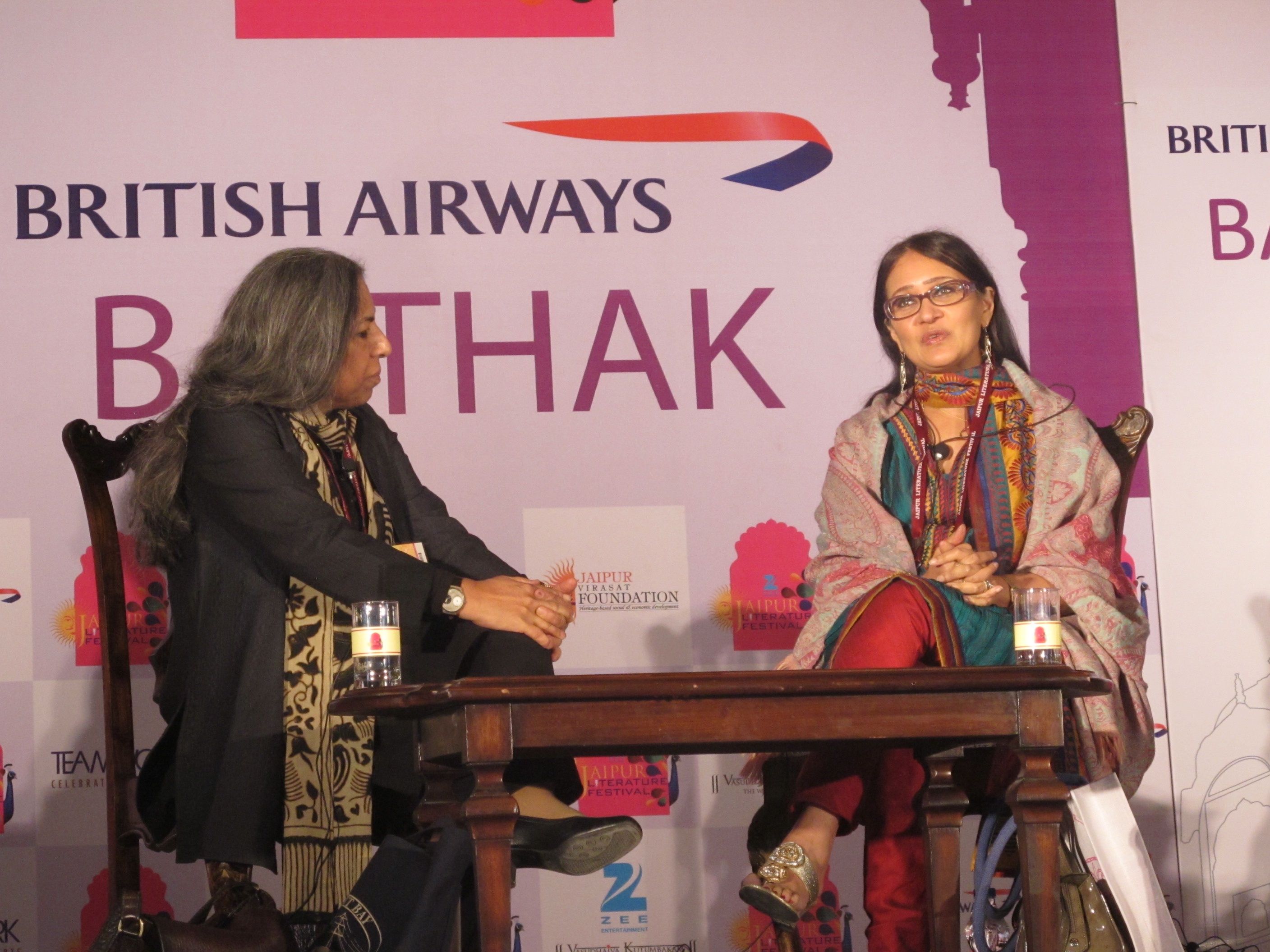
A great session centered on a conversation between Urvashi Butalia, co-founder of pioneering Indian feminist publishing house Kali for Women, and Ananda Devi, a Mauritian novelist.
There was something very open and honest in the way Devi spoke about her process and the feminism in her books, which deal with violence and mysticism. She spoke about using myth to create archetypes of human nature to understand our place in the world, blending prose and poetry in the process.
In another session, despite its clichéd name — “Behind the Veil: Women Writers of the Islamic World” — an inspiring discussion arose between five female writers who have each managed to find their literary voice in various strongly patriarchal societies. Each woman overcame danger to get to where she is now, such as Sahar Delijani, born in Tehran’s Evin Prison to activist parents. Iranian novelist and activist Fariba Hachtroudi spoke about topics ranging from prostitution in Iran to erotic poetry — and effectively dominated the forum with her monological style.
Another writer in the discussion was British-Egyptian Shereen El Feki, known for her recent book, “Sex and the Citadel: Intimate Life in a Changing Arab World.”
Feki earned a doctorate in immunology before becoming a healthcare correspondent with The Economist and presenter with Al Jazeera English. She is still actively engaged in working on sexual issues and reproductive rights, particularly within the framework of HIV in the Arab world.
“It’s very difficult to openly discuss sexuality, or quasi-sexuality, but if you give it the respectability of health — put on the white coat of public health — it’s more possible,” she said. “And this is one of the problems we have in the region: The only way we can talk about sex openly, publicly, is if we problematize it. It has to be a disease or dysfunction, or violence or exploitation, which is problematic for a number of reasons, but also interesting, because historically as Arabs we had no problem writing about sex, and not just about the problems but actually celebrating sexuality and its full diversity — ‘1001 Nights’ is just the tip of the iceberg.”
“All these grand ideas that uprising was based on — freedom, justice, dignity, equality, privacy and all that — if we don’t get those in the bedroom, we have very little chance of achieving them in the public domain,” she added.
The sensationalism of her book’s title could explain why many Egyptian feminists have consciously or unconsciously overlooked it. While I was of that camp, I’m now actually looking forward to reading it to decide what I think of her theories.
As the festival neared its end, it occurred to me that while there are a million lessons to learn from Western thinkers, the answers to our many riddles in Egypt may be better off coming from the East, due to endless similarities in culture, language and history across this part of the globe. I’m now armed with an arsenal of references connected to the East, like Mukulika Banerjee and her anti-colonial writing, Iranian religious scholar Reza Aslan, and prolific Rajasthani writer Vijaydan Detha.
When I think of Sen’s keynote speech, and the many thinkers I was exposed to — those mentioned in this article are merely a few highlights — it becomes obvious that there’s a cornucopia of brilliant and sane Eastern minds that should have a wide-ranging influence on discourse in Egypt and the region.

Maha ElNabawi
After graduating from the American University in Washington, DC with a Bachelors degree in Business, Maha began her publishing career in NYC with indie pop culture magazines, the likes of…
تقارير ذات صلة

A history of forced relocations
On October 29, the Egyptian army began bulldozing and dynamiting houses along Egypt’s border with Gaza to create a buffer zone 14 kilometers long and half a kilometer wide. The…
Preview: Festival brings Bollywood to Egypt
Back for its second edition, the India by the Nile festival started its month-long series of film screenings, workshops, concerts, exhibitions, talks and culinary events on April 1. Its intention…
Indian dance music throws political punch
I was invited to India to cover the seventh Jaipur Literary Festival — but while there, I also looked toward the vast musical landscape in hopes of better understanding a country I know…
Your support is the only way to ensure independent, progressive journalism survives.
You have a right to access accurate information, be stimulated by innovative and nuanced reporting, and be moved by compelling storytelling. Subscribe now to become part of the growing community of members who help us maintain our editorial independence.
Join us