
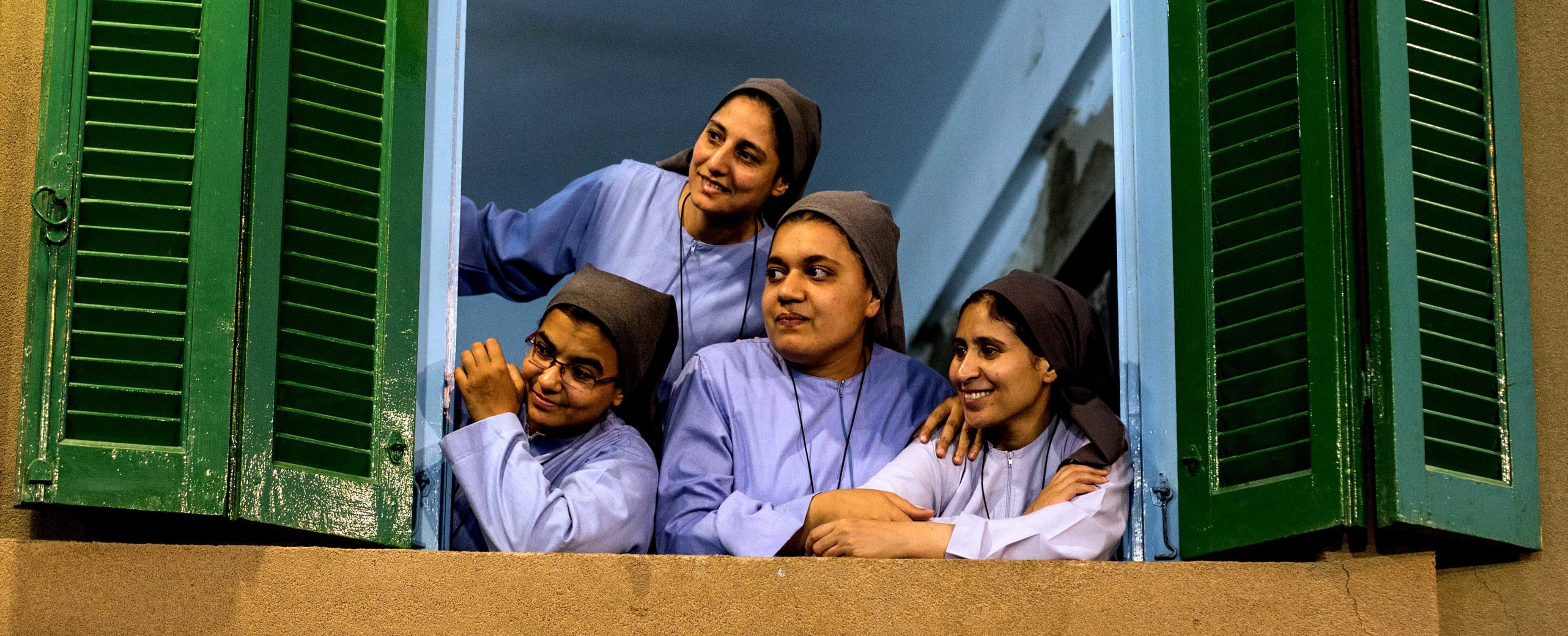
This is how they saw the moulid — photo story
The Virgin Mary moulid in Assiut, as seen by 7 photographers
A moulid, meaning"birth" in Arabic, is a popular celebration of a sacred figure's birth. In practice, it is a melting pot of different things.
In the first week of August every year, the Upper Egyptian city of Assiut is the site of a major moulid, that of the Virgin Mary. The celebration takes place around the monastery of the Virgin Mary in the Doronka mountains, a site that is revered as one of the stops of the Holy Family on their journey through Egypt.
This year, seven photojournalists from Cairo went to the moulid — a mixture of Egyptians, foreigners, Muslims and Christians. Here they recount their experiences and impressions as photographers and outsiders at this popular event.
Hamada al-Rassam

I chose this moulid because I haven't been before. I heard it is very exciting and I wanted to visit this holy place. Also, I knew beforehand that it isn't just Copts who go and celebrate this moulid, but Muslims as well, because the Virgin Mary is also an Islamic icon.
I have been adapting my photography style to try to deliver an image in which the feeling and experience of a place is conveyed.
[masterslider id="6"]
Amr Abdel Rahman

I didn’t have a clear aim when I went, but in general I like taking pictures at moulids and religious festivities. People were attentive to rituals and prayers, baptisms were performed, there was a procession and blessings were bestowed on people.
It was interesting to see that the coffee shops and amusement parks were far away from the places where the religious rituals were performed.
There was also a separate place for baptism and another for the belongings of the Holy Family. There were also several spots with chairs and allocated for people to meander around.
These were all positive observations. There were some negatives, such as the violence of many of the ushers, especially during the procession, and the stampede around it.
It was the first time for me to see a baptism that closely. It was also interesting for me, as a Cairo-based photographer, to travel to the site of a moulid in Upper Egypt, as those I had been to previously were more in the Delta area.
So it was a change for my eyes on many levels. I felt there was freedom to take pictures and no one was bothered about it. The few people who didn’t want to be photographed were very polite in saying so.
[masterslider id="7"]
Ahmed Gaber

I like moulids in general, so when I heard there was a Christian one in Assiut, I went in search of something different. I liked the atmosphere there. It was very different from Muslim moulids. We took pictures of baptisms, of the slaughter of animals, of amusement parks for kids. The sacred layer of the moulid gave me a different feeling, and many times I found myself putting my camera aside and looking directly at people. I haven’t seen Christians in Muslim moulids, but here there were Muslims and people were very welcoming to photographers. I don’t think one day was enough to document an event of that size.
[masterslider id="8"]
Roger Anis

The Doronka Monastery is usually empty, so I was curious about how it would be transformed during the moulid. I went with few expectations, as I thought that all moulids are essentially the same — people congregate, pray, visit the church, play and enjoy themselves.
But this was different, with elements like the procession, and priests carrying images of the Virgin Mary and chanting hymns as visitors who came to be blessed saluted them.
The first day, I shot pretty much everything I saw. The second day, I decided to look around without my camera, and then take pictures a bit more deliberately. This is when I looked more into people’s faces and saw their amazing facial expressions — it was as if the Virgin Mary was appearing before them as the procession was going around. Next time, I would want to stay the night in order to see the people who sleep at the site of the moulid and to speak with more of them.
[masterslider id="9"]
Georges and Samuel Mohsen

We have been wanting to go and document this moulid for year. We are originally from Assiut and our family had a house at Doronka, close to the monastery, so we have been hearing about it for years from our parents and grandparents.They used to move there for an entire month during the moulid.
But we had never been. They always used to tell us about the mountain and how it was the last stop on the trip of the Holy Family in Egypt. We didn't find the moulid to be so very different from other popular moulids in Egypt.
[masterslider id="11"]
David Degner

I was visiting the moulid mostly to talk with people about their religion as part of a longer-term project I am working on. The photos are my sketches as I try to think of different ways to visualize the experience of religion. While most photographers on assignment need to focus on the events or ceremonies, I was trying to talk with people about miracle stories.
The atmosphere was very religious and most people were very open to talking about how their God had helped them or others. But there were some moments when people where crying in the cave and they would just walk away. Those are the times I really wanted to know what they were asking God for.
I didn’t get very deep into the moulid itself, but I learned a lot about miracles and local stories for my project. There are some interesting side stories that I could investigate more, such as the people who come from Ethiopia to worship, or comparing this Christian moulid with the Muslim one that happens the week after, or talking with the people of this small village about how the moulid has changed over the years.
I went in completely blind — in the end I still don’t understand much about what happened. The best method for me was focusing on individuals in the crowd during the procession, as they were mesmerized by the icons and the parade. It’s one of the few times that you could really see people’s emotions on their faces, and they would ignore me entirely. Next time I’ll use a 50mm lens and possibly a flash to isolate individual emotions.
Translated by Lina Attalah
[masterslider id="12"]

تقارير ذات صلة
Will the laity save the Coptic Church?
The death of Bishop Epiphanius reopens discussions around electing a new Millet Council
‘We will kill the men and children and leave you to live the rest of your lives in misery’
Safwat Shehata, a man from Minya who lost six relatives in Friday’s attack, recounts the ordeal
‘Save us, St. Samuel!’: A survivor’s story of the Minya attack
Survivor Ibrahim Youssef recounts the details of Friday’s militant attack in Minya
Your support is the only way to ensure independent, progressive journalism survives.
You have a right to access accurate information, be stimulated by innovative and nuanced reporting, and be moved by compelling storytelling. Subscribe now to become part of the growing community of members who help us maintain our editorial independence.
Join us