
Hunger Strike
[aesop_quote align="left" quote="“May our frail bodies draw the path of salvation for this country, and direct a blow to the state of injustice…We are yet to be defeated.”"]
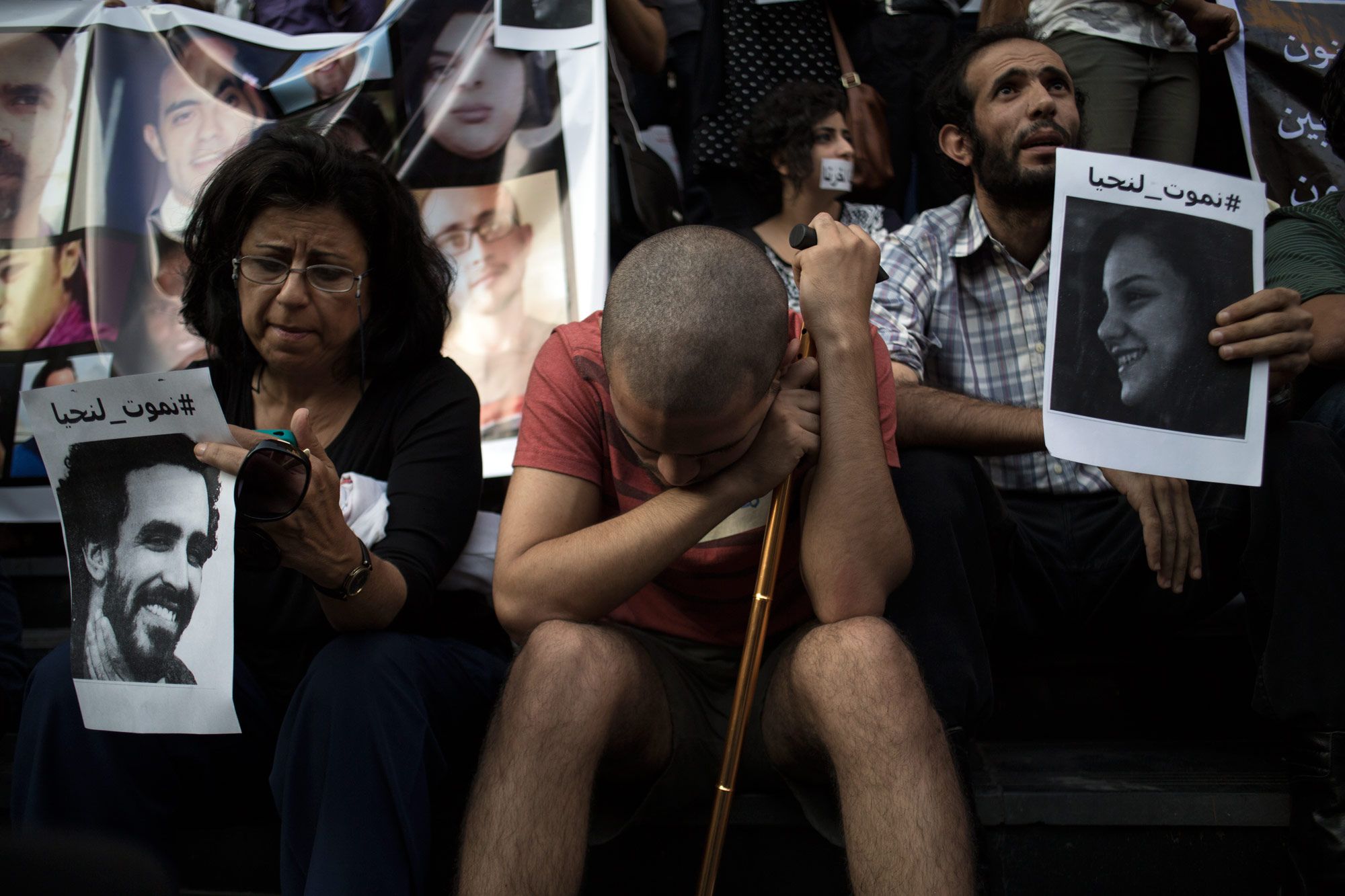
This is the slogan you see when you enter the Revolutionary Road Front’s headquarters, inscribed over the building's billboard, among photographs of the detainees that call for their release. None of the young hunger strikers who frequent the headquarters, to keep each other company throughout the day knew the identity of the author of this slogan, but they agreed that it represents their current struggle against the state’s injustice.
[aesop_image img="http://panorama.madamasr.com/wp-content/uploads/2014/10/0021.jpg" align="center" lightbox="off" captionposition="center"]
Recently, a number of political detainees entered an open-ended hunger strike in protest against their detention without trial for periods exceeding the legal limits. Alongside them are those who received unjust verdicts, in their opinions, under the cover of the Protest Law, which they opposed from the beginning. The law was issued on November 24, 2013 and stirred a wave of outrage among political opposition as it limited the right to protest, which Egyptians earned following the January 25 revolution and the following three years – especially after the Protest Law became the state’s preferred method for imprisoning activists. Over 66 of those activists inside prisons decided to put their lives on the line and start a wave of hunger strikes, demanding the immediate release of all prisoners of conscience and the suspension of the Protest Law. About 120 others entered the strike outside prisons in solidarity with the detainees, raising the same demands as well as improving the conditions of their imprisonment. One of the most prominent inspirations for the hunger strikers was the success of the hunger strike of released of Al-Jazeera correspondent Abdallah al-Shamy.
[aesop_image img="http://www.madamasr.com/wp-content/uploads/2016/07/0031.jpg" align="left" lightbox="on" captionposition="left"]
Alaa entered an open-ended hunger strike following a visit to his father on his death bed after a long struggle with illness. Alaa wanted to spend some time beside his father, but fate was not too quick to grant him or his sister Sanaa their wishes. Seif left this world while they were both held in prison. In a previous article titled “I’m fed up,” which was published in Mada Masr, Alaa described the circumstances of the family torn between two prisons; his imprisonment over the Shura Council case, and his sister Sanaa’s detainment over the Ettehadiya Presidential Palace case. Their mother, Leila Soueif, was surprised to learn of Alaa’s release and not her daughter’s. Alaa suspended his strike to regain his strength, with plans to rejoin it again to demand the release of his sister and the rest of the detainees.
[aesop_image img="http://panorama.madamasr.com/wp-content/uploads/2014/10/0061.jpg" align="right" lightbox="off" caption="Ahmed Mamdouh, a senior medical student, doesn’t belong to any political movements. Mamdouh volunteered to follow up on the strikers’ health conditions throughout the day – despite the fact that he himself is on a hunger strike for the same reasons. He rides his bike daily between revolutionary movements’ headquarters to check on the hunger strikers because he feels a sense of responsibility towards them. Enthusiasm might lead them to be carried away enough to cause harm to their health or strike, and then, Mamdouh steps in to make decisions that save the day. He focuses on mental games such as chess, and sleeps up to 16 hours every day to ease the pain of the strike. Whenever his strength weakens, he remembers the struggle of detainees inside prison like Mohamad Soltan and Ibrahim al-Yamani." captionposition="center"]
Many physicians agreed that a hunger strike should begin after a period of preparation to inflict the least health damage possible. Preparations include three days up to a week of ingesting large quantities of fruits, honey, milk, and other sources of glucose. Heavier food is ceased or decreased to avoid straining the stomach during the strike. According to many of the participants, the first two days are the most difficult because the sensation of hunger is at its strongest, which is why the time to prepare is quite beneficial. There is also the shock hunger strike, in which the participant stops all ingestion of food suddenly, making it a much more difficult experience than the first kind. The sensation of hunger can be almost fatal during the first two days of that strike. The longest recorded full hunger strike was 41 days, while a strike that includes taking saline solution can reach three years, according to a previous case in India. The length of the strike is measured through blood acetone levels and it varies from one person to the other, as well as according to the environment and the length of the preparatory period. The period of hunger strike is characterized by general weakness and, in more long-term cases, the striker cannot perform any activities other than sleeping. Some suffer from deteriorating health conditions and require constant medical supervision.
[aesop_gallery id="4525"]
Most of the revolutionary headquarters in Cairo receive hunger strikers outside detention facilities, including the Revolutionary Road Front, Revolutionary Socialists, Bread and Freedom Party and April 6 Movement headquarters. Most human rights centers like Al-Nadeem Center for Rehabilitation of Victims of Violence also open their doors to offer support to those on hunger strikes. As for journalists opposing the Protest Law, they prefer the Journalists' Syndicate where solidarity events – including protests – take place.
[aesop_gallery id="4527"]
Your eyes won’t mistake them; you will easily recognize them, young yet pale faces, frail bodies that can barely stand but never stop moving, hands that when shaken emit frightening coldness making you fear for those whose lives are threatened by hunger over their demands. Tens of youths who belong to different political currents were joined recently by journalists who announced a hunger strike in solidarity with political detainees who have been on a month-long strike, in objection to their detention, “which has gone far too long without just trials,” according to them.
[aesop_gallery id="4528"]


Your support is the only way to ensure independent, progressive journalism survives.
You have a right to access accurate information, be stimulated by innovative and nuanced reporting, and be moved by compelling storytelling. Subscribe now to become part of the growing community of members who help us maintain our editorial independence.
Join us