
Challenges of breaking fast in Gaza
Throughout the Gaza Strip, the struggle for survival entails daily forms of personal misery. Securing a meal with which to break Ramadan fasting presents a challenge to everyone given the destruction of the basic components of a comfortable and dignified life.
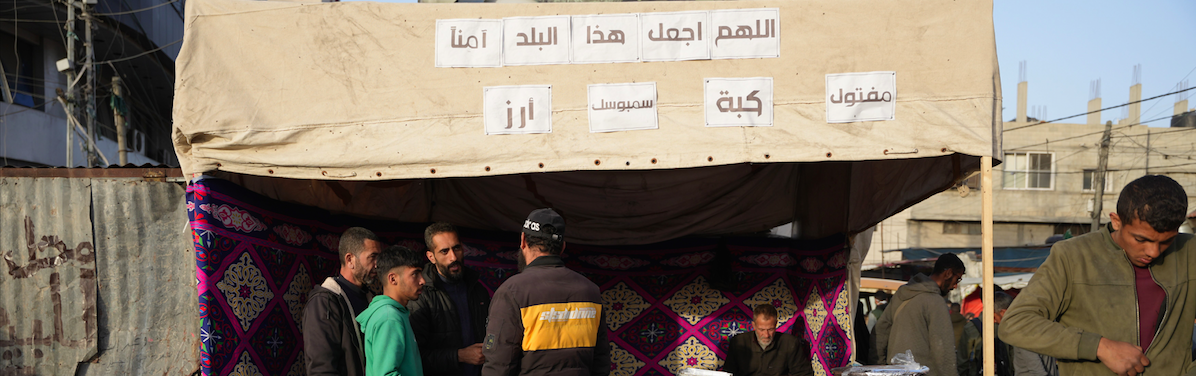
In Rafah, which houses the majority of Gaza’s displaced population, Palestinians crowd markets to buy ready-made food sold by displaced people on sidewalks and in small shops. Families unable to prepare their own meals due to their lack of means for cooking rely on food prepared by others. Similar scenes are found in Nuseirat camp’s main market. Here, people not only buy ready-made food, but those who lack kitchen equipment also have their purchased ingredients prepped for them.
The sidewalk stretching from the Awdeh square to the Nijmeh square in Rafah City is lined with tents made of repurposed cloth and which house people displaced from Khan Younis. Lacking stoves and gas canisters, they light fires with scraps of paper and tree branches to cook their meals in worn-out pots, using scarce and therefore expensive ingredients.
Even families who are relatively well-off find that their money has little value against the wild prices of market goods. Despite the income of many having been cut off, prices have risen at least ten-fold, and many of the displaced are unable to make purchases, resorting instead to free meals provided by a handful of charities and distributed in limited amounts.


بانوراما أخرى

Gaza’s phase two arrives. Kind of …
Consensus over key questions lags behind the United States' announcement of progress.

Gaza’s child amputees

Israel finally approves Egypt’s gas deal after nail-biting battle
In an unexpected move, Israeli Prime Minister Benjamin Netanyahu announced on Wednesday Israel’s final approval of a controversial gas export deal with Egypt, months after Israeli hesitation following the initial…
Your support is the only way to ensure independent, progressive journalism survives.
You have a right to access accurate information, be stimulated by innovative and nuanced reporting, and be moved by compelling storytelling. Subscribe now to become part of the growing community of members who help us maintain our editorial independence.
Join us