
The silent revolution of Gen Z: Angry messages, dreamy horizons

“The wounds left by the defeat of the Orabi Revolution weighed heavily on that generation, especially its intellectuals. For most of them, it seemed that nothing could ever mend what time had destroyed. And so, they lost all hope.“
- Salah Issa, Tales from the Nation’s Notebook: The Executioner of Denshawai
After the Orabi Revolution’s defeat, the sky too was heavy with despair. The intellectual elite of the era sank into a cycle of futility — it was their excuse for inaction and hiding behind masks concealing fear and the loss of their fighting spirit, as Issa describes.
The collapse of great dreams before the might of oppressive power — whether colonialism, tyranny or poverty — doesn’t wound dreamers alone; it wounds the soul of a nation. And when collective dreams are crushed, the loss doesn’t stop at one country’s borders. It becomes a contagion, spreading wherever hope is aborted.
Isn’t that exactly what we passed down, generation after generation, until Gen Z came along?
We tried; many from our generation sacrificed everything for the dream of a modern state. But we didn’t succeed this time. That chapter is closed, and history will judge.
Instead of confronting our failures, we kept chewing on our grief, clinging to the same ideas, the same worn-out tools, until we lost touch with the living pulse of the world around us.
And while we stood still, a new generation emerged — one with fresher ideas, capable of reviving us, if only we listened. This is a generation that never experienced the old dream, yet looks to the future with new eyes.
***
"When I look directly into the lens, it feels like I’m posing for a family portrait.”
- A Gen Z remark
Have you noticed how your children, or the young people around you, gravitate toward darker colors, especially black? Have you seen how they avoid facing the camera, preferring to appear from the side or from behind? Their hairstyles are so similar it’s nearly impossible to guess their social or cultural background just by looking.
Don’t worry. Your child isn’t being strange. This is common among Gen Zers around the world.
Over the past three years, I’ve met many from this generation. I’ve followed what they watch locally and globally, learned about their influencers, and had long conversations about their views on life, the future and the world. I found a generation born amid collective trauma and massive upheaval — one that found its refuge in a mobile phone. Through Google, TikTok, Instagram and Snapchat, they built their own worlds, their own sources of knowledge and self-expression. Their collective consciousness unfolded in societies burdened by defeat, unable to heal from post-traumatic paralysis. And so, they retreated from the collective, seeking personal salvation instead.
According to French psychologist Gustave Le Bon, crowds possess a shared mental and emotional unity that drives them to act unconsciously and irrationally. By that logic, this generation has chosen its own form of emotional unity, one that doesn’t gamble on a collective dream. Growing up in an era where all healthy channels of democratic expression were blocked, they’ve expressed their shared identity differently, through an almost uniform external appearance that carries a quiet message:
“You won’t really know us, but we’ll define ourselves in our own way. We’re not the same, and we don’t care what you think of how we look.”
They often photograph themselves from the side, from behind, or with their gaze lowered — and I believe this carries a quiet depth. We’ve always known eye contact as a basic act of acknowledgment, a bridge between presence and connection. Yet here stands a generation that asserts its presence while turning away from the lens. It feels like a quiet declaration: “I exist — but not for your validation. I see myself, not you.”
If you listen carefully to their casual conversations or pay attention to the lyrics of the songs they love, you’ll hear recurring expressions like “I don’t see you,” or “I don’t rely on anyone,” phrases that allude to one possible truth: this generation exists but refuses to depend on others.
They’ve witnessed the consequences of collective disillusionment in their societies. They intuitively understand that appearances cannot conceal the psychological and moral defeats carried by their parents’ generation.
You might think their youth shields them from grasping what has unfolded in their societies, but you’d be mistaken. No child raised in a post-defeat society can escape the uncertainty, fragmentation and lost sense of security. These youth grow up watching their parents scramble to protect them from collapsing education systems, declining healthcare and dwindling job opportunities. So they try to understand themselves and their world on their own terms.
Let’s admit it: a young person between 15 and 30 today is nothing like the generations before. They possess a layered, cumulative kind of knowledge — a decade’s worth of extra experience gained through instant access to global content and information. That’s all it takes for them to sense the weight of collective defeat and see its reflection in the weary eyes of those around them. They know the generation that raised them helped create this reality and has no clear plan to escape it. So they seek personal salvation instead.
Short-form videos on YouTube and TikTok and quick searches on Google become their mentors. Through them, they learn to question, to doubt and to cultivate intellectual independence.
They begin by creating a symbolic shield, a visual code of belonging through shared aesthetics. They assert their existence on social media, yet their images and messages reveal a subtle detachment from others’ opinions.
This is a generation searching for personal security, not collective change, one that keeps its distance from grand questions about political systems or ideology. It’s a generation that no longer asks who rules or who opposes because it no longer believes that either can truly change the world.
***
I am the child who can unsettle the world with my silence
and compel it to listen with care.
- Wael Fathy, Egyptian poet
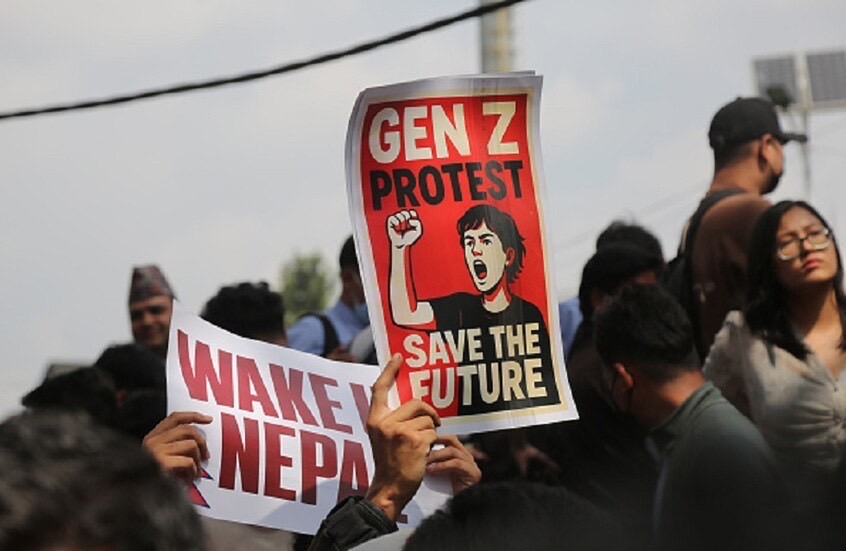
In Nepal, a new generation has announced itself on the political stage. Calls for protest spread under the banner of “Generation Z,” and demonstrations broke out in Kathmandu and other cities in September 2025. Protesters demanded the lifting of the social media ban, reforms in the education system, investigations into officials’ wealth and transparency in public spending. They also called for the resignation of the prime minister, the dissolution of parliament and amendments to the constitution.
The police responded with excessive force, leaving between 50 and 70 people dead, and the government imposed a nationwide curfew. The clashes ended with the prime minister’s resignation and the appointment of a temporary female prime minister until elections could be held along with the lifting of the social media ban.
In Madagascar, similar demonstrations erupted, this time against poor public services and administrative failure. Activists, journalists and a youth group calling themselves “Generation Z” led the movement.
Again, the response was violent. Around 22 people were killed before the president finally announced the dissolution of the government.
In Morocco, the Gen Z 212 movement began online, calling for improved public services — education, healthcare, employment opportunities — and for stronger efforts against corruption, favoritism and the exclusion of youth.
The protests were met with heavy-handed crackdowns and mass arrests, until the government was forced to acknowledge the need for genuine reform.
This scenario is likely to repeat itself elsewhere. And today, more than ever, we must listen carefully in order to understand, and not just defend the past. Perhaps, through this understanding, we may finally discover a way to solve the puzzle of why modernization efforts keep faltering in our societies, for within Gen Z there lies a starting point we can still build upon.
***
“What we want from the government is simple:
One — not to make mistakes.
Two — to serve the people.”
- Al-Tayeb Salih, Sudanese novelist
Generation Z has grasped, with striking simplicity, what Salih expressed decades ago: they want a government that does not make errors — and if it does, it must correct itself and serve its people.
This generation is not seeking philosophical answers, nor are they preoccupied with abstract debates about systems of governance. They demand, instead, their basic rights as citizens under any form of rule and a transparent, accountable administration that runs a modern state. Simply put, they don’t care who governs, but rather how they are governed. They move beyond grand ideological questions to ask the essential ones about the social contract between ruler and ruled: what the ruler has to offer.
They understand that their demands can only be met through the modernization of the state, the governance of its institutions and a commitment to transparency and sound administration.
They also know that real change doesn’t happen overnight. It requires patience, persistence, and the strength to hold onto every small step forward even if not all goals are achieved at once.
I’ve always been fascinated by Gen Z’s relationship with their artists and public figures. They may glorify a performer after one or two works that win their admiration, yet swiftly turn against them the moment they fall short of expectations. It’s not just indifference; it’s a fierce reversal. They unfollow, criticize and accuse them of lacking talent or intellect as if they weren’t the same beloved icons only months earlier.
This widespread phenomenon among Gen Z and its influencers reflects a practical, almost transactional mindset: “I gave you my time and attention, and in return, you owe me satisfaction. Fail to deliver, and I’ll leave, curse you, and move on to the next.”
It’s a straightforward relationship built on a clear exchange of value: if you’re an artist, influencer or public figure, I’ll give you support and engagement, as long as you give me what I expect. And if you’re a ruler, I’ll offer loyalty and avoid questioning the nature of your authority — on the condition that you secure for me a dignified human life.
Gen Z freed itself from the burden of inherited defeats, and thus became more pragmatic, more straightforward and faster to act. They don’t read lengthy manifestos; they go straight to the point.
We need to observe, and to listen well.

آراء أخرى

Gramsci at the Delhi Border: Indian Farmers and the Revolution against Inevitability
«Indian farmers are battling to subvert current neoliberal orthodoxy.»

Carbon Colonies & A Green New Deal
«Can the climate emergency show us how to see through the political stasis of our current regimes?»
Tali’at: Our Struggle to Reclaim Politics
«Our national struggle has yet to develop a radical, non-hierarchical understanding of liberation»
Your support is the only way to ensure independent, progressive journalism survives.
You have a right to access accurate information, be stimulated by innovative and nuanced reporting, and be moved by compelling storytelling. Subscribe now to become part of the growing community of members who help us maintain our editorial independence.
Join us
لا توجد تعليقات بعد