
The future of Egyptian special forces

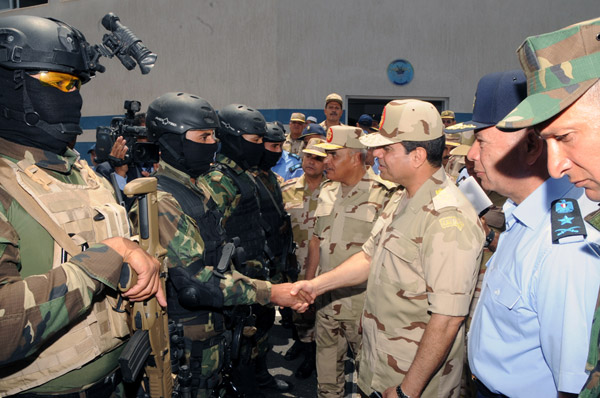
Since Abdel Fattah al-Sisi was appointed defense minister in late 2012, the military’s special forces have received a fairly unique level of attention among the Armed Forces and the greater public. Sisi’s personal visits to their headquarters over the past seven years have reflected a major shift in the prestige and status of these elite units. Formations that had largely been ignored during the tenure of long-time Defense Minister Mohamed Hussein al-Tantawi and several of his predecessors now feature prominently in Armed Forces media releases, Ramadan TV series, and high-profile joint exercises with Egypt’s foreign partners.
Their status and importance have also grown alongside the Egyptian government’s attempts to quell a virulent militant insurgency in the Sinai Peninsula. As the conflict has stretched on, virtually every special forces unit has been deployed to Sinai either permanently or on rotation. Their performance in combat, however, has often failed to live up to their carefully managed reputation. This deficit can be largely attributed to a history of neglect by the government and the Armed Forces, which delayed attempts at modernization and allowed long-standing institutional inefficiencies to fester.
Without organizational reform and structural change, Egypt’s special operations outfits will not only likely continue their history of poor performance but will also ensure their own strategic relevance diminishes as contemporary security challenges and warfare continue to evolve. As for the Egyptian government, a lack of corrective action in this area will leave them with inept specialized forces that are largely incapable of carrying out the tasks prescribed to them and prone to catastrophic errors during combat operations. That issue, alongside a willingness by several special operations outfits to take extra-legal action, can cause significant reputational damage and prolong or otherwise aggravate complex security situations such as domestic counterinsurgencies, including in Sinai.
Sinai insurgency
The Egyptian military’s war against a militant insurgency in North Sinai has been a struggle from its outset in late 2012. Consistently suffering heavy casualties and making slow progress over the past seven years, the military has sought to address some of the shortcomings of its poorly trained and ill-equipped conscripted general-purpose forces that were incapable of uprooting the insurgency in early offensives by introducing elite special operations orientated units and special forces.
The results, however, since their introduction in 2015, have been decidedly mixed: the elite forces deployed have, for the most part, failed to significantly outperform their regular counterparts in dismantling the Islamic State-affiliated Province of Sinai and often had little in terms of independent or credible special operations capability. In other words, they were largely used for missions typical to average infantry formations.
According to foreign military sources involved in training Egyptian special forces, the Egyptian forces are beset by a series of problems: lax selection and training standards, dated organizational structures, restrictive mission sets, problematic corporate cultures, little in the way of organic support capabilities, and poor management practices. As a result, Egypt’s special operations have not only showcased a great degree of tactical frailty in North Sinai but also proven wholly unready and unsuited to face contemporary security challenges.
Rather than rely on small, highly trained, mobile and self-sufficient special operations cadres capable of operating independently, the Egyptian military persists with a dated model of mass conscripted shock troops augmented by niche special mission units that are almost completely reliant on the support of the regular military for the majority of their functions. The lack of enabling combat and service support units — units that provide a range of essential capabilities, including intelligence acquisition, demining expertise, military communications, fire support, logistics and aviation assets — within their force structures has left them almost completely reliant on conventional forces (that are often subject to availability, lack the necessary expertise, or are slow to mobilize).
Consequently, the country’s special operations forces have been unable to work outside conventional military frameworks or beyond the purview of regular combatant commands that have not used special operations assets to their maximum potential in counterinsurgency scenarios. Rather than focus on missions relevant to their specialist skill sets, such as direct action raids, special reconnaissance and surveillance, they have been beholden to the labored operational tempo and misaligned focus of conventional forces in North Sinai. They thus often act as elite infantry in large offensives, conducting simple patrols, or designated as mechanized quick reaction forces, according to security sources familiar with operations in the area and analysis of media releases by the Defense Ministry.
Outside of direct combat, the military’s special operations forces have not only failed to ensure a process of accountability to correct failures in the war against insurgents but have also allowed lapses in moral leadership and discipline, including involvement in alleged war crimes and rights abuses against civilian protesters, to go unpunished.
How did we get here?
The poor performance of special operation forces in Sinai, however, is primarily a reflection of a larger systemic and organizational malaise that can be traced back to the end of the 1973 October War.

Established in the 1950s and evolving throughout the Arab-Israeli conflict, Egypt’s special operations units have often been celebrated by historians as some of the best troops in the Middle East. A storied record and unique traditions, from distinctive marching styles to training rituals, uniforms and unit nomenclature, allowed them to generate a distinguishable esprit de corps that much of the Arab world attempted to emulate over the 20th century and beyond. Where their history of success begins to fade, however, is the end of hostilities with neighboring Israel and the emergence of militant threats for which these outfits were not especially ready given their focus on special operations within conventional conflicts. Following the October War, much of the military’s special operations community existed in a state of limbo without relevant missions, split under various commands, or like the distinguished 39th Combat Group, completely disbanded.
During the post-war period, Egyptian special forces conducted only three noteworthy operations, two of which were daring though ultimately failed high-profile counter-terrorism raids. The first, and only success, came in 1976 when an incognito detachment of special forces soldiers stormed a captive passenger flight that had landed in Luxor and captured the culprits. The second operation, which came two years later and was the beginning of a series of calamities, was an Entebbe-esque raid attempt that left more than a dozen commandos and airmen dead by way of friendly fire after the failure of the Egyptian government and raiding force to liaise with their Cypriot partners while pursuing a hijacked airliner. The last operation, in 1985, would also involve a hijacked passenger flight, but, in this instance, Unit 777, a specialized counter-terrorism hostage rescue force, would catastrophically botch an assault on the tarmac resulting in 57 dead hostages in one of the most disastrous operations in global special forces history.

Understandably displeased, then-President Hosni Mubarak oversaw the temporary disbandment of the unit involved, beginning a process — coinciding with changes in internal regime security dynamics — that would effectively marginalize the military’s special operations forces from national security policy. In the intervening years, these outfits would become little more than glorified circus performers, paraded in military shows and only ever deployed in symbolic capacities in instances where they were not an essential requirement, despite ample opportunities for both counterinsurgency and counter-terrorism duties in the early nineties and mid aughts both outside and within Egypt. Consequently, attempts to enact internal reform were largely dismissed by senior brass who saw little need for change, according to a security source familiar with special operations dynamics, and, perhaps more importantly, the Egyptian military’s elite forces would be excluded from advances in international special operations norms which rapidly progressed throughout the supposed Global War on Terror.
Where we are going and chances for reform
While Anwar al-Sadat and Mubarak oversaw the gutting and stagnation of special operation formations, Sisi’s government has been keen to upgrade their capabilities in response to the country’s struggle against militant insurgency.
To that end, Sisi has directed the military to expand established units, create new ones for counter-terror orientated tasks, upgrade training infrastructure, invest in new equipment, and has personally pursued the return of hands-on Western training that had virtually ended after the disastrous raid on Flight 648 by Unit 777. However, many of these changes have foregone deep reforms and restructuring necessary for the creation of relevant and competent special operation forces organizations in favor of incremental improvements in areas that are largely secondary to overall capabilities and competencies: part of a longstanding trend within the Egyptian military that pursues superficial modernization rather than prioritize deep or structural reforms that can potentially disrupt command power dynamics, corps traditions and corporate mythologies. While new equipment and training by international partners may have led to marginal improvements in performance, it has not addressed the structural and organizational failings that have existed for over 30 years.
[wonderplugin_video iframe="https://www.youtube.com/watch?v=qBaj8OxGzr4&ab_channel=AIIRSOURCE" lightbox=0 lightboxsize=1 lightboxwidth=960 lightboxheight=540 autoopen=0 autoopendelay=0 autoclose=0 lightboxtitle="" lightboxgroup="" lightboxshownavigation=0 showimage="" lightboxoptions="" videowidth=600 videoheight=400 keepaspectratio=1 autoplay=0 loop=0 videocss="position:relative;display:block;background-color:#000;overflow:hidden;max-width:100%;margin:0 auto;" playbutton="https://www.madamasr.com/wp-content/plugins/wonderplugin-video-embed/engine/playvideo-64-64-0.png"]
With that said, the failings of Egypt’s special forces in Sinai and the existence of a motivation to address this issue at the top levels of the Egyptian government and military has provided a rare and unique opportunity to correct course. The challenge, however, is steering this motivation to modernize and reform toward necessary restructuring and organizational change rather than the acceptance of incremental change in superficial areas while openness to new concepts and foreign advice still exists.

At the heart of any future proposal needs to be a move toward a unified or joint special operations command that pools together existing component special operations commands and units from across the main branches of the Egyptian Armed Forces. However, rather than seek to imitate the example of Western joint special operations organizations that have grown into branches in their own right and dominate how these countries respond to security threats across the world, Egypt’s version must be built around the country’s specific context.
A future joint special operations command must contend with both a limited budget and a military that faces conventional and asymmetric threats, while also providing options that fit in line with Egypt’s highly securitized foreign policy. As such, it must remain small, modular and tethered to conventional formations while prioritizing its focus on a hybrid form of traditional special operations specialties, which include conventional commando operations, counterinsurgency and foreign internal defense. The purpose is to remedy the bureaucratic deficits of the current organizations by creating flat command structures that can address issues that have hobbled Egyptian special operations commands for decades, including a lack of mechanisms for interagency cooperation and an inability to liaise with various levels of military and political decision making, which together have resulted in the underutilization and misuse of the military’s special operations outfits in addition to the creation of a perception that many of the components are only ever to be used in the rarest of occasions.

On a more organizational level, the Egyptian military’s special operations forces must be convinced that current practices are outdated and largely counterintuitive for contemporary special operations. This includes their reliance on poorly trained mass-produced conscripted formations, the direct entry of inexperienced officers without rigorous selection processes, and a lack of enabling support capabilities in vital areas such as intelligence. To restructure special operation forces under a single command may also provide a mechanism for the standardization of competencies, equipment and training requirements in order to mitigate current issues with variance in unit quality and ability. It is important to note that reform in this area is achievable without radical changes to existing units or a need to create entirely new formations, with the possible exception of an aviation component as the Egyptian Air Force has yet to develop a special operations capability of its own. The component parts of a future Egyptian joint special operations command already exist, and for some units, like the Thunderbolt Forces, reform would see them take inspiration from their United States Ranger Regiment origins and their own history as the army’s premier raiding force during the War of Attrition.
To that end, the Egyptian military must abandon its current conceptions of special operations as the domain of large, disaggregated bodies of conscripted shock troops augmented by niche special mission units and look toward a more modern joint structure that fits in line with the demands of contemporary security challenges and national policy. At the same time, they should also look to remedy longstanding organizational issues through the professionalization of the force, the introduction of new rigorous training programs, the expansion of special operations schools, widening the scope of foreign mentorship, standardization of operational requirements, and the inclusion of essential support capabilities into force structures. Lastly, these changes must be accompanied by processes of accountability that ensure professional shortcomings or failures are adequately addressed, and that cases of misconduct, which are counter-productive to the overall effectiveness of the force and undermine operational strategy, are suitably punished.

آراء أخرى

In Egypt, nothing has changed — but perhaps everything has
«This repressive regime has set itself an unattainable goal: to silence everyone all the time forever»
Civilian deaths and unaccountability in North Sinai
«The country’s conscripted combat forces are tactically frail and ill disciplined»

Structural crises that have become pressing
«Continuous political turmoil since January 2011, and the resulting decline in the annual growth rate to a near-recession level, have turned many of the Egyptian economy's…»
Your support is the only way to ensure independent, progressive journalism survives.
You have a right to access accurate information, be stimulated by innovative and nuanced reporting, and be moved by compelling storytelling. Subscribe now to become part of the growing community of members who help us maintain our editorial independence.
Join us
لا توجد تعليقات بعد