
The campaign against UNRWA: Israel’s attempt to erase Palestinians

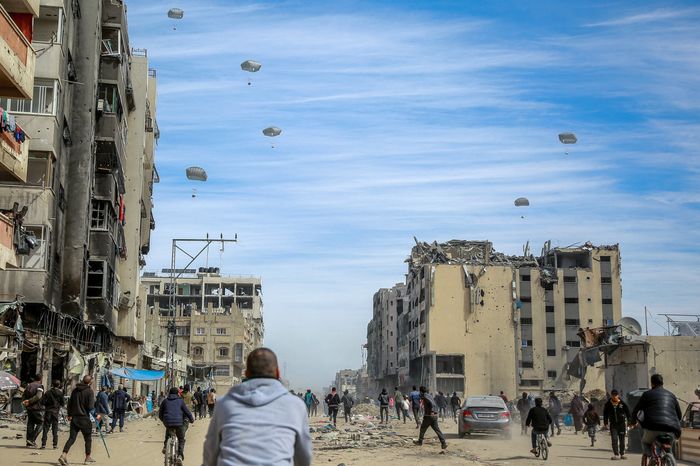
US military aircrafts recently began airdropping thousands of meals over the Gaza Strip in an emergency intervention authorized by President Joe Biden, in response to the increasingly dire humanitarian situation unfolding. Experienced humanitarian workers uniformly agree that airdrops are among the most expensive and inefficient ways of getting aid to those in need. The United States government’s resorting to such measures illustrates what happens when humanitarian agencies with local knowledge and experience are sidelined, such as UNRWA, the United Nations Relief and Works Agency for Palestine Refugees in the Near East.
The US should be pressing Israel to end restrictions and obstructions that have hindered UNRWA and other agencies from distributing aid that is piling up at the border. Instead, the US suspended the agency’s funding following Israel’s accusation that 12 of its employees were involved in the October 7 attacks. That accusation came on January 26, the same day that the International Court of Justice issued its interim ruling ordering the state of Israel to “take all measures within its power” to prevent acts of genocide. Germany and 12 other donor states followed suit in suspending their funding to UNRWA — a decision made before any actual investigation into Israel’s accusations.
This represented a 60 percent cut in the agency’s budget. Such a drastic reduction in funds, at a time when the agency serves as a lifeline to 2.3 million Palestinians in Gaza, made what is already a dire humanitarian situation even more catastrophic. Despite this, Israel persists in calls for UNRWA to be dismantled entirely.
This is not the first time UNRWA has come under attack. In 2012, an amendment to a spending bill in the US Senate proposed that the agency “re-count” the number of Palestinian refugees, based on their belief that numbers were grossly inflated. In 2018, the Trump administration pulled its funding for the organization (and restored it later after Joe Biden took office).
Israel has waged a long campaign against the agency, which it has often accused of being an agent of radicalization and currently sees as an arm of Hamas, an entity that indoctrinates and radicalizes Palestinians, inflates refugee numbers and perpetuates refugee status that Israel wants to see eroded. In fact, Netanyahu’s post-war plans for Gaza call for UNRWA to be dissolved.
Clearly, in the current context, by weakening UNRWA and undermining its ability to provide humanitarian assistance, Israel intends to make survival in Gaza impossible for Palestinians. This directly contravenes one of the ICJ’s interim orders — that the State of Israel take immediate and effective measures to enable the provision of urgently needed humanitarian assistance to Palestinians in the Gaza Strip.
Making life in Gaza impossible will push increasing numbers of Palestinians out of Gaza, a consistent goal for Israel — held since the very beginnings of the State’s formation — to take over as much of historic Palestine with as few of its indigenous population as possible. The idea of “thinning out” Gaza’s population has been advanced by various Israeli ministers and politicians over the decades, as discussed in this publication and elsewhere. It appears that by ridding itself of both the Palestinians and UNRWA, Israel hopes to put a definitive end to the question of refugees and the right of return in its entirety.
However, Israel must understand that taking UNRWA out of the picture will not resolve the refugee issue. Palestinian refugees don’t exist because UNRWA exists; rather, UNRWA was created to address the needs of Palestinian refugees. Refugees will continue to exist after UNRWA’s demise (and it is only the UN General Assembly that can formally put an end to UNRWA’s mandate), for it is a political question that requires a political solution and interventions — an issue never within UNRWA’s humanitarian purview.
From the outset, UNRWA’s existence was meant to be temporary. Its creation was initially strongly supported by both the United States and Israel. For Israel, putting a UN agency in place to provide humanitarian relief to Palestinians and facilitate their integration in the places to which they had dispersed was far preferable to the alternative of seeing them return to their homes, from which they had been expelled. And return was very much on the minds of Palestinians as well as others.
The history of UN attempts to address the question of Palestinian refugees begins with the appointment – in May 1948 – of Swedish diplomat Count Folke Bernadotte as UN mediator for Palestine, a move necessitated by the violence that followed the UN’s Partition Plan for Palestine and Israel’s unilateral declaration of independence on May 14, 1948.
Bernadotte, who during World War II had negotiated the release of thousands of prisoners from German concentration camps, visited Palestine with a mission to conciliate the parties and promote a truce. In the course of his time in Palestine, it became clear to him that no lasting peace would be possible without the recognition of the right of Palestinian refugees to return — a point he stated officially. On September 17, 1948, Bernadotte was assassinated by Lehi — a Zionist paramilitary militant organization.
Following Bernadotte’s assassination and pursuant to his recommendation, on December 11, 1948, the General Assembly adopted Resolution 194 (III), which established the United Nations Conciliation Commission for Palestine (UNCCP), to take over the functions of the UN Mediator in negotiating a political solution. Paragraph 11 of Resolution 194 specifically addresses the issue of refugees and affirms their right to either return or be compensated for lost property. In order to implement their mandate, the UNCCP convened a number of talks and conferences attended by Israel, key Arab states and the Arab Higher Committee (which represented the Palestinian leadership). However, political resolution, especially of the refugee issue, was stymied by the lack of political will and the intransigence of Israel in particular.
It was the obstruction of a political solution to the refugee issue and the recognition that it may not occur in the near future that led to the creation of UNRWA. A mission headed by an American, Gordon Clapp, undertook an examination of the situation of Palestinian refugees and where they had scattered, with the aim of making recommendations to the UNCCP that would facilitate their integration, repatriation and resettlement. Although this mission, formally known as the Economic Survey Mission (ESM), recognized that the majority of refugees wished to return to their homes, the political question was outside the scope of its mandate. In the interim, its recommendation was to improve the immediate circumstances of refugees, wherever they were, until the resolution of the political issue. The commission recommended that the UN establish an agency under its auspices to take over the ad hoc humanitarian services, which so far were being provided by organizations like the Red Cross and the American Friends Service Committee.
And so, on December 8, 1949, the United Nations General Assembly adopted Resolution 302 (IV). Paragraph 7 of the resolution established UNRWA to carry out relief and works programs as recommended by the ESM. As it was meant to be a temporary source of humanitarian support for Palestinians until a political solution is reached, its mandate was made renewable every three years, and so it continues to the present time.
It is worth noting that UNRWA’s mandate was to provide assistance not to “Palestinian” refugees, but to “Palestine refugees,” who were defined as persons whose place of residence was Palestine during the period from June 1(1946) to May 15 (1948) and who had lost their homes and means of livelihood because of the 1948 war. Its beneficiaries included Israeli citizens, non-Palestinian Arabs and others displaced by the war, provided they met the above criteria. The agency’s mandate has since expanded to include Palestinians displaced in 1967 and subsequent hostilities. Its areas of operation include Lebanon, Jordan, Syria, the West Bank and the Gaza Strip. As such, its mandate did not extend to all of the places to which Palestinians had fled. For instance, the Egyptian government at the time did not permit UNRWA to operate in its territory, preferring to see a political resolution to the refugee issue instead. To this day, the lack of UNRWA services and the continued political impasse have meant that Palestinian refugees in Egypt experience many protection gaps.
UNRWA is unique among UN agencies in that a majority of its staff are Palestinians — the agency’s own beneficiaries. Since the start of Israel’s military operations in Gaza, an estimated 142 members of UNRWA’s staff have been killed - the highest number of UN aid workers killed in the UN’s history. One cannot help but wonder if these deaths would have been met with greater outrage from the international community, had the victims not been Palestinian. UNRWA’s primary services are in education and health. UNRWA has run over 700 schools in its fields of operations and its health clinics receive millions of visits annually. It also provides microfinance to beneficiaries and emergency assistance.
Of all places where UNRWA operates, its services in Gaza have been the most essential. This is due to the decades of occupation, isolation and violence that Gaza has endured at the hands of Israel. In the more than five decades since Gaza has been occupied, Israel has pursued a policy of isolating it and preventing its economic development. Even before the blockade that was imposed after Hamas’s rise to power, Israeli occupation measures cut off Gaza from the West Bank with permit requirements and the building of fences. With Hamas’s electoral victory, Israel began to treat the Gaza Strip not as its occupied territory, but as an enemy country. In the 16 years since the blockade, Israel has waged multiple brutal military operations in Gaza. It is no wonder that these measures collectively have left the Gazan economy devastated and Gazans dependent on aid. To be a Palestinian in Gaza has become synonymous with being a person dependent on international aid. This is intentional. Now, with UNRWA under threat of collapse, Gazans are pushed to even greater desperation.
There are critics of the international aid regime, not just for the dependency it fosters (even if in the case of Gaza, conditions of dependency have been deliberately brought about), but also for perpetuating the status quo. More specifically, much of the criticism has focused on the central role international aid has played in the political economy of the Occupied Palestinian Territories since the signing of the Oslo Accords, and the way donors, by favoring certain political elites, have entrenched an elite in the Occupied Territories whose interests are intertwined with the Occupation. The Oslo Accords, and the ensuing peace process, have kept Palestinians in a continual state of expectation (the creation of a sovereign Palestinian state was not explicitly agreed upon, but it was not ruled out either), with injections of foreign aid that allowed for the development of some infrastructure, ensuring that the occupation of Palestine could continue indefinitely without allowing Palestinians to truly develop their own independent economy. In the 30 years since Oslo, Israel has only accelerated its settler colonial policies, all under the façade of an internationally-sanctioned peace process. But this status quo is unacceptable and untenable. The current calamitous events of Gaza make this clear.
And, eliminating UNRWA will not change any of this.
On the other hand, Israel claims that UNRWA perpetuates refugee status and has questioned why Palestinians should have a unique agency devoted to them as opposed to being subsumed under the mandate of the other UN refugee agency, the United Nations High Commissioner for Refugees (UNHCR). Palestinians became refugees in 1948, prior to the creation of UNHCR. At the time, the creation of ad hoc bodies to address the concerns of particular displaced communities was the norm (for example, the UN Korean Reconstruction Agency). So, creating a specialized agency for Palestinians was not out of the ordinary. It is also worth noting that at the time UNHCR was created, its mandate was restricted to refugees displaced by the wars in Europe prior to January 1, 1951. It was only with the addition of the 1967 protocol that the geographical restriction on UNHCR’s mandate was lifted.
But what if UNHCR were in fact to take over UNRWA’s functions? Would this address Israel’s position regarding the exceptionalism that it claims is applied to Palestinian refugees? UNHCR’s mandate includes attempts to find “durable solutions” for the world’s refugees. Of the three durable solutions, “voluntary repatriation” is for many refugees the preferred option — if they can return home. UNHCR cannot impose durable solutions on refugees. In fact, of the three durable solutions — repatriation, local integration, and resettlement — the only one that is an obligation on states is repatriation, or return, since no state is legally obligated to integrate or resettle refugees.
No state can deny return to its nationals — something Israel has been denying to Palestinians for over 75 years. So, if there is anything that makes Palestinian refugees exceptional is that their wish, and right, to return is actively blocked by Israel.
Therefore, as previously mentioned, it is not UNRWA that perpetuates refugee status, but it is the failure to achieve a political solution to the issue that does. Palestinians are not unique in experiencing a protracted refugee crisis. Other refugees across the globe, including Afghans, Somalis, Sudanese and Angolans, to name a few, have lived in protracted refugee situations that have spanned generations.
Israel has more specifically objected to the fact that Palestinians, even upon acquiring another nationality, have maintained UNRWA registration. This is especially relevant in Jordan, one of the only countries that extended citizenship to the Palestinians displaced in 1948. For many, however, the acquisition of a new nationality does not erase the fact of their first denationalization by Israel. The Nakba, as a seminal, collective and intergenerational trauma of displacement, has come for many Palestinians to define what being Palestinian means. Israel’s refusal to acknowledge this over the decades has only compounded the trauma. Eliminating the agency that has come to symbolize this displacement will not erase the underlying history and memory of that displacement.
Just as creating UNRWA did not eliminate the question of the Palestinian right to return, dismantling it will not do so either. That right exists independently of UNRWA, and is rooted in several branches of international law, including the law of nationality, the law of state succession, international humanitarian law, international refugee law and in UN resolutions, namely UNGA Resolution 194. What makes Palestinian refugees exceptional is that in other refugee situations, a refugee may return to their country of origin once the conflict or danger faced ends. Other refugees are not prevented from returning to their country or origin, even if they have acquired another nationality since their escape.
However, since its creation, Israel has systematically refused and prevented the return of Palestinians to their homeland in order to maintain a Jewish majority.
Undoubtedly, the right to return has been one of the more intractable issues of the Palestinian question. However, it and other longer-term questions having to do with Palestinians and their right to self-determination will not disappear with the elimination of UNRWA. In the shorter term, incapacitating the agency with the knowledge, expertise, and decades-long experience of serving its beneficiaries with no real plausible alternative in place, is only going to ensure more death, devastation and displacement. The current war in Gaza — with Israel foreclosing humanitarian relief as it also steadfastly refuses a political solution rooted in justice for Palestinians — is a prime example of necropolitics.

Parastou Hassouri
Parastou Hassouri is a Cairo-based independent researcher and consultant focusing on refugee and migration law and policy. She teaches courses on international refugee law and Palestinian refugees and international law…
آراء أخرى

How the horrible month of March for Meloni might change the path of Italy
«Italian Prime Minister Giorgia Meloni will not forget March 2026.»

Trump’s Palestine is worse than mandate Palestine
«In September 2025, United States President Donald Trump unveiled a 20-point “peace plan” for Gaza, calling for a ceasefire, the release of Israeli captives and the…»
Anas, my neighbor
«The loss here is not personal, but a profound collective fracture»
Your support is the only way to ensure independent, progressive journalism survives.
You have a right to access accurate information, be stimulated by innovative and nuanced reporting, and be moved by compelling storytelling. Subscribe now to become part of the growing community of members who help us maintain our editorial independence.
Join us
لا توجد تعليقات بعد