
On social protection in COVID-19 times

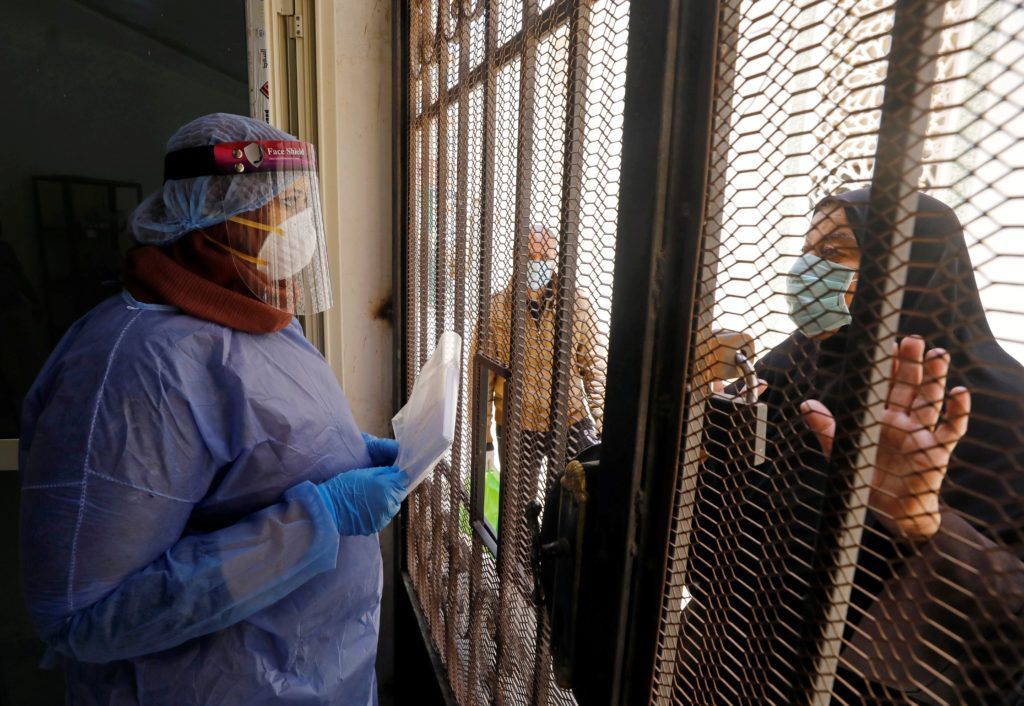
This piece came out of a series of webinars titled “Social Protection after Social Distancing,” organized by the Arab Hub for Social Protection from COVID-19. The first session was about the emergence and evolution of the notion of social protection in the Arab world.
Save from issues directly connected to the medical side of things, the coronavirus pandemic has hardly introduced new problems. Rather, it has laid bare the structural deformities in the civilizational pattern governing our societies and our models of economic and social development. This plague has largely acted as an acceleratory agent, aggravating already existing problems and turning them into open crises. A divergent set of responses were also evoked by the pandemic, prompting the need to ponder various contradictory visions for the future — some of which do not only remain committed to blighted old models, but seek to further expand the defective value system and force it on people and the planet in even more blatant ways, taking the pandemic as a window of opportunity to further regress from and abandon any democratic rights-based mindset or equality and social justice-centered value system.
Social protection is a right. It is translated and institutionalized — to enable its application and realization — through effective, universal social protection systems. Standards for how these systems should be are conceived of on these grounds. One of the most widely recognized standards was developed by the International Labor Organization. It requires any social protection system to cover nine principal branches: medical care, sickness, unemployment, old age, employment injury, family, maternity, invalidity and survivors’ benefits. This framework, no doubt, comes in handy when planning and assessing the comprehensiveness of a social protection system. Here and now, however, it is not enough.
Three cases have to be taken into account, and make a critical difference, when assessing systems of social protection.
- Wars, such as those in Arab countries, pose a direct and wholesale threat to the right to live. The protection of life should be prioritized. The general design for systems of social protection comes with an implied assumption that the right to life is already protected, given that social protection can only be provided to the living. But in our region, we need to protect the right to life in the most basic sense, meaning stop people getting killed.
- Another, more extreme case also takes place in our countries, where rights are violated on a large scale. This can be because of war or occupation, such as in the case of refugees and displaced people, who need a special kind of universal protection that goes beyond the limits of typical protection systems. The same can be said of occupied people, such as in Palestine, where the totality of an entire nation’s rights are violated at the same time with no real protection against the occupation authorities. It can also be because of tyrannical and undemocratic political systems, where there is no rule of law and no commitment to any human rights code in the first place, and under which political, civil, economic and social human rights are violated by means of arrest, imprisonment, stifling free speech and cracking down on unwanted disagreement. This is another domain of protection that is not covered under the traditional conception of systems of social protection.
- During pandemics, the need becomes clear for social protection that is truly universal and complex, given the multitude of economic, social and psychological effects of pandemics. This, too, extends beyond the limits of the social protection systems currently in place — taking into consideration that the more universal a country’s social protection system is and the more it is rooted in the idea of the right to protection, the more effective its response to the pandemic can be. But the pandemic also raises fundamental — and even existential — questions about the essence of protecting people’s health and lives and the tools to dispense these protections.
The issue of social protection, which is generally an integral part of a broader social policy or anti-poverty policy, elicits two main, and opposing, approaches.
- The first approach sees no real problem with the dominant economic mode, where market mechanisms are the upper mechanism governing the economy (as well as the social realm, one might add.) It views poverty as the result of a glitch in the regular operation of the market that can be alleviated through relatively minor correctional measures. To that end, poverty needs to be defined, usually a definition that only applies to a limited number of people. Policies and special programs are then devised to make up for their inability to access market opportunities, but no structural changes to the economy or its mechanisms. Social assistance systems are proposed as part of these policies; the modern ones are called “social security networks.” They are based on a targeted approach. Universal support is disregarded in favor of assistance to eligible poor individuals. These security networks do not involve any changes to economic policy or view poverty as interconnected with any other angles or phenomena, such as inequality, polarization, political or legal discrimination, economic or historical dynamics, etc.
- The other approach is rooted in the principle of rights: the idea that social protection is an integral human right — a right to all, not just to the poor or some of the poor. This approach is based on the interconnectedness of poverty and inequality: of economic, social, political and other factors. It resists the idea of policies devised specially for poor people and independently from general policy. Part of this approach is to view policies to combat poverty, including social protection systems, necessarily as one component in overarching national strategies for sustainable human development from a universal rights perspective. It follows from this that the design of social protection systems must comply with the principles of human rights, meaning that everyone must be covered by them — and even if the design is gradual or targeted, it must be complementary to universal protection, not detrimental to it. It follows, too, that a protection system must cover all the basic factors. Coverage must also be provided through institutional and legal frameworks, with mechanisms that codify it as a right that citizens do not need to beg for or work the system to avail themselves of, but rather place the burden for dispensing it with officials.
The coronavirus pandemic has led to large swathes of the population being plunged into poverty, worse living standards for middle classes and even more severe inequalities, both vertical and horizontal. The brunt of the crisis has been borne disproportionately by poor people, women, refugees, displaced communities and vulnerable groups. Economic activity came to a total or partial stop, unemployment rose and wages dropped, including for middle class workers. Under a lack of universal social protection systems and in light of the inadequate economic policies and limited financial resources in our countries, the better part of the middle classes have come to be in need of assistance and social protection themselves, much like those who were classified in government policies as poor.
When half to three quarters of the population is in need of assistance and protection, as in the current situation, the targeted approach becomes almost completely ineffective. The only realistic, effective solution is just public policies and universal social protection systems built from a rights-based perspective — and that also costs less than any other approach.
The pandemic forces us to look at our very civilizational pattern and the set of values driving societal development around the world. People’s health and the health of the economy are viewed, somewhat reductively, as opposing interests. A more appropriate reading of this contradiction would be as being between the public interest and the accumulation of profit, or — in a philosophical reading — as the contradiction between a mindset that prioritizes exchange value over use value and one that looks at things in the opposite order.
Those who rule the economic and political realm present the choice as either people’s health or the economy. For those of us who think in terms of rights and development, it seems odd and outrageous. But for them, the obvious answer is that the economy has priority — and so we see them hard at work trying to find ways to reopen the economy and regain growth.
From the opposing perspective, people’s health and right to life comes first; the economy does not compare as a priority. It is important to note that this juxtaposition is partly false. Economy is the management of society, resources and activity in service of the people. This is the purpose of the economy and its true meaning. So it is a means to eco-friendly development and prosperity for everyone — and is therefore, by definition, for the good of people. But in the minds of high-up decision makers, the economy is defined as the model that existed before: one that elevates economic growth above the environment and social justice, a type of growth that is dominated by the interests of mega corporations and the ultra rich (the one percent, both the global and national versions.) But this economic model — and the associated social and value model — are governed solely by the principle of utility. It is the clash between exchange value and use value which the pandemic has put on our agenda. It is as well the need to transition from a civilizational pattern governed by utility to a substantially different model, in which the priority is use value, justice and equality for all and building a new relationship between economic growth and the environment and between needs and rights.
Adib Nehme is a consultant on poverty and development and an affiliate of the Arab NGO Network for Development. He previously worked as UN ESCWA’s regional consultant on governance and state building.

Adib Nehme
Adib Nehme is a consultant on poverty and development and an affiliate of the Arab NGO Network for Development. He previously worked as UN ESCWA’s regional consultant on governance and…
آراء أخرى

Social protection in Tunisia: An example of the decline of the welfare state
«The question before us now is: How do individuals fit into social protection systems?»
Is a ban on wildlife trade the best way to prevent another pandemic?
«Egypt is also a player in the global wildlife trade.»

What protective measures can you think of so we don’t go back to the pre-crisis production model?
«If everything has stopped, and all cards can be put on the table»
Your support is the only way to ensure independent, progressive journalism survives.
You have a right to access accurate information, be stimulated by innovative and nuanced reporting, and be moved by compelling storytelling. Subscribe now to become part of the growing community of members who help us maintain our editorial independence.
Join us
لا توجد تعليقات بعد