
Not a hunger artist: Laila Soueif and the silence of the state

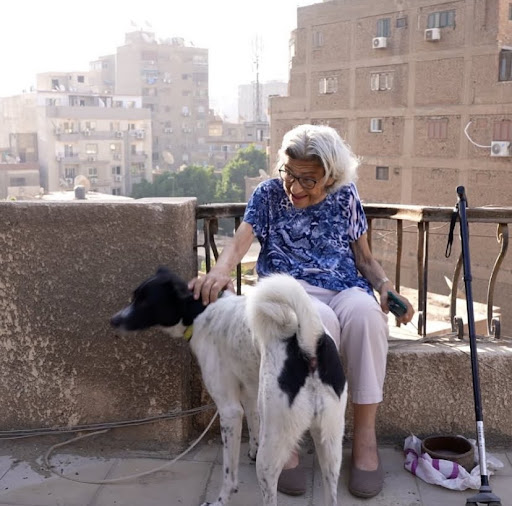

Each time I come across a new photograph of Laila Soueif — eight months into her hunger strike — I’m engulfed by a nameless feeling. It isn’t fear, nor is it grief, exactly. It lies somewhere between stunned bewilderment and ethical shame.
I watch her thinning body slowly and deliberately withdraw from the world. The more emaciated she becomes, the more undeniable her presence. To speak of her like this feels indecent; the image resists interpretation. My language falters, and I’m left confronting the fact that my solidarity is tenuous. This sense of powerlessness is not mine alone — it’s shared, it belongs to us.
Laila’s hunger strike does not lend itself to metaphor. Her refusal of the status quo, her protest against the ongoing imprisonment of Alaa — carried out through her own body, in muscle, fat and bone is devastating. Unintentionally, I find myself returning to two literary figures that haunt the modern imaginary of refusal: Franz Kafka’s A Hunger Artist and Herman Melville’s Bartleby, the Scrivener. Both choose withdrawal (through starvation or silence) from absurd systems that regard them as obstruction or spectacle, or both.

In Kafka’s story, a man turns starvation into an art. He sits in a small, exposed iron cage, on display for an audience who observe him closely, as to verify his abstention. At first, his act drew the public’s curiosity, gradually descending into boredom. His fast is capped at 40 days — a limit set by his impresario, who knows exactly when the crowd loses interest. Eventually, the hunger artist is left to die, curled and barely visible in a heap of straw, tucked in some forgotten corner of a dilapidated circus. With his final breath, he confesses: he never found anything he truly wanted to eat. He is replaced by a tiger —vivid, ferocious — the sight of him a show of vitality so excessive it borders on the obscene.

Bartleby, a clerk in a Wall Street law office, begins by refusing assigned tasks one by one, repeating his now-famous refrain: I would prefer not to. He stops working, then stops responding, then stops leaving the office, and finally, stops eating. He is transferred to prison, where he dies quietly — without protest, without explanation, without plea. His phrase becomes a kind of shorthand for passive defiance: abstention as virtue, withdrawal as resistance.
Both Bartleby and the hunger artist are often summoned as icons of retreat — figures quickly stripped of their gravity and rendered symbolic. Bartleby is reduced to his single phrase, a romantic emblem of private dissent. The hunger artist’s body, transformed by starvation, mutates into a performance — something to be consumed, not grieved. When their stories are revived, their danger is defused and their meaning becomes hollow.
And when we encounter a hunger strike as an image, it is metaphor that most threatens it. Defiance is dulled, recoded into a display. The violence of the act is repackaged, its cost diminished.

Laila is not a symbol. Her body must not be collapsed into metaphor. Her resistance is not romantic in any sense. Laila’s hunger strike is an incalculable risk — a wager she is staking on her body and her life. Her hunger is not performed; it is exacted, from within the flesh.
There is no metaphor in what Laila is doing, and no ending open to interpretation. This is what it means for the body to speak when ambiguity is no longer a luxury. By refusing food, Laila reclaims her body — not as something to be confined or surveilled, but as a site of deliberate action, unsettling the very logic of sovereignty. In a context where bodies are routinely reduced — through arbitrary detention, solitary confinement, torture, medical neglect, extrajudicial killing and the bureaucratic violence of delay, denial of care and disappearance — they are rendered expendable: unprotected, unmourned, forgotten. Her act exposes a regime that does not distinguish between survival and extinction, where the question of life or death barely registers as consequence.
Laila’s strike is not a call for sympathy. It demands political and moral reckoning. It makes no plea to survive, but politicizes its own fragility. Her hunger is a form of indictment. In refusing nourishment, she invokes what Judith Butler names grievability — the right to be mourned, the demand that absence register as loss. But in the logic of the state, not every absence counts. Grievability is both a measure of recognition and a mechanism of erasure. Laila’s emaciated body insists that Alaa’s life be treated as one worth grieving — and that her own disappearance not fade into silence, but rupture it, as scandal, as accusation.

Laila Soueif is not Bartleby, nor is she a caged hunger artist. Nothing about what she is doing is allegorical — it is maternal and political, directed squarely at the present. She knows this regime only responds to crises — and so she is decidedly turning herself into one. Through her body, she is simply stating: My son is imprisoned. I will starve myself so that he may be free.
What makes Laila’s act all the more unbearable is its unintended timing. Her hunger strike unfolds alongside the vast and systemic starvation of Gaza. Two hungers, distinct yet intertwined: one chosen, one imposed; one solitary, one borne by millions. They speak the same language — of bodies abandoned to perish, made visible only through their slow disappearance. Gaza is starved. Laila starves herself. While the images are not synonyms, they imply each other: bodies are perishing, and we are made to watch.

Kafka once wrote that the world had lost interest in hunger artists. He may have been right. When the performance endures, engagement fades. Sympathy, if repeated, wears thin. Any act, sustained too long, loses its edge. But Laila does not seek sympathy. Nor does she await praise. Her silence does not comfort, it is indicting. The burden of the question is not hers, it’s ours. In a world accustomed to pain, does this hunger still have the power to disturb? And if we can justify our silence — what does that make us?
To say her act should not be glorified is not to diminish it, but to acknowledge its weight. Her hunger is a refusal of loss, a stand for what cannot be unseen. This loss is not hers alone. It wounds meaning, justice, memory. As in Gaza, where hunger becomes an instrument of erasure. Her body reveals what the state works to obscure: the collapse of the body, and of freedom, when reduced to bare life.

If there is a lesson in Kafka or Melville, it is that misrecognition is fatal. The audience grows weary. Repetition numbs response. Death, when prolonged, becomes background noise. But Laila’s hunger strike demands attention — not because it is heroic, or tragic, but because it is true, painful and directed at us. We, who still eat and sleep and wait. Her body carves itself into our awareness — not to move us emotionally alone, but to unsettle our silence, to confront our complicity in forgetting.
Laila does not display her pain for pity. She asks for nothing. She forces us — those of us habituated to consuming images of suffering — to stop. To remain in the scene, not drift at its edge. To look, to feel, to register the weight — not as headline, but as summons. This is not only the story of a mother fighting for her son. It is a moral reality we cannot bypass without asking what part we play in silence, and in waiting.
And if there is a question at the end, it is not about Laila. It is about us. Can we bear to know — and still remain silent? What will we do with that knowledge?
What remains, then, is not a conclusion — but a responsibility.

Sarah A. Rifky
Sarah Rifky is a curator and writer based in Cairo, Egypt. She is the co-founder of the Beirut art initiative.
آراء أخرى

Alaa and Laila: A struggle for freedom and family
«A woman with gray hair steadily walks toward the gate as if on a mission or path she set for herself»

Letter to Alaa, to our Egyptian Comrades
«We have a steep fight ahead of us, Alaa, for your life, for our lives»
Thinking with Alaa: Nothing but love
«We have much more from Alaa than his absent condition and possible disappearance to grapple with»
Your support is the only way to ensure independent, progressive journalism survives.
You have a right to access accurate information, be stimulated by innovative and nuanced reporting, and be moved by compelling storytelling. Subscribe now to become part of the growing community of members who help us maintain our editorial independence.
Join us
لا توجد تعليقات بعد