
Madame Defarge reminds us of the core of her revolution

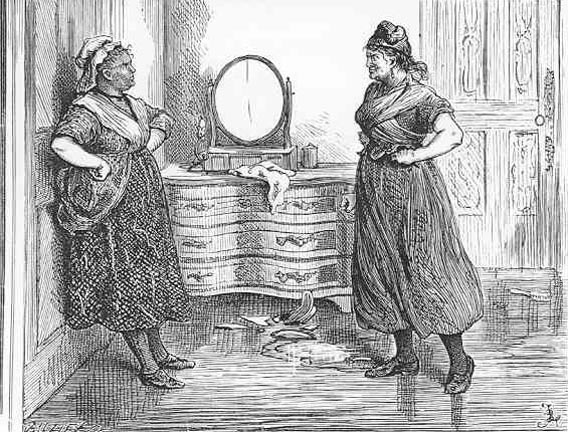
I can’t stop thinking about Madame Defarge, the ringleader of the tricoteuses (knitting women) from Charles Dickens’s 1859 novel Tale of Two Cities. I can’t remember anything about her — her motivations, what she lost, why she was part of the French Revolution. All I remember is her persistence: her constant knitting in a rigorous effort to encode the names of all those who need to be killed because they are enemies of the newborn revolution.
In literary criticism, Madame Defarge’s character has been viewed as an embodiment of the “Reign of Terror” during the French Revolution, but scholars often see that reading of Madame Defarge as one-dimensional, and not taking into account the complexity of her position.
Teresa Mangum, a literary scholar, reflects on Madame Defarge’s character and suggests that "the logic driving her story is that the secret crime of sexual violence against women fuels the French Revolution."1 I find this statement very relatable. Within this woman — who becomes a devout follower and then leader in the uprising against the aristocrats’ oppression, in the core of all her rage, vengeance, quest for justice and pain — is sexual trauma: a trauma a lot of women can easily relate to. In any political event that changes the course of history, female bodies have been a bargaining chip. Because it is a female body, torture, mutilation, or death is not enough: rape and sexual violation is the go-to move because it feeds the power-hunger of the aggressor and also pains the male ego of this female body’s owner, be it a father, a son, a husband, or a brother.
I couldn’t stop thinking of Madame Defarge when attending the premiere of About Her, the debut film of 49-year-old indie cinema godfather Islam al-Azzazi, founder of the Jesuits Alexandria Film School, and co-founder of SEMAT, Egypt's first independent film production company established in the early 2000s.
Less than 48 hours before the premiere, two testimonies were anonymously published on the blog “Daftar Hekayat”, which collects accounts of sexual violence. The anonymous authors of the testimonies accused film director I.A. of sexual assault and harassment. In the following days, four more anonymous testimonies were added, including accusations of rape against the director. In parallel, feminist filmmaker and artist Salma al-Tarzi shared her knowledge of other incidents of sexual assault involving Azzazi.
At that point, I am sitting in the main hall of the Cairo Opera House. I am a female filmmaker and I know three of the victims who shared their stories. I was clenching my teeth, losing my cool, seriously considering making a scene, violently hitting that director who dared to come with his partner and gave a few interviews arranged by his distributor after they kicked out all media outlets who might ask uncomfortable questions.
I only found one soothing action, recalling Madame Defarge. I took out my phone, opened a new note and started writing the names of every famous person who came to show support to that man. I don’t know what I could do with the list, or if I ever could do anything. I am not part of a group that has any power or that can set up tribunals and chop off heads using a guillotine. And I don’t think I want to be.
But over the next few days, I found myself adding to the list people who congratulated him on Instagram and posted videos from the red carpet of the film, people who wrote statuses of solidarity with him on Facebook, and slandered the women who spoke up, wondering why they picked that timing. They are women and men who belong to the same industry, people whose films I love. They are people who continue to stoop so low in defending a sexual predator who has been systematically taking advantage of young women.
Around the same time, and in the realm of the Cairo International Film Festival, Mayye Zayed, a dear friend, screened her award-winning feature documentary film in its Middle East premiere after being screened at the Toronto Film Festival. Lift Like a Girl is the story of Zebiba, a girl trained by Coach Ramadan, father of world champion Nahla Ramadan, in weight lifting. The film is a touching work about being a woman and playing sport in an underprivileged urban community outside of Cairo.
After the film screening, the second unit director (as he was credited in the film) Amrosh Badr wrote a status on Facebook accusing Zayed of stealing the film from him, and saying that he wouldn’t let go of his lawful rights. According to Badr, he was forced to leave the film project back in 2016, because the financial backers told them as a team they need to make a film about the girls, not Coach Ramadan, for that makes for a “fashionable” film that would secure funds. Badr refused to compromise his vision and felt dismissed and disrespected by the film cinematographer, Mohamed al-Hadidi, and Zayed herself.
The same community of filmmakers and creative producers who supposedly know how documentary films are made shared Badr’s status to support him. This followed a statement published on the film’s Facebook page that kept to facts that Badr signed contracts, picked that specific title and was credited in more than one position in the credits according to his contribution. The statement added that he was paid for his work in the film in full. The statement also mentioned that there were two years of shooting and another two years of editing that Badr was not involved in. The film cinematographer Mohamed El Hadidi and editor Sara Abdallah wrote extensive statuses about what they witnessed first hand in the making of the film. The statuses backed up Zayed as the film director.
I personally believe that the film is Zayed’s work, but I was surprised by the rhetoric that Badr’s claim stirred. We are in a situation where Zayed needs to prove that she is the film director. The victims of Azzazi too need to prove that they were harassed, assaulted and raped. What I am simply questioning is: if Zayed and Azzazi both share the defendant position, why is the response different?
Azzazi is a heterosexual male who comes from a privileged class and a certain age group and positioning in the world of indie cinema in Egypt. Claims against him, despite their seriousness, are doubted and the victims are asked to prove what they claim. This is happening in a context where the director-actress power dynamic easily lends itself to abuse. It is also happening in the total absence of any discussion of his class privilege. All that was muted and victims were questioned about their intentions, timing and what proof they had.
Zayed, instead, is a woman from a privileged background, and the claim against her was stealing the work and ideas of an underprivileged male filmmaker. Here, suddenly class sensitivity is part of the conversation, while Amrosh’s intention or timing or evidence of his claims were not questioned. There were only other male filmmakers showing great understanding of his frustration and jealousy of the success of what could have been his film. At the same time, Zayed needed to prove that she has not abused the power of her class in order to make that film.
This double standard is gendered: The biases to defend Azzazi and attack Zayed are related to the fact that he is a man and she is a woman. I can’t help but wonder if just one simple factor was reversed — if the sexual assault allegations were against a woman, and the artistic vision theft accusation was directed toward a man. How different would the reactions and the whole conversation about those two incidents be?
I went back to Madame Defarge and wondered: If she was a filmmaker in 2020 and witnessed the violation of female bodies, and their shaming for speaking up, how would she feel? Would she be part of the Me Too movement? Would she be more radical?
I wonder if she saw my note on my phone, with the list of names: What would she tell me to do?
I thought long and hard about that list. I will do nothing with it, I will just keep it on my phone to remind me that being a female filmmaker is not an easy choice, that the fight is long and hard, that justice is far away, that I am not part of a progressive community as it claims to be, that I can’t be vindictive, that I need to restore faith in humanity, that I need to allow a space to heal, that I dream of a matriarchal way where healing and life come first.
1 Mangum, Teresa (2009). "Dickens and the Female Terrorist: The Long Shadow of Madame Defarge". Nineteenth-Century Contexts.

آراء أخرى

Things I want to talk about
«My life is by far more valuable than what they like to call honor.»
Inherent guilt: Menna Abdel Aziz and the victims of Ahmed Bassam Zaki
«Rape is not done by monsters, it is done by human beings»

Israel’s madness loses its luster
«Nael al-Toukhy explores Israeli youthfulness and its reversal on October 7.»
Your support is the only way to ensure independent, progressive journalism survives.
You have a right to access accurate information, be stimulated by innovative and nuanced reporting, and be moved by compelling storytelling. Subscribe now to become part of the growing community of members who help us maintain our editorial independence.
Join us
لا توجد تعليقات بعد