
US, Israel attack Iran, triggering Iranian response against US bases in the Gulf
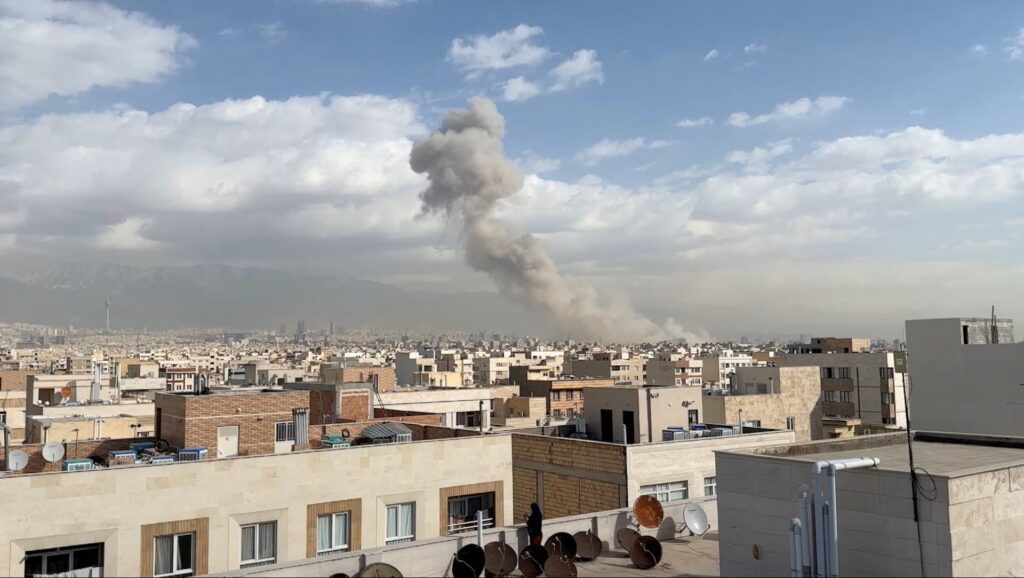
Israel and the United States launched joint attacks on sites across Iran on Saturday morning, marking the beginning of an operation that comes after weeks of US military build-up in the region.
Impacts were visible in downtown Tehran, sending plumes of smoke over the capital, including in central parts of the city near the presidential offices and other key government buildings.
Iranian media said several hours later that the Iranian Revolutionary Guard responded with strikes targeting US bases in Kuwait, Bahrain, the United Arab Emirates and Qatar, where air defenses were deployed.
Israel’s iron dome was also deployed to deter strikes around the same time, according to live reports.
The strikes come after months of indirect negotiations between the US and Iran, in which a belligerent administration under US President Donald Trump has threatened repeatedly to attack Iranian targets unless Tehran commits to ending its nuclear program.
Regional powers have sought to mediate a diplomatic solution to limit the feared regional implications of a prolonged conflict. The third round of talks in Geneva was held on Thursday with the US and Iran walking away without a deal, although Oman, which has been mediating, said there had been significant progress.
A video shared by Iranian news agency ISNA showed smoke rising near Tehran’s Pasteur Street, an area that houses key government institutions, including the Leadership House and the Presidential Administration, along with several other state buildings.
Reuters reported that Iran’s Supreme Leader Ali Khamenei left Tehran and has been moved to a secure location as the city comes under attack.
Other targets in the capital were also struck, with residents describing hearing several strikes ripple across the city. One person near Mehrabad Airport told news agencies that they heard “two heavy explosions” shaking windows shortly before, while another in central Tehran near Vanak reported the sound of blasts erupting at nearly the same time, echoing through the neighborhood.
Other strikes across the country were geolocated to sites in Qom, the locations of the Fordow nuclear facility that was targeted in US strikes last year, as well as in Kermanshah, Isfahan and Karaj.
Israel was the first to announce it had launched strikes shortly after 8 am on Saturday, with Defense Minister Israel Katz describing the attack as a “preemptive” operation against Iran to remove threats to Israel’s security. Katz declared an immediate nationwide state of emergency across the country.
Israeli Prime Minister Benjamin Netanyahu echoed Katz's statements, saying that the strikes were intended to eliminate an “existential threat” posed by Iran. He thanked his “great friend” Trump for his support. Reports in the Israeli and US press said the operation had been planned months ago and anticipated that it could last for several days.
Trump later confirmed that the US had “begun major combat operations” in Iran in an eight-minute video published on his Truth Social platform. Trump described the US-Israeli military campaign as “massive and ongoing," saying Saturday’s strikes marked the beginning of a broad operation designed to destroy Iran’s missile capabilities, dismantle its missile industry and neutralize its naval forces.
The US president incited “the great proud people of Iran” to use the US-Israeli offensive as an opportunity for regime change. “When we are finished, take over your government,” he said, adding that the opportunity being granted to them by the US “will be probably your only chance for generations.”
Trump made a similar appeal to Iranians at the beginning of this year when protests against the Iranian regime broke out across the country, prompted by dire economic conditions, saying that the US would come to the “rescue” of Iranian protestors if authorities used violence against them.
Iran’s economy has declined steadily over the past two decades under punishing US sanctions that have created a combination of persistently high inflation, low employment and low or no real GDP growth, causing a drop in the quality of living for Iranian households.
The popular protests at the end of 2025 were among the most widespread seen in recent years and were met with the deadliest period of repression by Iranian authorities in decades.
In his Saturday morning address, Trump added that the current operation’s goal was to prevent what he described as Iran’s terrorist proxies from destabilizing the region or targeting US forces, acknowledging that US personnel involved in the operation could face casualties, saying service members may lose their lives as he claimed that Iran "seeks to kill.”
Since the conclusion of a 12-day war between Iran and US and Israeli forces last year, Iran had not launched any form of strike on Israeli or US assets in the region.
Omani Foreign Minister Badr al-Busaidi, who has mediated several rounds of negotiations between the US and Iran, said on Friday night that Iran had committed to not stockpiling weapons-grade enriched uranium.
“Now we are talking about zero stockpiling and that is very, very important because if you cannot stockpile material that is enriched, then there is no way you can actually create a bomb,” Busaidi told CBS.
Iranian Foreign Minister Abbas Araghchi said before the latest round of talks in Geneva that “Iran will under no circumstances ever develop a nuclear weapon” but insisted too that “neither will we Iranians ever forgo our right to harness the dividends of peaceful nuclear technology for our people.” He said that “a deal is within reach, but only if diplomacy is given priority.”
Trump’s administration has insisted, however, on a commitment to zero-enrichment and for existing stockpiles Tehran is believed to hold to be transferred outside the country.
Iranian officials have voiced their resolution to defend themselves against a US or Israeli assault, with Parliament Speaker Mohamed Bagher Ghalibaf warning on Wednesday that the US would “taste the firm grip” of Iran and its defenses if it and Israel were to launch an attack “in the midst of negotiations.”
The impact of Iran’s retaliatory strikes were reported across the region around three hours after Israel announced its attacks in what appeared to be the beginning of an Iranian response to the aggression. The Qatari foreign minister said that air defenses had deterred several missiles from reaching targets in his country, while Bahraini state media said a US base in the country had been targeted. Strikes were also reported in Abu Dhabi, the site of another US air base.
Air defenses in Haifa were activated to intercept missiles. Clouds of smoke were visible in the air on live reporting from Al Jazeera.
Iran retaliated to US strikes against its nuclear facilities in June last year by launching what was understood as a symbolic response targeting the Al-Udeid Air Base, which houses the Qatar Emiri Air Force, United States Air Force, United Kingdom Royal Air Force and serves as the forward headquarters of US Central Command in the region. The Iranians had given the Qataris and the US prior warning and the base was evacuated. Air defenses prevented the missile hitting its target, but the operation was a clear signal that Iran would respond to aggression on its territory by hitting US allies in the region, sources told Mada Masr at the time.
While the strike and its ramifications — the implication of US military assets in the region and the associated cost of their deployment to defend a whole range of allies across several countries — was described at the time as a factor in the establishment of a ceasefire.
For the past month, the US has built up military assets in the region and in Europe in the largest deployment of equipment since its 2003 invasion of Iraq.

أخبار ذات صلة
‘Typical negotiating lines’: Assessing the 1st round of US-Iran talks
Regional diplomats and officials in US foreign policy quarters say talks will likely resume.

Iran’s insistence on Lebanon ceasefire a test for regional sway
After authorizing the deadliest strikes on Lebanon in years on Wednesday, Israeli Prime Minister Benjamin Netanyahu took to the podium in a national address to assure his audience that Tel…

Iran and US claim victory in a war that hasn’t ended. The biggest loser? The GCC
Day 40 of the war between Iran and the United States and Israel was going to be decisive, one way or another. That is because it was the day US…

‘It felt like time stopped:’ Israel launches 100-strike attack across Lebanon despite ceasefire announcement
Israel launched a sweeping wave of at least 100 airstrikes across Beirut and the rest of Lebanon on Wednesday afternoon, shattering hopes…
Your support is the only way to ensure independent, progressive journalism survives.
You have a right to access accurate information, be stimulated by innovative and nuanced reporting, and be moved by compelling storytelling. Subscribe now to become part of the growing community of members who help us maintain our editorial independence.
Join us