
Tensions build at presidential palace

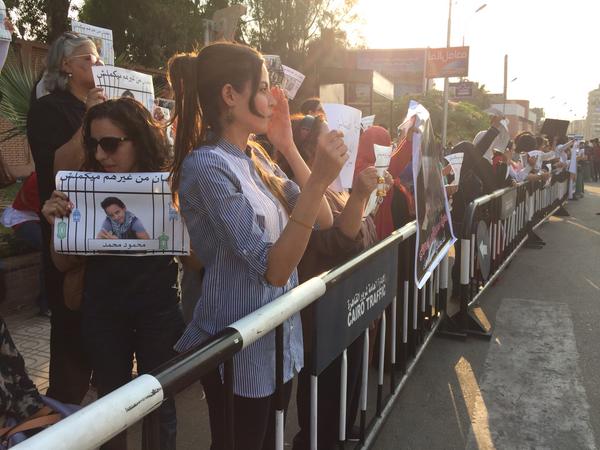
Thousands of protesters gathered early on Sunday in front of the Ettehadiya Presidential Palace, waiting for even larger crowds to join them when marches moving across Cairo converge on the palace later in the day.
Yasser Aboul Nasr, a business owner, came to the palace with his family of five. His 48-year-old wife, Abeer Lotfy, says that she was too scared to join the protest, but her husband convinced her that it was a religious duty to rebel against an unjust ruler.
The Brotherhood is “worse than fascists or the Nazis,” Aboul Nasr claimed.
“The Muslim Brotherhood came out of prison to imprison the rest of the country,” he said. “The era of the Muslim Brotherhood will end at the hand of the people.”
Tension at Ettehadiya began to mount when one protester was singled out by a group of people who accused him of being a member of the Muslim Brotherhood. After forcing him out of the demonstration, the group started chanting “peaceful.”
There were also altercations between anti-Morsi protesters, who have different views of the military. One camp views the army as a potential savior and viable option to rule the country, while the other camp sees it as an even greater evil.
Some protesters stopped Mervat Morsi Abdullah, spokesperson for the Revolution Youth Coalition, when she tried to hang a banner in support of the army. She claims that members of the Tamarod (Rebel) campaign told her that they would tear it down if she put it up.
Abdullah, however, insists on voicing her support of the military, and says that the Tamarod campaign can’t stop the people from their pro-army chants.
“Do they think they would be able to stand here [at the palace] today without the army’s protection?” she asks. “We’ve been chanting for the army here and at the Defense Ministry for the past few days, and 80 percent of Egyptians want the army [back in power],” she says.
Rabie Bendary and Sameh Dahmash are among dozens of protesters who traveled from Sharqiya in microbuses to join the protests at the palace.
The Zagazig residents were boasting about being from “the hometown of Shafiq,” in reference to Ahmed Shafiq, Morsi’s competitor in the presidential elections runoffs and a former member of the Mubarak regime. They were proud to have given him, and not Morsi, their votes.
Bendary says that while Mubarak’s state was marred by institutional corruption, the Brotherhood’s form of corruption is religious in nature. Dahmash believes that the Brotherhood is intentionally causing the state to fail in order to deploy their militias to take over.

Dalia Rabie
Dalia has a pragmatic perspective on things and has a way of telling it just like it is. This informs her professional practice, with all the humor and wit that characterize…

Amira Salah-Ahmed
Leave it to Amira to poeticize a stock market crash or an inflation hike. Her creative writing skills put a silver lining on the cloud that is Egypt’s economy. …
أخبار ذات صلة
One year after Ettehadiya protest arrests, activists organize tactical women’s protest
On the first anniversary of the arrest of 23 protesters, including seven women, in front of the Ettehadiya Presidential Palace, activists organized…
Q&A on Morsi’s Ettehadiya clashes trial
The Cairo Criminal Court sentenced former President Mohamed Morsi and 14 co-defendants to 20 years in a maximum security prison on Tuesday morning at the Police Academy. The case pertains…

Update: Ettehadiya defendants’ fate uncertain amid conflicting reports
The fate of the Ettehadiya defendants remains uncertain following a series of conflicting statements made in reaction to a list of defendants supposedly to…
Appeals court reduces sentence against Ettehadiya detainees to 2 years in prison
An appeals court has amended the verdict against 23 protesters who were arrested while marching to the Ettehadiya Presidential Palace last June…
Your support is the only way to ensure independent, progressive journalism survives.
You have a right to access accurate information, be stimulated by innovative and nuanced reporting, and be moved by compelling storytelling. Subscribe now to become part of the growing community of members who help us maintain our editorial independence.
Join us