
Striking journalists await action from courts, president after their expulsion from Al-Bawaba News premises
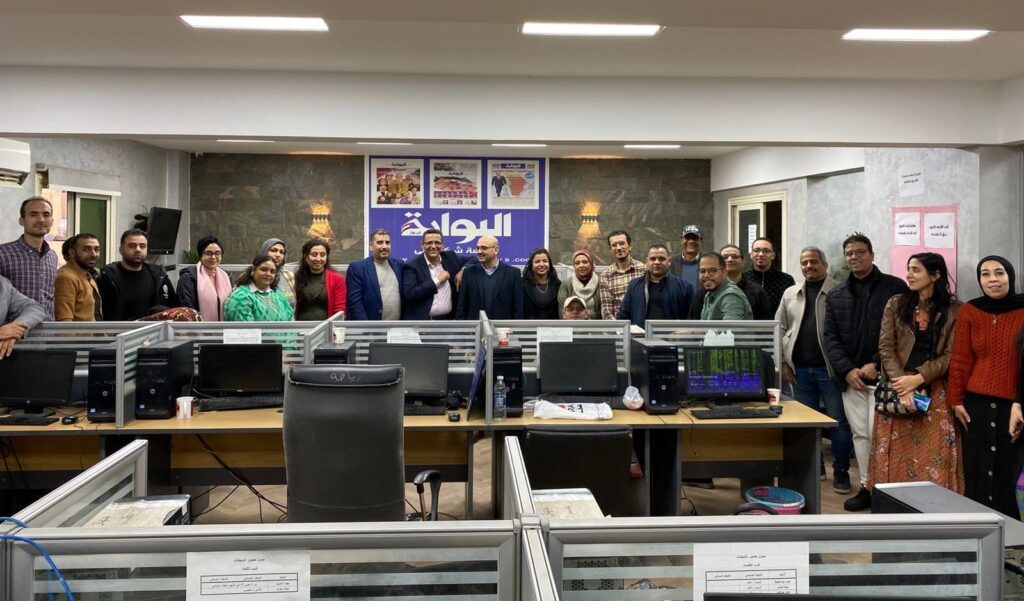
Journalists at Al-Bawaba News are continuing their sit-in at the Cairo Journalists Syndicate headquarters after company security expelled them by force from the newspaper’s premises where they began their strike almost two months ago.
Their protest has seen them clash with the newspaper’s management, which has pointed to its financial troubles to justify its failure to compensate the journalists fairly, seeking liquidation.
This week, the journalists appealed for the president to intervene, as they await the courts’ response to two months of unpaid wages and the company’s efforts to close its doors for good without responding to their strike action.
The steps come after the company’s management escalated its action against the strike, which was forcibly dispersed at the beginning of this week.
On Sunday evening, nine security guards burst into the Al-Bawaba office at around 8 pm, said Wesam Hamdy, one of the journalists who was present, speaking at a conference the journalists held at the syndicate on Monday.
Only three journalists were present in the office at the time, Hamdy said, since several of the staff on strike had returned home for the day or stepped out of the premises temporarily. The security guards demanded that the journalists leave the office, threatening to remove them by force if they did not leave of their own volition.
The guards then confiscated their phones to prevent filming, restrained two of the journalists, locked the office and handed the key to an employee affiliated with the company’s owner, Abdel Rahim Ali, before leaving, handing the phones to the security staff at the building, Hamdy said.
Within the span of two hours, Al-Bawaba News’ editorial board issued a counter statement , dismissing the journalists’ account of events as “allegations” which it said aimed to thwart ongoing efforts toward mediation being led by “a colleague” who it claimed had been approached by some of the journalists on strike. The board stressed its commitment to the initiative and to discussing it carefully.
The journalists said that the strike is ongoing and that “a colleague of ours proposed a solution,” in a Tuesday evening statement affirming that that they remain “open to any solution that guarantees our rights.”
Al-Bawaba News’ management had tried to forcibly break up the sit-in the week prior, with private security guards attempting to prevent striking journalists from entering the building and to remove four protestors inside. It also cut electricity, water and internet to those inside.
When they contacted the electricity company, they found that the office’s power meter had been removed.

Legal battle as management seeks liquidation
Journalists Syndicate head Khaled al-Balshy repeated at Monday's conference that the syndicate is working on a lawsuit they have filed seeking to halt the company’s attempt to begin liquidation proceedings.
Ali announced in the new year that the institution’s general assembly had given its approval for the dissolution and liquidation of Al-Bawaba News, citing accumulated financial losses. He said a judicial liquidator would handle dealings with government bodies throughout the one-year legal liquidation process.
But the syndicate challenges the legality of this step.
There are two legal infractions that could be present in the case. A Labor Ministry official, speaking to Mada Masr on condition of anonymity, said the decision to liquidate the company at this stage violates the labor law, since Article 240 prohibits companies from filing for full or partial closure “while collective labor disputes are being resolved,” and bans submitting such a request “because of, or during, a workers strike.”
These conditions apply to Al-Bawaba News, the official said, adding that even after a court order or official decree is issued, liquidation in no way absolves the employer of obligations toward workers, foremost among them the payment of wages in accordance with the latest minimum-wage decree.
The other potential legal infraction is that “in cases where an establishment is dissolved, liquidated, fully or partially shut down or its activities reduced, the decision must come through a court ruling or a decision by the competent authority,” and “a suitable period must be set for settling workers’ rights, which cannot exceed one year from the date of the ruling or decision,” as per Article 3 of labor ministerial Decree 259/2025, issued to implement the Labor Law.
The lawsuit filed by the syndicate is due to have its first hearing scheduled later this month.
The company could face litigation from another angle as well, since the official told Mada Masr that the ministry recently delivered to the labor court a stack of reports dating back to November that it had filed against Al-Bawaba News for failing to implement the minimum wage. The official said the ministry had resorted to the court after negotiations with the company failed.
They added that the ministry was unable to provide financial support to Al-Bawaba News journalists through the Emergency Labor Aid Fund since the company’s management failed to submit paperwork the ministry required.
Balshy previously said the company was stalling on the paperwork needed to process its own request for wage support through the fund — a claim that the institution’s legal advisor Yehia al-Diasty dismissed at the time as “misleading.”
When Mada Masr contacted Diasty to ask what legal measures the company had taken before announcing its liquidation and why it failed to submit the documents needed for wage support to the ministry, Diasty replied: “I have nothing to tell you.”
Al-Bawaba News has sought to deploy legal action against nine of its journalists and two members of the Journalists Syndicate board, filing complaints with the Public Prosecution accusing them of “protesting without a permit” and of “insulting and defaming the institution’s owner Abdel Rahim Ali and editor-in-chief Dalia Abdel Rahim.” The prosecution released all of those accused after questioning last week.
After management began to escalate action against the sit-in last week, the Journalists Syndicate’s board voted to strike Ali’s syndicate membership, and has said it is reviewing petitions to remove his daughters, Dalia and Shahenda, the newspaper’s editor-in-chief and deputy editor-in-chief, from the rolls.
The syndicate is also considering further punitive measures, Balshy said, without specifying their nature, adding that it remains open to any initiative that preserves the institution and journalists’ rights.
It also took a series of measures against the newspapers’ leadership two years ago when several reporters faced arbitrary dismissal and salary cuts. The syndicate suspended the paper’s registration with it at the time and referred editor-in-chief Dalia Abdel Rahim and Ali himself to investigation.
A family affair
Conflicting information and a lack of transparency from the company has complicated the syndicate and journalists’ route to pursue legal action.
No data was available on the company’s ownership, excepting the conflicting statements issued by management itself.
Ali wrote and published an article in Al-Bawaba News just days after the strike began in November, claiming that the outlet “emerged” in 2014 from the Arab Center for Research and Studies, which he said he founded in 2006 in partnership with “a number of respected friends in the United Arab Emirates.”
The Emirati partners withdrew from the center during the COVID-19 crisis, he wrote, claiming that he “chose, unlike them, to carry on” funding the newspaper from his own pocket.
“I own no more than 20 percent of Al-Bawaba’s shares, while I was, and still am, its sole financier for the past five years,” the editor and businessman claimed.
Yet another report published by the outlet in October 2018 states that the newspaper was launched on June 30, 2014 by the Arab Center for Journalism, which Ali founded in 2013.
The Journalists Syndicate reached out to several authorities in search of official documentation on the ownership structure, according to syndicate head Khaled al-Balshy.
In a statement made last week, on Sunday, he said the syndicate had secured official records showing the most recent shareholding update Ali filed for the Arab Center for Journalism — the company that publishes Al-Bawaba News — in January 2023.
The documents show that the news portal is “entirely a family institution,” he said, with Ali holding 60 percent of shares, his son Khaled 30 percent and his wife 10 percent. The records also confirm that “all shareholders since the company’s founding have been Egyptian, with no foreign partners.”
Al-Bawaba News journalists appeal to president, saying ‘some believe themselves above the law’
Though the Journalists Syndicate court case awaits its hearing, Al-Bawaba News journalists said in a statement last week that they fear “all legal and institutional avenues” reached a dead end, calling for intervention from the president.
In their statement, published Tuesday, they warned that allowing the situation to continue would set “a dangerous precedent” and send a message that “some believe themselves to be above the law, and that citizens’ rights can be squandered with impunity.”
Ali, who was formerly an MP, was notoriously recorded insisting he was “above the law,” and boasting that President Abdel Fattah al-Sisi could neither hold him accountable nor bring him to trial in a call to his son-in-law State Council judge Maged Monged. The recording was leaked in 2020 as Ali sought reelection to the House of Representatives.
“The owner of the institution continues to defy the law, showing no regard for the decisions of the competent authorities, for the stature of the state or for the rights of the workers who built this institution with their efforts,” the Al-Bawaba staff appeal read.
The striking journalists said in their appeal that they had turned to the presidency only after “every lawful avenue” had been exhausted, and after Labor Ministry reports documented “serious violations and clear breaches of the labor law, including the suspension of wages, reprisals against workers and the denial of their most basic legal and human rights.”
أخبار ذات صلة
Punitive measures against Al-Bawaba News leadership as syndicate negotiations falter
After negotiations on implementing the minimum wage reached a dead end, the Journalists Syndicate referred Al-Bawaba News’ founder Abdel Rahim Ali and…
Detainees released after at least 16 arrests from protest in solidarity with women in Gaza, Sudan
Authorities released 16 people on bail on Wednesday evening after their arrest on Tuesday from a demonstration in solidarity with women in…
Protestors face backlash over criticism of Egypt’s role in aiding Gaza
A Monday demonstration at the Journalists Syndicate received backlash from pro-government voices for calling on Egypt’s administration to do more to help…
Two Journalists who participated in state media workers protests detained for 15 days
They voiced criticism of working conditions in state media, and, in Fahmy’s case, of the president.
Your support is the only way to ensure independent, progressive journalism survives.
You have a right to access accurate information, be stimulated by innovative and nuanced reporting, and be moved by compelling storytelling. Subscribe now to become part of the growing community of members who help us maintain our editorial independence.
Join us