
Pro-army group Tamarod slams protest law
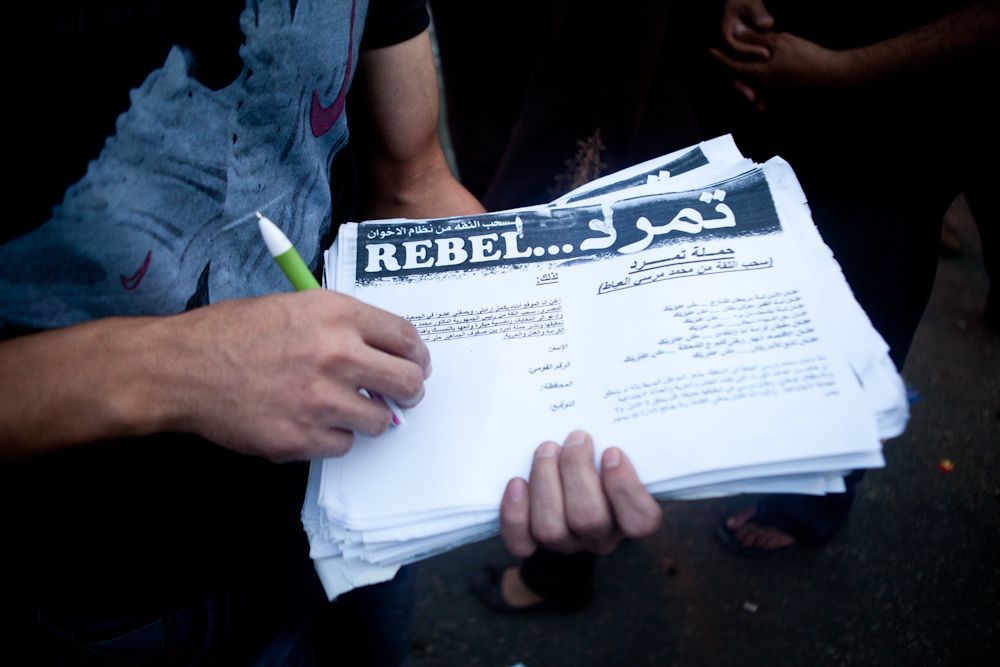
The controversial protest law continues to trigger reactions, the most recent of which was voiced by Tamarod, the activist group which led a campaign to remove then-president Mohamed Morsi in June. The group slammed the new law on Monday in a statement released on its Facebook page.
"We reject the protest law after the National Council for Human Rights declined to amend it," the group said, referring to the government body, which falls under the purview of the upper house of Parliament and was involved in the law’s review. In the statement, Tamarod called for the amendment of an article relating to the right of citizens to attend peaceful meetings. A second controversial article pertains to the Ministry of Interior's right to pre-emptively block protests to prevent potential violence.
"We had previously demanded from the National Council for Human Rights to amend these articles," the statement said, adding that the law already has measures to penalize protesters who commit violent acts during their protests.
"We confirm that we are not against [a law] organizing the right to protest, but it has to be in accordance with the freedom of expression that Egyptians have gained," the statement said.
The group distanced itself from the Muslim Brotherhood's criticism of the protest law. The banned group is believed to be the main target of the new legislation, with the state attempting to prevent further protests against the pro-military government.
“We won't allow for terrorist forces to continue their campaign against the Egyptian people and their consistent acts of violence and sabotage against the Egyptian state," the Tamarod statement read, mirroring the government’s branding of its Islamist opponents as terrorists.
The law, passed on Sunday, requires citizens to give the Interior Ministry three days’ notice before holding public meetings and electoral gatherings. Organizers must provide the place, time and reason for the proposed event, and name organizers.
The law also empowers the ministry to prevent a gathering from happening if it receives information that the protest could disturb public order. The ministry can also determine how close a protest can be held to military and security establishments, parliament, embassies, hospitals and other sites.
Prison sentences of up to seven years and fines up to LE300,000 may be imposed on protesters judged to have violated the law. This includes the broadly defined offense of disturbing public order.
The director of Human Rights Watch in Egypt, Heba Morayef, wrote on her Twitter account Sunday: “Overall law is designed to give the police free reign to ban protests, the Ministry of Interior has absolute discretion to prohibit any demonstration or public meeting."
In a satirical response to the new statute, April 6 Youth Movement member Mohamed Adel addressed a notice to the Qasr al-Nil Police Station of a demonstration against the law. In the notification published on his Facebook page, the organizers said their protest would include "10 million Egyptians" and listed chants such as “down with the protest law” and “down with military rule.” Another mock slogan — “you are acting like lions with us while you are being screwed at the borders” — made reference to recent attacks on military targets in Sinai.

أخبار ذات صلة
Limited access to prisons still undermines national rights council’s efforts to protect detainees
The National Council for Human Rights published its annual report on Sunday, detailing the state’s work to guarantee Egyptians’ rights and its…

Egypt’s National Human Rights Council gets global rubber stamp, though its access to prisons remains limited
The National Council for Human Rights celebrated on Wednesday its achievement of first grade status from an international accreditation body. The classification…

Freedom for Alaa at last
Alaa Abd El Fattah's family celebrated his release from prison early on Tuesday morning, almost six years after the day authorities detained…

Sisi orders authorities to review petition for Alaa Abd El Fattah’s release from prison
President Abdel Fattah al-Sisi instructed “relevant authorities” on Tuesday to look into the national rights council’s petition for amnesty to be granted…
Your support is the only way to ensure independent, progressive journalism survives.
You have a right to access accurate information, be stimulated by innovative and nuanced reporting, and be moved by compelling storytelling. Subscribe now to become part of the growing community of members who help us maintain our editorial independence.
Join us