
Parliament approves all but two laws in first voting session

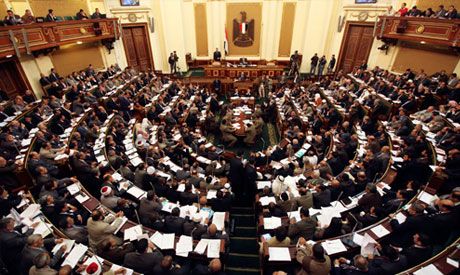
In a 12-hour session, parliament ratified over 40 laws issued by President Abdel Fattah al-Sisi, interim President Adly Mansour and the Cabinet, including the anti-terrorism law and the prison law.
Two laws that didn’t make the cut include the law to appeal state sanctioned contracts and the mineral wealth law, which parliament is set to reconsider.
Although it was previously ratified, the law issued by Sisi giving him power to remove immunized heads of supervisory bodies received the most opposition, and was rejected by 134 members of parliament.
Parliament also passed another law issued by Mansour raising the basic presidential salary from LE2,000 to LE21,000, in addition to another LE21,000 in bonuses.
Member of parliament Osama Sharshar supported his vote by arguing that Sisi’s annual income totals US$63,000, while US President Barack Obama earns $480,000.
The anti-terrorism legislation was drafted by the Cabinet in July, in the wake of the assassination of Prosecutor General Hesham Barakat and attacks in North Sinai, and was ratified by Sisi the following month. The controversial law imposes the death penalty for anyone convicted of establishing or leading a terrorist group, and stipulates five to seven years in prison for anyone propagating ideas and beliefs calling for the use of violence via social media or other mediums.
The law was passed with a 457 majority vote, with commentary from parliamentary speaker Ali Abdel Aal, who told members of parliament they should approve it in “a second not half a minute.”
Meanwhile, amendments to the prison law, issued by Sisi in October, enable prison authorities to use force in cases of self-defense, attempts to escape, or if prisoners resist orders based on prison regulations. Rights advocates argued this may further extend the powers of prison administrators to use force.
The Salafi Nour Party’s parliamentary bloc objected to both laws, according to local media reports.
The electronic voting system got off to a rocky start, with the screen showing 693 members in attendance, while parliament comprises only 596 members. However, parliament’s official website later clarified this was only a screen test.
Local media reports quoted head of the Salam parliamentary bloc Said Hassaneen as saying that parliamentary speaker Ali Abdel Aal had asked the bloc to pass all laws up for discussion on Sunday during a meeting with them.
Other reports also suggested that Sameh Seif al-Yazal, head of the Support Egypt alliance, had also asked members of the alliance to pass all laws.
Around 20 journalists were banned from entering parliament and covering the session on Sunday, prompting the Journalists Syndicate to issue a statement deeming this a violation of the public’s right to follow events.
The syndicate called on parliament not to be “party to any arbitrary action against journalists.”
Last week members of parliament decided to temporarily ban live broadcasts until they finished discussing the laws issued by presidential decree since July 2013 in the absence of an elected legislative body. They made the decision after 40 members of parliament submitted a proposal to stop the live broadcasts. However, heads of parliamentary blocs agreed with the speaker that the sessions would soon be broadcast live again.

أخبار ذات صلة
What has happened to the NGO law?
More than 30 days have passed since Parliament approved the NGO law and there is still no word from the president. According to the Constitution, this is the deadline for the president to have a say on any law submitted to him.

Infighting among the Free Egyptians
The leading liberal party is drowning in internal disputes, as another post-2011 party disintegrates

MPs, Justice Ministry face off over contempt of religion article
Members of Parliament and the Justice Ministry are going head-to-head over Article 98 of the Penal Code, which criminalizes contempt of religion,…
Sisi approves Parliament bylaws
President Abdel Fattah al-Sisi has issued a decree approving the Parliament’s bylaws, thus putting them into effect, the state-owned Middle East News…
Your support is the only way to ensure independent, progressive journalism survives.
You have a right to access accurate information, be stimulated by innovative and nuanced reporting, and be moved by compelling storytelling. Subscribe now to become part of the growing community of members who help us maintain our editorial independence.
Join us