
Media blackout for witness testimonies in Morsi’s palace clashes trial
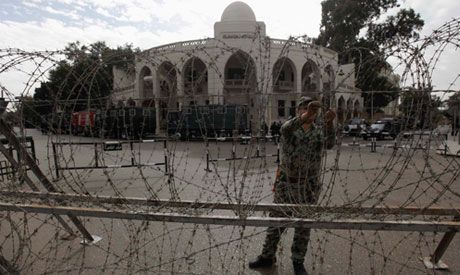
Cairo Criminal Court reconvened the trial of ousted President Mohamed Morsi and 14 of his associates concerning clashes outside the Ettehadiya presidential palace in December 2012.
Following Tuesday’s closed session, judges adjourned the trial to Wednesday.
The 15 defendants are facing charges of murder, conspiracy to murder, and inciting violence against protesters in the clashes that killed at least 10, including supporters and opponents of the Islamist president.
Tuesday’s court session was held behind closed doors at the Police Academy in the district of New Cairo. A media blackout imposed on the session was attributed to the sensitive nature of the four witnesses’ testimonies.
Claims of torture and assault at the hands of alleged Morsi supporters were evidenced in photos and videos captured outside the palace.
One of the witnesses, whose name is being withheld due to security concerns, told Mada Masr: “We don't want our testimonies to be used in justifying the execution of any of the defendants, but we also don't want them to be acquitted of their crimes.”
The witness expressed concern regarding the court’s ability to independently issue a non-politicized and just verdict, especially given the recent death sentences against several hundred Muslim Brotherhood supporters, along with other harsh verdicts recently given to secular opposition forces.
An official statement issued on Tuesday afternoon by two of the witnesses — Ola Shahba and Ramy Sabry — accused the Muslim Brotherhood of being the aggressors, and their leaders of instigating the violence on December 5 and 6, 2012.
Shahba and Sabry were both subjected to physical abuse and torture, with photographic and forensic evidence supporting their claims.
Their official statement asked why more of the Brotherhood members and their allies who were personally involved in these bloody clashes were not brought to stand trial along with the 15 defendants. It also questioned why the then-Minister of Interior, Ahmed Gamal al-Dein, was not summoned for questioning regarding the complicity of his riot police forces in the dispersal and detention of anti-Morsi protesters from around the palace.
The witnesses’ statement called on the judiciary to uphold the principles of justice and judicial independence. It also called on the court not to turn this trial into a case of score-settling or political revenge against the ousted regime.
The Muslim Brotherhood issued an official statement in December 2013, on the first anniversary of the Ettehadiya clashes, in which they claimed the case had been “fabricated to tarnish the image of the legitimate president.”
However, Morsi’s opponents claim that he was directly and personally responsible for the deaths and injuries outside the palace.
On November 22, 2012, Morsi granted himself, his Islamist-dominated upper house of parliament and his constituent assembly, supra-constitutional powers. The Islamist president claimed that these sweeping powers were only “temporary measures” until a new constitution could be drafted.
Morsi’s controversial declaration led throngs of angry opponents and activists to protest outside the palace on December 4. On December 5-6, Muslim Brotherhood activists and Morsi-supporters took to the streets outside the presidential palace and forcefully dispersed the protest camp that had been established there.
Morsi supporters detained numerous opponents in the process, reportedly tying-up a number of them, while allegedly assaulting them physically and psychologically. Some of the victims claim they were subjected to torture at the hands of Muslim Brotherhood activists.
Riot police forces, which were deployed to protect the palace, sided with the pro-Morsi camp, firing teargas canisters at opponents of the president.
Morsi supporters were repeatedly witnessed using firearms as they sheltered behind rows of riot-police troops.
Several of Morsi’s opponents have also been accused of using firearms against supporters of the Islamist president during the clashes on December 5 and 6, yet, like the police forces, these individuals have not yet been brought to trial.

أخبار ذات صلة
Q&A on Morsi’s Ettehadiya clashes trial
The Cairo Criminal Court sentenced former President Mohamed Morsi and 14 co-defendants to 20 years in a maximum security prison on Tuesday morning at the Police Academy. The case pertains…
Appeals court reduces sentence against Ettehadiya detainees to 2 years in prison
An appeals court has amended the verdict against 23 protesters who were arrested while marching to the Ettehadiya Presidential Palace last June…
Ettehadiya detainees to spend another month in prison pending trial
A Cairo misdemeanor court decided on Saturday to postpone the case of Ettehadiya protesters to October 11, while continuing to detain the…
More testimonies to be heard May 3 in Morsi trial for palace clashes
Cairo Criminal Court adjourned the trial of former President Mohamed Morsi and 14 other defendants — on charges of inciting murder at…
Your support is the only way to ensure independent, progressive journalism survives.
You have a right to access accurate information, be stimulated by innovative and nuanced reporting, and be moved by compelling storytelling. Subscribe now to become part of the growing community of members who help us maintain our editorial independence.
Join us