
Egypt’s oldest papyrus on display, details construction of Great Pyramid
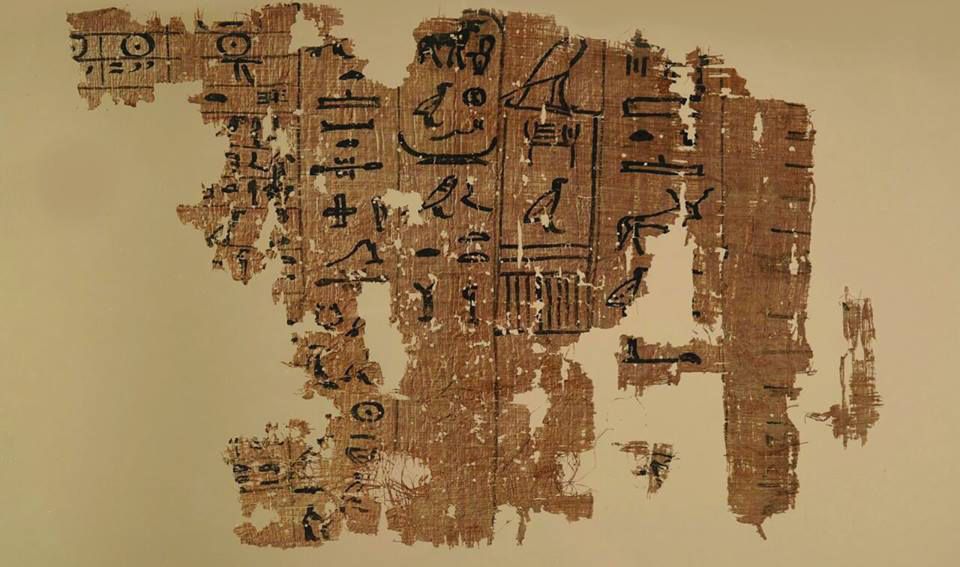
Fragments of pages from the oldest existing papyrus document in Egypt have been put on public display for the first time at the Egyptian Museum in downtown Cairo.
Aged over 4,500 years old, these illuminated notes on the process of constructing the Great Pyramid have been attributed to a nobleman known as “Merer.”
Six pages of Merer's 30-page logbook were restored and put on display at the museum on July 14, when Minister of Antiquities Khaled al-Anany confirmed it to be the oldest existing papyrus in Egypt’s history, local news outlets reported.
The pages were unearthed in 2013 near the ancient Red Sea harbour of Wadi al-Garf (around 120 kilometers south of modern day Suez City) by French archaeologists Pierre Tallet and Gregory Marouard, along with Egyptian archaeologist Sayed Mahfouz.
Inscribed with hieroglyphs, Merer’s logbook was reportedly written during the 27th year of Khufu’s reign. Although Khufu’s life can roughly be dated between 2,600-2,501BC, there are conflicting accounts regarding the duration of his reign as Pharaoh. Some accounts indicate he ruled for 27 years, while others cite his reign circa 2,589-2,566BC or 2,609-2,584BC.
Tallet and Marouard’s findings indicate the Great Pyramid was nearing completion by the 27th year of Khufu’s reign, with much of the remaining work being on the limestone casing covering the exterior.
Merer’s logbook kept records over a period of several months, detailing operations related to the construction of the Great Pyramid of Khufu in Giza and the work at limestone quarries on the opposite bank of the Nile, according to Tallet and Marouard.
One of the logs details that the limestone used in the casing of Khufu’s pyramid was quarried at Tora, in the southeast of modern day Cairo. The stones were then transported to the pyramid’s construction site by boat, through a system of ancient canals. One of these boat trips between Tora and the Giza plateau took four days to complete, according to Merer’s logbook.
The pages also reportedly include details of the lives of Khufu’s pyramid builders, and the forms of compensation they received.
Archaeological evidence from the pyramid area indicates the presence of work camps, which housed local laborers that were most likely compensated for their services with bread, beer, fish, and meat, along with medical treatment and tax exemptions. Each of Giza’s three major pyramids may have employed 10,000 workers or more at a time, and it is thought each pyramid took around 30 years to construct.
Several Egyptologists claim Merer did not oversee the bulk of the construction of Khufu's pyramid, but his predecessor Hemiunu oversaw the work in the earlier years of Khufu's reign. Hieroglyphs in Merer’s logbook, however, indicate Heminu was only responsible for around 200 workers, including sailors, boat crews and navigators, some of who were also reportedly employed at the ancient Wadi al-Garf harbour.
Merer’s logbook, according to Egypt’s Antiquities Ministry, details everyday accounts of sailors as they hauled limestone blocks from the Tora quarries to the pyramid site, as well as the revenues transferred from Egypt’s various provinces to pay for workers’ food and expenses. Revenues were recorded in red and workers’ compensation in black, indicating, according to Anany, “the highly efficient administrative system during Khufu’s reign.”

أخبار ذات صلة
Looking back to see the present through the Grand Egyptian Museum
The coincidental nature behind the establishment of the Grand Egyptian Museum

Staging a grand opening for the grand museum
In Cairo, sidewalks have been repainted, screens set-up and security measures tightened. People living nearby say fireworks have been test-run in Giza.…
All around the Grand Egyptian Museum
The museum will not be open to visitors until after the three-day celebration
Detox | An adventure in your living room
According to the film, the expedition unearthed more than 3,000 artifacts.
Your support is the only way to ensure independent, progressive journalism survives.
You have a right to access accurate information, be stimulated by innovative and nuanced reporting, and be moved by compelling storytelling. Subscribe now to become part of the growing community of members who help us maintain our editorial independence.
Join us