
Egypt-hosted Palestinian reconciliation talks falter over proposed agenda

Egypt-hosted talks between the Palestinian factions, the first meeting between the deeply divided political leaders of the West Bank and the Gaza Strip since last month’s mass resistance movement against the Israeli occupation, have been postponed indefinitely due to disagreements between Hamas and Fatah, sources close to the talks told Mada Masr.
A source close to Hamas said that Egypt postponed the meeting over fears that it was destined for a “swift failure” were it to go ahead, as Cairo realizes that the differences dividing Hamas and Fatah, groups which have been in an intense rivalry since Hamas’s 2006 victory in the legislative elections, are too big to overcome at the moment.
An Egyptian official who spoke to Mada Masr hours after news of the postponement reached Palestinian media said Palestinian Authority President Mahmoud Abbas had informed Egyptian officials he would abstain from attending the meeting at the last minute in protest of the Cairo-proposed agenda and for the decision to not have him chair the meeting alongside the Egyptian president.
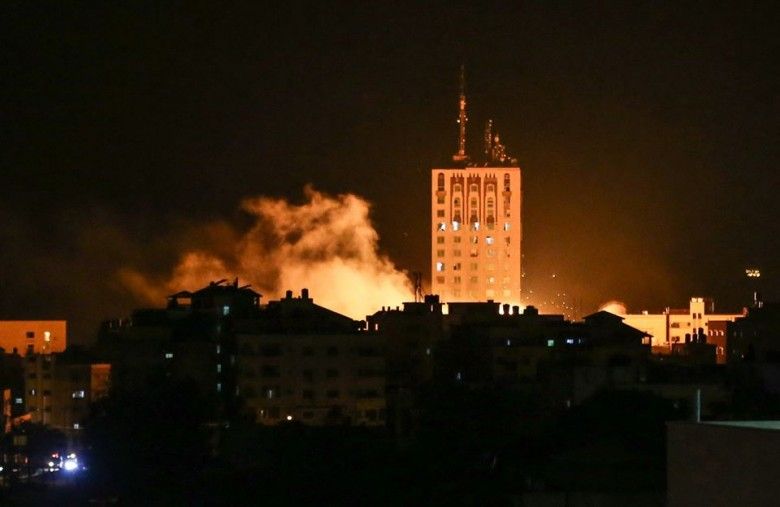
The meeting is the first high-stakes event for Egypt following the prominent role it played in securing a ceasefire last month alongside a host of other countries. The 11-day Israeli offensive on Gaza, which killed over 250 people in the Gaza Strip and left over 1,900 wounded, came on the heels of Hamas rocket attacks on Israel after the latter’s attempts to evict Palestinians from their homes in East Jerusalem and the storming of Al-Aqsa Mosque.
In response to the evictions and the mid-Ramadan invasion of Al-Aqsa, resistance to the Israeli occupation escalated, with Palestinian citizens of Israel conducting protests and holding mass strikes, especially workers in the health and the construction sectors. Over 64,000 Palestinian construction workers went on strike, according to Israeli news sources.
For officials in Cairo, who expressed concern that Egypt’s historic role as a broker in Palestinian politics had receded in the wake of normalization agreements sponsored by the United States and United Arab Emirates in 2020, the ceasefire that began on May 21 was an important step toward rekindling Cairo’s influence, officials previously told Mada Masr.
However, Cairo’s latest reconciliation efforts are off to a rocky start.
Cairo’s proposed agenda for the talks that were set to start today included a discussion of legislative and presidential elections, which Abbas postponed indefinitely in late April citing Israel’s refusal to allow the elections in East Jerusalem. Cairo also planned to discuss restructuring the Palestinian Liberation Organization and PA security cooperation with Israel.
According to political commentator Ibrahim al-Madhon, who is close to Hamas, the admission of Hamas and Islamic Jihad into the umbrella classification of the PLO was a priority for Hamas in the talks.
The Egyptian official told Mada Masr that Abbas refused to discuss all three issues, while Hamas refused to coordinate with the PA on the reconstruction of areas in Gaza destroyed by Israeli airstrikes — to which Egypt pledged $500 million to build new infrastructure and residential units and to which several other countries have pledged funding. Both Israel and the US, however, have insisted that funds to reconstruct Gaza should not pass through the hands of Hamas, with US President Joe Biden stressing the point during a phone call to Sisi in May. Negotiations over the exchange of prisoners from the 2014 war with Israel, and Gaza’s security sector were also refused by Hamas.
While both Hamas and Fatah had premised attending the meeting on strict conditions, Hamas, according to the source close to the group, was keen on making the meeting happen as a nod to Egypt’s role.
Following May’s ceasefire, Egyptian General Intelligence Service Director Major General Abbas Kamel made a historic visit to Gaza — the first by an Egyptian intelligence chief since the early 2000s — to discuss reconstruction efforts and the ceasefire. Kamel was given a warm welcome, with photos of Egyptian President Abdel Fattah al-Sisi plastered on billboards flanking roads throughout Gaza.
The postponement deals a blow to the laborious weeks of back-and-forth talks carried out by Egyptian officials with Hamas and Fatah to bring them to agreement on the meeting's agenda.
Nevertheless, Egypt will to continue to lead indirect negotiations between the Palestinian factions in the coming few days in hopes of gathering consensus for the meeting’s agenda, the Egyptian source said. According to the source close to Hamas, the General Intelligence Service is holding several meetings separately with Fatah and Hamas representatives in an attempt to build common ground between the two groups.
It is not clear how long the face-to-face meeting between Hamas and Fatah leaders will be on hold, the source close to Hamas told Mada Masr.
Despite Abbas’s last-minute decision to pull out from Egyptian efforts, the Egyptian official downplayed the possible negative repercussions his decision would have on the relations between Egypt and the PA. What matters for Cairo, the official added, is a swift mobilization for the reconstruction of Gaza in a way that is acceptable for Palestinian factions, the international community and Israel.
While the enmity between Hamas leaders and Abbas continues to obstruct any serious moves toward reconciliation in the near future, the official said, Cairo will continue to try to position itself as the mediator between Palestinian factions. According to the official, Cairo must continue to handle the factions in Palestine to improve the situation of Palestinians and to seize what he described as a “political opportunity” to relaunch the peace process between Palestine and Israel.
After Hamas’s 2006 election win ended Fatah’s dominance in the PA’s legislative council, the two groups have been enmeshed in a tense rivalry that included military clashes in 2007. Since the elections, Fatah have ruled the West Bank via the Palestinian Authority, while Hamas rule over the Gaza Strip. Since Hamas took control of Gaza, Egypt and Israel have imposed a blockade on the strip, which has caused severe humanitarian issues for Gazans. Efforts for a unity government and reconciliation have consistently failed over the last 15 years.

أخبار ذات صلة
Hamas and Israel reach 10-day deescalation agreement to ‘test’ will for further negotiations
Hamas and Israel agreed to a 10-day deescalation on Friday after Egyptian mediation efforts
Egypt hands over four Qassam Brigades members ‘missing’ since 2015 to Hamas
Egypt handed over four members of Hamas’ military wing who were kidnapped in Egypt in 2015
Egypt pushes for return to Hamas de-escalation in exchange for release of 4 Qassam Brigades members ‘missing’ since 2015
The development is a stark reversal, as Egypt has long refused to recognize the men's disappearance
As Egypt defends control of crumbling mediation efforts in Palestine, Hamas escalates on Israel border
Any hopes Hamas had for Egypt as a mediator were dashed after last week's visit to Cairo
Your support is the only way to ensure independent, progressive journalism survives.
You have a right to access accurate information, be stimulated by innovative and nuanced reporting, and be moved by compelling storytelling. Subscribe now to become part of the growing community of members who help us maintain our editorial independence.
Join us