
Detention renewed for Abd El Fattah and two others in Shura Council case
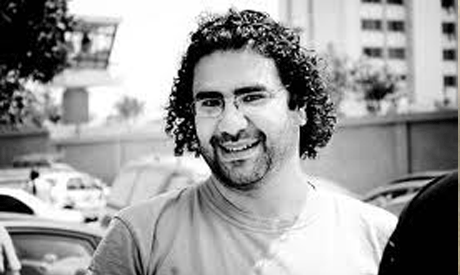
A Cairo court ordered the renewed detention of activist Alaa Abd El Fattah and two others sentenced to 15 years jail in absentia, a LE100,000 fine and five years’ probation in June, in a trial known as the Shura Council case. Seventeen other defendants who attended the court session were released pending further investigations.
The court adjourned the case until September 10, when eye-witnesses from the defense will be heard.
Five of the 25 defendants in the case did not attend the retrial, and the court will uphold their previous verdict. Of these five, two defendants had begun retrial procedures.
According to Mada Masr’s journalist Lina Attalah, who attended the trial, the defendants were being held behind a glass dock, which meant they couldn’t communicate with journalists and their lawyers.
“New glass dock in Tora policemen makeshift courtroom is humiliating,” Attallah tweeted.
At the start of the court session, the prosecution read out the names of the defendants. They responded by microphone.
The prosecution then read out the accusations, which include violating the Protest Law, assaulting policemen and stealing a walkie-talkie.
The defendants’ lawyers also presented their demands. They spoke of the glass dock violation of the defendants’ right to listen to the trial’s procedures.
Abd El Fattah's lawyer demanded his release, because he was previously released pending the same case and he never failed to show up to any of the hearings. “This renders the reasoning behind his current imprisonment void,” the lawyer said.
Abd El Fattah and fellow defendants Mohamed Noubi and Wael Metwally were arrested on June 11 outside the Police Academy at Tora prison in Cairo as they were waiting for the judge to give them permission to enter a court hearing on their case. The sentence was handed out before they were allowed to go in, and they were subsequently arrested, in a move that shocked their family and lawyers.
In today’s hearing, Alaa’s lawyer also reinstated the activist’s demand for a change in the composition of the court, in particular the judge overseeing the case, and a change in the courtroom from a police premises to a real judicial premises.
The judge, Mohamed al-Fiqqi, is believed to have a personal vendetta against 33-year-old Abd El Fattah, a well-known blogger and political activist.
Abd El Fattah demonstrated against Fiqqi in 2005 on accusations that he was part of a team of judges that rigged the parliamentary elections that year. Fiqqi’s name had been placed on a black list of judges by the Lawyers' Syndicate.
The activist’s father is the well-known human rights lawyer Ahmed Seif, who runs the Hisham Mubarak Law Center.
Former presidential candidate and lawyer Khaled Ali, who is working on behalf of the defendants, demanded witnesses from Egypt’s constituent assembly, including politician Amr Moussa and the head of the journalist syndicate Diaa Rashwan, to show up in court and explain whether the subject of the protest was discussed with the protesters as the constitution was being written.
The Shura Council protest was held against military trials for civilians, and not to assault policemen as the prosecutor claims, Ali argued in court.
He added: “I’m not here to defend thugs, but to defend engineers, doctors and programmers, who were playing a patriotic role in society.”
Ali also said that the way three of the defendants were arrested in absentia, despite being present outside the court, is a manifestation of the violation of open trials and of holding court hearings in a police academy.
“This has been a year of strange practices for the judiciary,” he said.
In demanding the relocation of the trial to a judicial premise, one of the lawyers told the judge to “return Egyptians’ trust in their judiciary.”
The defendants had staged a protest outside the Shura Council, Egypt’s parliamentary advisory body, in Cairo on November 26 to demonstrate against a law that places severe restrictions on protesting and public assembly, as well as an article on military trials for civilians included in the 2014 Constitution.
The Protest Law, which had been issued a few days before the November 26 protest, was first implemented in the Shura Council case. At the time, 50 people were arrested. They were all subsequently released, except for defendant Ahmed Abdel Rahman, who protesters say was not even demonstrating but instead was simply trying to protect one of the female demonstrators.
Abd El Fattah’s name was added to the case a day after the protest. He announced at the time he would voluntarily hand himself in to the prosecution for questioning, but police stormed his home before he was able to do so, on November 28, forcefully arrested him.
Human rights groups have condemned the Protest Law, which was signed by then President Adly Mansour. It bans protests without prior police approval from the Ministry of Interior. It was believed to have been aimed at the banned Muslim Brotherhood organization, but has since also been used against secular political activists.

أخبار ذات صلة

Alaa Abd El Fattah cleared to travel
Writer and activist Alaa Abd El Fattah’s name has been removed from travel ban lists under a decision by the public prosecutor,…
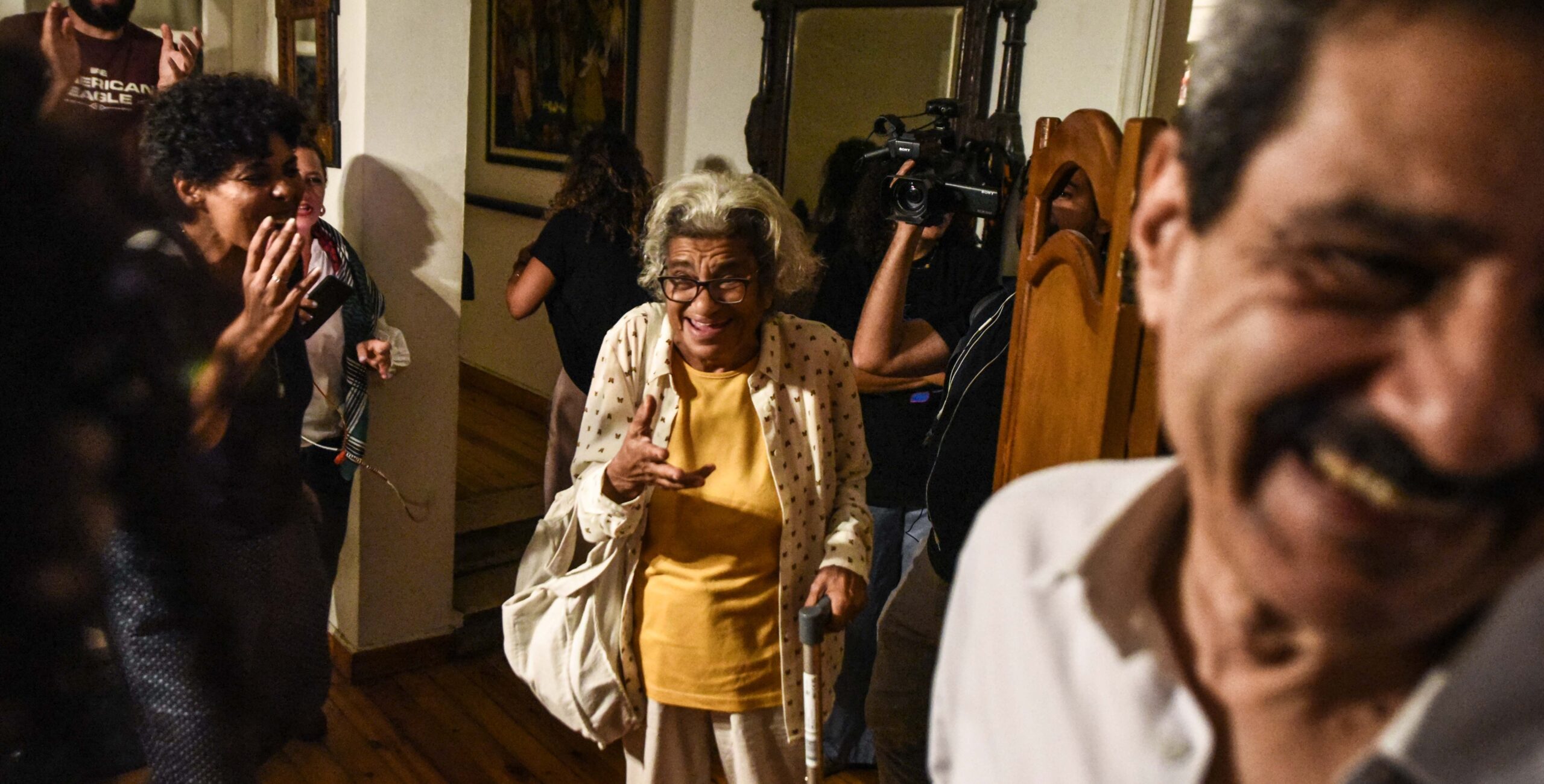
Freedom for Alaa at last
Alaa Abd El Fattah's family celebrated his release from prison early on Tuesday morning, almost six years after the day authorities detained…
Sisi orders authorities to review petition for Alaa Abd El Fattah’s release from prison
President Abdel Fattah al-Sisi instructed “relevant authorities” on Tuesday to look into the national rights council’s petition for amnesty to be granted…

Laila Soueif ends hunger strike amid concerns for her deteriorating health
Sanaa Seif stressed in her statement that Abd El Fattah is still committed to the partial hunger str
Your support is the only way to ensure independent, progressive journalism survives.
You have a right to access accurate information, be stimulated by innovative and nuanced reporting, and be moved by compelling storytelling. Subscribe now to become part of the growing community of members who help us maintain our editorial independence.
Join us