
Authorities delay newspaper from printing due to security concerns
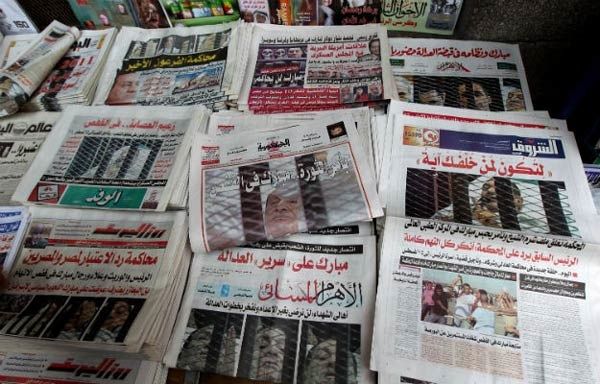
“Sovereign bodies” held the presses when the privately owned Al-Masreyoon’s Saturday issue went to print, the paper’s editor-in-chief Gamal Sultan told Mada Masr on Monday, due to "security concerns" regarding its content.
The authorities notified Sultan that the issue was being “reviewed” by security forces outside the Al-Ahram publishing house, where most of Egypt’s newspapers are printed, ultimately delaying publication by more than eight hours, he said.
“This is a flagrant violation of the Constitution. It is unbelievable that censorship in Egypt is reaching this level. Having people who censor newspapers while they are being printed is against all principles of free press,” Sultan argued.
The issue was cleared for printing without any editorial changes, “but the message was clear, for us and for everyone else: There is always someone watching,” Sultan said.
According to Sultan, the unnamed “sovereign bodies” were concerned with three items in the issue. His op-ed on former presidential candidate and Mubarak-era official Ahmed Shafiq’s relationship with President Abdel Fattah al-Sisi — in light of Shafiq’s residence in the United Arab Emirates, a major regional supporter of Sisi’s administration — was flagged for review.
Two other stories that caused concern included an article on Egypt's cooperation and the United States on the CIA’s rendition program, as well as a piece titled, “Why is Sisi afraid of the upcoming Parliament?”
Sultan circulated the issue’s front page on his official Twitter account, declaring the paper provoked a security crisis.
The Arabic Network for Human Rights Information (ANHRI) released a statement on Sunday decrying the incident as “more confiscation and censorship against press freedoms.”
“The freedom of the press in Egypt has come under severe siege, in light of the strict censorship imposed against it,” ANHRI warned.
“Banning the publication of a newspaper is a clear violation of the freedom of press. Such an approach was widespread during the era of ousted dictator Hosni Mubarak, yet it has returned as part of a series of violations of the freedom of the press, in an attempt to cover any opinion or criticism concerning the regime in Egypt, and to reestablish ‘red lines’ once again,” ANHRI added.
A similar incident took place in October, when the privately-owned Al-Masry Al-Youm (AMAY) newspaper attempted to publish an interview with a former intelligence officer.
AMAY was compelled to discard 40,000 editions that carried the article, and reprint the issue without the problematic interview.
AMAY had published five installments of its interview with Refaat Gibrael, a retired intelligence officer who passed away in 2009. The editor of the newspaper, Mohamed al-Sayed Saleh, conducted the interview a year and a half before the officer’s death.
According to Ahmed Ragab, the chief editor of AMAY’s online portal, the printing press received a call from intelligence services ordering them to stop printing Wednesday’s edition. The newspaper wasn’t able to resume printing until it removed the interview, he told Mada Masr at the time.
Article 80 of the Penal Code stipulates that “news, information, data and documents related to the nation’s intelligence and its activities, methods, personnel and anything connected to its duties in maintaining the peace and security of the state and its political system is considered a state secret, stipulated in Article 85 of the Penal Code, unless published by written permission from the head of the intelligence services.”
The media is restricted from publishing any information that might affect the intelligence services and their work. Section A of Article 80 stipulates a prison sentence of six months to five years, and a fine of LE100 to LE500 for violators of the law. The punishment is harsher during times of war.
However, there is no law that gives the intelligence services the right to halt the printing of any publication, rights lawyer Ahmed Ezzat told Mada Masr.
Halting printing and rescinding publications is a right only given to those with arrest powers, which do not include the intelligence services, according to Ezzat. He contended that such procedures are not based on laws, but rather on internal and administrative understandings.

أخبار ذات صلة

Beating the block: Mada Masr launches Tor mirror
This cat and mouse game has been going on for too long now.
Security directives instruct media to attack National Council for Human Rights
One message suggested that the head of the human rights council suffers from Alzheimer's Disease

Update: Security forces raid Al-Mesryoon newspaper, hand management over to state-owned publication
Security forces raided the headquarters of privately owned Al-Mesryoon newspaper on Monday

Chief editor of Al-Tahrir website accused of insulting judiciary, released on bail
Mohamed Fawzy was questioned Saturday concerning an article published on Egypt's judiciary
Your support is the only way to ensure independent, progressive journalism survives.
You have a right to access accurate information, be stimulated by innovative and nuanced reporting, and be moved by compelling storytelling. Subscribe now to become part of the growing community of members who help us maintain our editorial independence.
Join us