
After over 7 years’ detention in Egypt, 2 Eritrean migrants face deportation
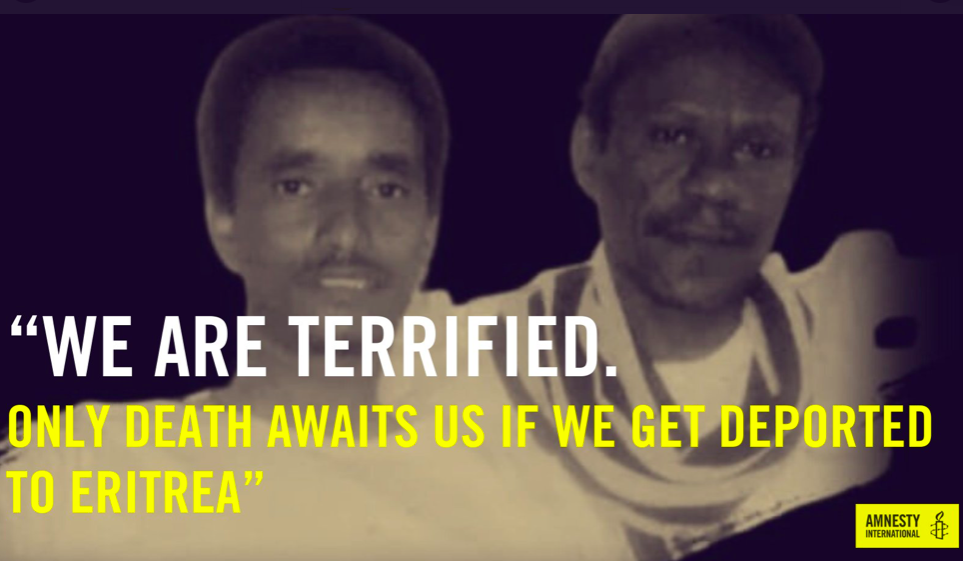
Two Eritrean nationals are facing deportation from Egypt within the next few days after over seven years’ detention in Qanater Men’s Prison, several sources and a lawyer told Mada Masr.
Authorities obliged the two men, named Alem Tesfay Abraham and Kibrom Adhanom, to take PCR tests at a hospital outside the prison on Thursday morning, informing them that they would be deported and forcing them to sign temporary Eritrean travel documents, an Eritrean national in Egypt who is following their case told Mada Masr on condition of anonymity.
Legal charges likely await Alem and Kibrom in Eritrea for fleeing the country without documentation and for evading compulsory military service, with a risk of facing life-threatening torture in prison if they are convicted, the lawyer and other sources said.
Both the first source and a lawyer who acted pro bono in their defense, who also spoke to Mada Masr on condition of anonymity, said that Alem Tesfay Abraham, 42, was arrested in March 2012 while seeking to reach Europe by crossing from Sudan, to Egypt and then to Libya. After trying to enter Libya via the Egyptian border town of Salloum, he was detained for days before being transferred to the foreign nationals' ward in Qanater Men’s Prison.
Kibrom Adhanom, 37, is the other Eritrean national facing deportation, the sources said, adding that Kibrom migrated from Eritrea to Sudan without documentation and was then kidnapped by human traffickers in July 2013 and taken to North Sinai. In December 2013, Kibrom's kidnappers thought he had died of injuries inflicted by torture and abandoned him. He was later found and handed over to the police. In September 2014, he was moved between various detention facilities and ultimately held in the foreign nationals ward in Qanater.
The lawyer said that Kibrom and Alem’s cases were presented to the Interior Ministry’s passports and migration department on a monthly basis, though no legal action was taken. When irregular migrants are detained, they are normally presented to a military court, receive a sentence, which is usually suspended, and then migrants can apply for asylum afterward, the lawyer continued.
“However, [Kibrom and Alem] were not even tried before a military court. They were arrested at a time when things were not under control,” said the lawyer, referring to the changes in government that occurred between the 2011 revolution, the Muslim Brotherhood’s accession to government in 2012, the military overthrow of the government in 2013 and President Abdel Fattah al-Sisi’s election in 2014. “The policy at the time was that migrants would be locked up a little and then let go, but [Kibrom and Alem] were forgotten,” the lawyer added.
In August 2020, the Egyptian government received a memorandum from the United Nations rapporteur on human rights in Eritrea requesting more information about the two migrants and any police reports or charges against them, according to Committee for Justice. The Eritrean national in Cairo who is following the case told Mada Masr that after the memo, Alem and Kibrom were physically assaulted by prison authorities who tore their clothes, reduced their food portions and obliged them to sign documents whose contents they did not understand.
Kibrom and Alem were also not helped to register with the United Nations High Commissioner for Refugees office throughout their detention, according to their lawyer. The lawyer said that the authorities and the UNHCR should have allowed them to register, adding that the office was aware that Kibrom and Alem wished to register but did not facilitate their registration.
In July this year, the lawyer, who was asked to take the case a few months ago by a group representing the Eritrean community in Egypt, headed to the passports and migration department to inquire about the two migrants’ legal situation, but was denied any information and told that any detainees pending a passports and migration division investigation are due to be deported, the lawyer said.
The lawyer told Mada Masr that there is a major shortcoming in Egypt’s regulatory framework around refugee and migration issues, including, for example, the absence of a legal pathway to challenge orders for deportation. The lawyer stressed, however, that even if migrants do not hold refugee status, their deportation is a violation of international conventions that are binding for Egypt, including the directives of the UNHCR against forced deportation in cases where the person may face a threat to their life or freedoms, or be subjected to discrimination or torture.
Mada Masr reviewed messages exchanged until Friday between Gebre Bahadori, a US-based activist in the Eritrean rights group Bayto Yiakl, and the UNHCR office in Cairo, in which Bahadori informed the office that Kibrom and Alem were facing deportation. The Cairo office’s protection department responded saying the office is following up on the case with the relevant authorities. Mada Masr tried to contact the office’s protection and information departments for comment, but was yet to receive a response at the time of publication.
In mid-August, two Eritrean embassy employees visited the two migrants during the regular passports and migration department visit and asked them to sign the deportation papers. When they refused, the prison administration took disciplinary action against them for a week, according to the first source. The incident was also confirmed by a London-based NGO called Human Rights Concern Eritrea, which is also following their case.
Mada Masr tried to contact the current UN human rights rapporteur in Eritrea, Mohamed Abdel Salam Babiker, to learn about the latest correspondence between him and the Egyptian government regarding the case, but has yet to receive a response at the time of writing.
If Alem and Kibrom return to Eritrea after fleeing the country without documentation and evading Eritrea’s compulsory conscription for military service they are likely to face legal charges, the lawyer said. Bahadori and Saba Heritage, another US-based activist in Bayto Yiakl, likewise told Mada Masr that Alem and Kibrom would likely face legal charges if returned to their country of origin. Heritage, Bahadori and the lawyer all said that the two men could face imprisonment and could be at risk of torture in Eritrea.
High rates of desertion or avoidance of conscription have been recorded among Eritreans pursuing irregular migration into nearby countries or to Europe. The country stipulates harsh prison sentences and even the death sentence for desertion taking place during times of war. A war between Eritrea and Ethiopia that began in 1998 was only officially brought to a conclusion in 2018.
On Saturday, Amnesty International's East Africa office called on Egypt to “halt the imminent deportation of Kibrom and Alem,” release them and allow them to apply for asylum. It is likely that the deportation was already set to take place on Saturday.
Writing by Ahmed Bakr
أخبار ذات صلة
Egypt deports Syrian asylum seeker, forcibly disappears 2 Egyptians of Ahmadi faith
Egyptian authorities deported a Syrian asylum seeker on Wednesday morning after detaining him incommunicado for over a month, Amnesty International Egypt Libya-focused…

ENHR: After deportation from Bahrain, 2 Egyptian opposition figures detained pending terrorism charges
Both Ajez and Hassanain had been legal residents of Bahrain for eight years

Human Rights Watch documents arrests, forced labor of dozens of Sudanese refugees in Egypt
The threat of deportation is a common practice against refugees of all African nationalities
Egyptian authorities prepare 24 Eritrean nationals for deportation
At least 200 Eritrean asylum seekers have been held in detention in Egypt since 2019
Your support is the only way to ensure independent, progressive journalism survives.
You have a right to access accurate information, be stimulated by innovative and nuanced reporting, and be moved by compelling storytelling. Subscribe now to become part of the growing community of members who help us maintain our editorial independence.
Join us