
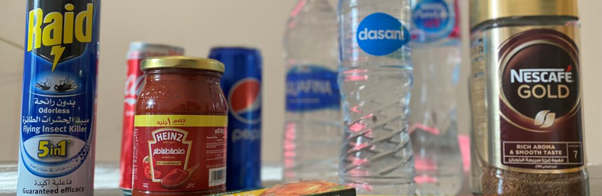
With grassroots boycott campaigns, consumers wield their weapon
Nine-year-old Aly Eddin’s logic is simple and straightforward, “A can of soda could buy bullets” that kill the children of Gaza. This is why Aly will longer buy this brand of soda or any product on the “list” of brands supporting Israel that he used to regularly consume.
Given the clarity and force of this reasoning, Aly’s commitment to the boycott is unshakeable. Heba, Aly’s mother, says that he has taken on the responsibility of managing the boycott process in their household, checking to see if any of the products coming into the house are on the list of products that should be boycotted in solidarity with Gaza. A few days ago, he came across a canister of Pyrosol, the popular insecticide. Thinking it was produced by Raid, a “listed company,” he alerted his mother, but she pointed out the difference between the two products. Likewise, Aly and his younger brother refuse to buy any food from McDonald’s.
“They really love McDonald’s,” his mother says. “They really crave it, but they refuse to buy it”

Neither Heba nor anyone in her family has ever been really active in support of any cause before, because she “really didn’t care,” she says, underlining her former indifference. She used to withdraw from any discussion on public issues. Her mother used to accuse her of ignorance, but she denies this. It wasn’t ignorance, she pushes back. Rather it was “sparing herself the headache,” as she puts it.
But not this time.
“This time, I really care that this madness stops,” she says. And for that reason, she is trying to find a role to play. Like millions of others, Heba has settled on the answer that her power resides in her role as a consumer in today’s world.
Calls for boycott have reverberated throughout the world over the past two decades. However, the current calls for boycotting Israeli products are unique from those over the last two decades, revealing the depth of the societal changes that have unfolded during these years and the gravity of the crisis we are presently facing.
Throughout history, boycotts have served as a weapon advocated by resistance and liberation movements across the globe. For instance, Jews called for boycotting Nazi German products. But perhaps the most famous is the Anti-Apartheid Movement's boycott in South Africa that spanned from the late 1950s to the early 1990s. Most of these movements appealed to a wide global audience with a straightforward logic akin to Aly Eddin’s: purchasing Nazi or South African Apartheid products supports their crimes, grants them legitimacy and enables their acts to persist. This is why everyone should boycott them to the best of their abilities. It is the least they can do.
The same stance applies to the boycott of Israel, a movement that has taken on different trajectories throughout its history. In the first decades after the Nakba, boycotting Israel was an official stance adopted by all Arab nations. Many of these countries had official boycott offices, as explained by Hazem Jamjoum, a Palestinian historian and activist in the Boycott, Divestment and Sanctions movement. These offices monitored permissible and prohibited products and companies engaged in normalizing relations with Israel. As a result, people did not have to pose the question of boycott to themselves. The state was doing it on their behalf.
But the question of individually managed boycott arose after some Arab countries started to ink peace treaties with Israel. I can recall this from my childhood. It was after the Oslo Accords signed by Yasser Arafat and Israel in 1993, which led to the establishment of the Palestinian Authority. The agreement came after a string of similar agreements set in motion by Egypt, followed by Jordan in the 1980s. It seemed that the official Arab stance was leaning toward normalization.
The Egyptian government was incentivizing some of its employees to relocate to North Sinai as part of the Sinai "reconstruction" plan after Egypt regained sovereignty over the peninsula and signed the peace treaty with Israel. Some members of my family responded to these incentives and made the move to Arish. This is why the coastal city near the Egyptian-Palestinian border became a family summer retreat in the mid-1990s.
In Arish, some Israeli products were sold in the local market — products with Hebrew writing on them, including various types of soap and shampoo. Tempted by the reasonable prices and high quality of the products, some members of my family started buying them, but my own family's stance was clear. We would never buy Israeli products that came directly from occupied land and bring them into our home. I remember a family debate about this position, which some considered extreme at the time.
Alongside the peace treaty with Israel, Egypt proceeded on its path of integration into the global market, and other markers of globalization began to appear. International restaurant chains began to open their branches throughout the country. Imported products became more available. With these developments, the Egyptian middle class started adopting a consumer behavior that was previously reserved to the wealthier classes.

Then the tides shifted with the eruption of the Second Intifada in 2000 and later, with the invasion of Afghanistan and Iraq in 2003. This is the moment when posing the question of boycott to the public in the Arab region became socially logical — newly fashioned consumers were looking for a role in the Arab countries that had started normalizing relations with Israel.
Boycott campaigns targeting American and Israeli products spread in Egypt, primarily adopted by the Muslim Brotherhood, the Popular Committee in Solidarity with the Palestinian Intifada, and the Egyptian anti-Globalization Group (AGEG). One could see posters bearing logos of various products with drops of blood on them from war victims, likening consuming Coca-Cola or Pepsi to drinking the blood of murdered children. The money that paid for these products — the posters made clear — could be the price of a bullet that could kill someone, just as Aly Eddin describes it. This discourse relies on a hidden power: we, as consumers, are a part of this whether we want to be or not. And for this reason, there is a role we must play.
Boycott discourse began to take shape in other Arab countries at the time. Some of these campaigns achieved a degree of success, but did not garner widespread popular support outside circles invested in the Palestinian cause, such as Islamists and leftists.
But the drive to boycott was not limited to Arab countries. In Europe and America, various groups started calling for boycotts. Although, there, the rationale was different. The strategies and tactics of these groups differed from their counterparts in Arab countries because they operated in contexts that were completely different in terms of their relationship with Israel and the Palestinian cause as a whole. But in Arab countries, normalization was brought about after the severance of ties with Israel, after the 1967 war. The West, however, had maintained relations with Israel since its existence, and the primary mission of the boycott campaigns in this context was to spread awareness.
The culmination of these efforts led to the establishment of the Boycott, Divestment, and Sanctions (BDS) movement in 2005, which was founded by dozens of popular unions, syndicates, parties, popular committees and Palestinian civil society organizations. In its founding statement, the movement called “to impose broad boycotts and implement divestment initiatives against Israel similar to those applied to South Africa in the apartheid era."
Different chapters of the BDS movement started to work across the world, each one with a specific strategy tailored to the context they worked in. There have been cross-border campaigns (such as the boycott campaigns against Puma sportswear or HP computers and printers) as well as national campaigns adding domestic pressure.
The movement has been active worldwide for nearly two decades, with impact and popularity waxing and waning. One of its major successes globally has been the academic and cultural boycott, with some relative successes (the most recent being the American Anthropological Association's resolution in July to boycott Israeli academic institutions). Economic boycott campaigns have remained a pillar in the movement.
However, the movement has faced criticism, even from supporters of the Palestinian cause. The most prominent one revolves around the argument that boycotts ultimately amount to individual acts that provide personal satisfaction to those who adhere to them, potentially deterring them from actively participating in the collective struggle against the Occupation through other available means. In other words, the criticism would have it that boycott is an individual act in line with liberal tendencies that separates the individual from the collective political struggle.
In some cases, calls for boycotts may actually be a feeble measure if the moment presents itself for greater action. Wael Gamal, an economic researcher and member of the AGEG campaign, recalls that two decades ago some considered boycott campaigns to be "a regressive act" because protests and popular mobilization for Palestine were permitted, thus making the focus on calls for boycott effectively "stay at home and boycott, don't take to the streets'' and therefore a step back.
In contrast to the more organized and politically mature boycott movement, there is a broader current that has gained momentum in recent weeks. It is the current of Heba and her son, Ali Eddin, and perhaps hundreds of thousands like them. It is based on the same logic: our only power lies in the fact that we are consumers.
These days, this current is informed by a unique emotional experience. Everyone expresses it time and again: a mixture of shock, disbelief, panic, and confusion. A mixture that always leads to anger, an anger they describe as being unparalleled in contemporary memory in its collective nature and intensity coloring every aspect of life for over a month, day and night.
Heba knows that social media networks existed during previous Israeli attacks on Gaza, but the news was never that "explicit." Even in 2014, during one of the largest Israeli attacks on Gaza, she does not recall experiencing events with this intensity. This time, "the catastrophe is too immense. The blood is too much" she says. "This time you feel like you're with them, that the bomb can fall on you."
Perhaps the world has really never known anything like this before. Comparing the number of casualties makes this clear. In the 2014 war on Gaza, which lasted six weeks, Israel killed about 2,300 Palestinians. This time, the number of Palestinians killed exceeded 12,000 in the first six weeks alone, around five times as many as in 2014. Weeks after weeks of an ongoing massacre. We live its vivid details every day, every moment, in living color. Thousands of rockets fall there, and we feel them here. This has not stopped for weeks, and it does not seem like it will stop anytime soon.
On the other hand, there seems to be no room for any activism beyond the internet. With the exception of a single day weeks ago, the Egyptian government does not allow any form of protest, not even within universities, which were once the traditional spaces for expressing anger over the events in Palestine. But none of this happens now. The potential price has become much greater. Any act of protest in Egypt now could easily lead to lengthy imprisonment.
It becomes logical in the midst of this powerlessness to resort to the internet to create and leverage networks to explore an "easy and safe" way of taking action, as Gamal puts it. The most ready at hand avenue at the moment is the power of consumption. Through various small but wide-ranging networks, calls for boycotts have garnered unprecedented popular support.
Yet, there is much more to the story. A lot has changed over the past two decades.
Developments in consumption patterns in recent years indicate the rise of what can be called the global consumer citizen. The defining aspect of this new citizen is that they share mutual aesthetic values, standards of excellence, and criteria for social distinction with similar consumer segments worldwide. This citizen in Egypt is the offspring of the ‘shopping mall’ generation, a citizen who recognizes the role of brands in shaping part of their identities, ideas and society.
The seeds of this new global consumer citizen were sown decades ago and triggered significant social changes. The state withdrew from its traditional responsibilities underwritten by a social contract, which granted it power in exchange for ensuring a minimum level of social care. Capitalism, in its Egyptian modality, expanded to occupy the spaces left behind by the state.
Each iteration of this new global consumer citizen has their mix of colors that make up their specific aura, a slightly different mix of colors when compared to other consumer citizens, but, for all intents and purposes, mostly the same. This general uniformity has been precipitated by the internet, which has spread brands and their attendant modes of expression across borders. But as the speed of exchange happened, new shades sprang to life: a fusion of the local and global, a K-pop, a Taylor Swift, global clothing brands, fast food consumption but with a local twist, international schools in Egypt— all aglitter in ever new hues.
During her years as a psychological, educational and art therapist, Salma Yakout observed a correlation between the rise of these consumerist tendencies in Egypt and the collapse of other values in people's lives. According to Yakout, all people search individually or collectively for a sense of worth, agency, freedom and security. These four values are fundamental to every person, family or community. However, over the past two decades, collective endeavors to uphold these values have collapsed. People have grown accustomed to calamities, such as the death of hundreds of citizens in the Salam ferry incident or the Ramses station fire. Even the revolution, once a collective dream with collective values, "blew up in our faces," as she puts it, after raising our hopes. Since then, the defeats have not stopped.
Consumption has become a fundamental tool to compensate for these values and emotions. "They purchase to comfort themselves," says Yakout. This is how the middle class has coped with all these crises, in her opinion.
However, with the start of the aggression on Gaza, Egyptian society faced a major shock, and consumption was no longer able to numb its existential crises. Suddenly, as Salma puts it, "no one could argue: there’s no worth, agency, freedom or security. People now have to face this."
Amid all of this, the idea of boycott presents a simple solution to these complex crises. Consumption itself is no longer capable of providing individual salvation, but weaponizing it gives it deeper meaning. Through boycotting, consumption transforms into struggle. It says: I exist. I have an impact.
From this moment on, boycott has become the answer to various individual, societal and political questions. For example, the UAE's stance on what is happening in Gaza has raised many reservations, after it went to great lengths to condemn Hamas's attack on Israel on October 7 and its hesitation in supporting the Palestinian people. The answer: "At a certain moment, there was talk of boycotting Abu Auf [a chain of food stores owned by an Emirati company that now holds the majority of its shares]," says Heba. “And I liked the idea."
The same goes for the dispute involving the actor Mohamed Sallam, who publicly called off his participation in a theater performance on account of the genocide in Gaza during the "Riyadh Season," the Saudi entertainment festival that launched a few days ago and sparked significant controversy due to the insensitivity of the timing. Salem's action garnered a great deal of sympathy, but it also led to the removal of a series he participated in from Shahid, a Saudi online broadcasting platform. Rumors circulated that the platform demanded his exclusion from future seasons of the show in exchange for making it available to stream again. In response, a boycott campaign against the platform was launched. "If I had Shahid, I would have boycotted them," Heba says. During the same festival, another actor stepped forward to attack Sallam, triggering a storm of anger and mockery aimed at him and prompting a boycott campaign against a restaurant he owns in Cairo.
It is akin to discovering a new weapon (maybe it is not appropriate to resort to an analogy from the world of weapons at the moment, but that is where reality and fiction are at now), one that can be held, contemplated and understood, one with the hopes of possessing a destructive capability that suits the extent of our anger. It is a weapon that a large segment of people are learning to wield for the first time at this scale. And like any weapon, people need some time to try it out, get used to it and understand the limits of its capabilities.
This was the case for Shorouk, who started the boycott on the second day of the Gaza bombardment. Initially, she did not know the list of products that should be boycotted. She began her research and realized the extent of the list. Dozens of major companies around the world, owning hundreds of famous brands, operate in or support Israel in one way or another.
The first challenge she faced was the lack of alternatives. Shorouk relies on a skincare product manufactured by L'Oréal, one of the companies on the boycott list, as it is the only product that works for her chronic eczema. And since there is no alternative, she knows she will not be able to boycott it.
This extends even to the most basic of products.
Heba also pointed out this issue. There is no alternative to Nescafe coffee or Heinz products. All types of stock cubes like Maggi and Knorr are on the boycott list.
Even if alternatives are available, they are mostly found in Cairo and to a lesser extent in other major cities. But outside central cities, they become much more scarce.
Heba's family stopped during their return from their hometown of Kafr El-Sheikh to Cairo, where they live, to buy mineral water bottles from a roadside kiosk. The seller only had Dasani and Aquafina, both of which are on the boycott list. They stopped at another one and asked for Egyptian bottled water. For Heba, in these cases, she would try to do without these goods altogether or only buy them when needed.
I asked her about the available brands of Egyptian bottled water, and she mentioned several brands, including Baraka. I explained to her that Baraka is owned by Nestle, which is also on the boycott list. This caused a confused silence, a silence carrying a sense of guilt over the few pounds that may have been spent on the company in the past weeks, a confusion that indicates the spontaneity of the movement and the lack of awareness around the complex relations of capitalist production chains.
Another example of this confusion is evident in what some people have been circulating online, calling for boycotting Heineken beer and replacing it with Stella. What many Stella lovers do not know is that the Ahram Beverages Company, which produces it, is now owned by the same international Heineken company.
This confusion becomes evident in questions raised by some around the impact of the boycott campaigns on Egyptian companies. Over the past weeks, the anti-boycott stance argues that many of the companies affected by the campaigns are Egyptian, only licensed to use international trademarks and operated by Egyptians. One of the most prominent examples in public discussions is McDonald's. For those adhering to this line of thought, boycotting these companies jeopardizes the livelihoods of hundreds of Egyptian employees.


Gamal, for instance, wonders about boycotting Egyptian companies involved in the QIZ agreement, which allows Egyptian products to enter the US market without tariffs or specified quotas if they contain at least 10.5 percent Israeli inputs. The list of these companies now includes more than 1,100 Egyptian companies.
This causes friction between the broad conviction of the boycott's importance now and the practical reality of the world we live and consume in. At the heart of this friction, questions arise about the intersection between the Egyptian and global nature of companies. The current moment’s grappling with these questions opens the door to a possible transformation of boycotting from a movement for individual salvation into a political discourse that distinguishes between strategy and tactics, defining its red lines and areas of compromise.
Shorouk, for instance, provides direct answers to the question of the intertwinement of Egyptian companies with global brands. For example, she says, "franchises can change their names, as happened in Russia. They can sever ties. They have solutions." The spread of the boycott movement presents an opportunity to revive local products. "Demand for local products is increasing, so it requires labor," she added.
The emphasis on local products represents one of the most important features of the boycott discourse that is now taking shape in Egypt. Boycotting Coca-Cola and Pepsi no longer means replacing them with Mecca Cola, the drink that spread from London during the first boycott two decades ago, but rather with Spiro Spathis, the old Egyptian drink that returned to the market years ago. Serious discussions are being held by many about the importance of supporting local products. Some shopping platforms have started to advocate for local products on their homepages. This local discourse does not necessarily originate from an Egyptian nationalist discourse but rather, most likely, from the effects of the increased spread of conscious and ethical capitalist consumption that characterizes the modern international consumer citizen.
The crystallization of the discourse in this manner has allowed Shorouk to move from boycotting everything to attempting to make choices that give the act of boycotting real political efficacy within a political framework that is more cohesive and informed. This has been facilitated by groups that are advocating for boycotting and are organizing their work. "This time, the issue is systematic. There are people compiling lists and conducting research," she says.
What Shorouk describes here are the opportunities that the current moment presents to create a more organized even if less broadly popular current, to formulate a political framework that can properly explore its own mission, objectives, and obstacles. .
There are millions of angry people looking for a roadmap that extends beyond all the social and political stagnation they have suffered for years.
Or maybe not. I asked Aly Eddin when he would stop boycotting. "When the issue is over," he firmly confirmed, "when Palestine triumphs."
As for me, amid my unbridled anger, I decided to boycott the TV show Seinfeld, my all-time favorite, after Jerry Seinfeld signed a letter supporting Israel. I stopped watching any episodes or clips online, and I also stopped using his jokes. I don't know what benefit will come from this, but I know deep inside that this is the right stance.
تقارير ذات صلة
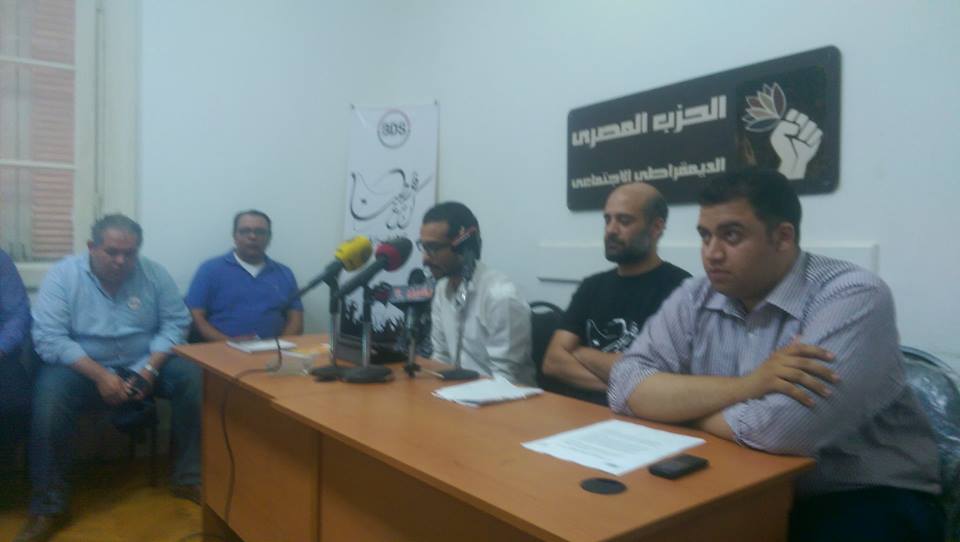
Campaign to boycott Israel kicks off with Mobinil
Egypt’s newly established initiative to boycott Israel kickstarted its activities with a campaign demanding telecoms provider Mobinil put pressure on its multinational owner, Orange, to end investments in Israel. …
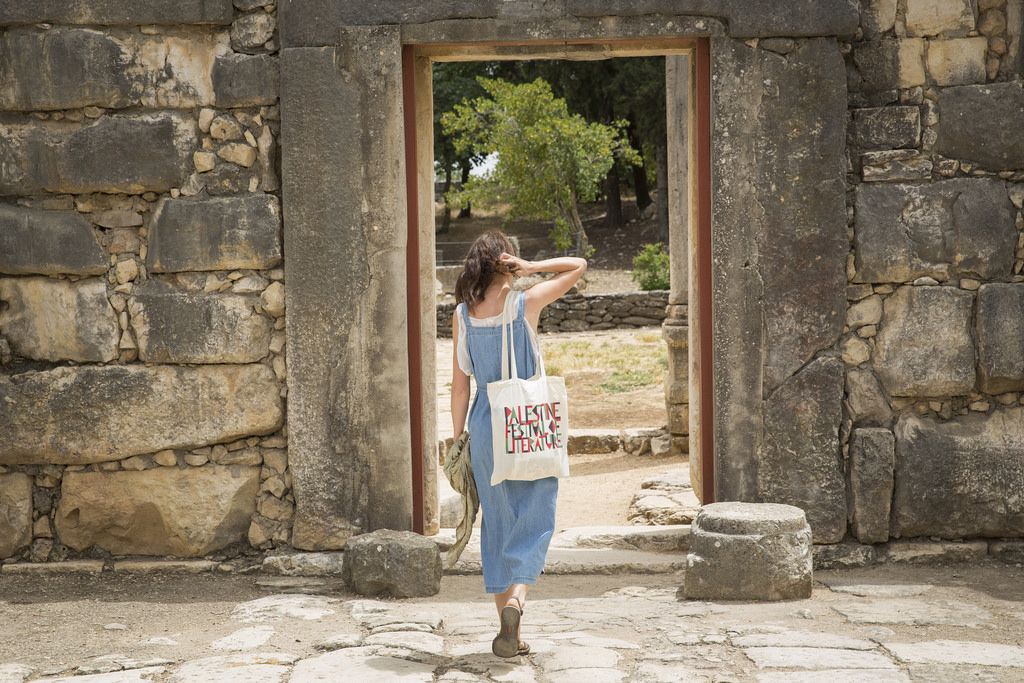
Crossing lines with PalFest
Ursula Lindsey's thoughtful piece on freedom of movement in Palestine and the importance of the annual literary festival there.

‘The camp has grown tighter around us’: Palestinian refugees in Lebanon between war and internal restrictions
In the early hours of Thursday, March 5, an Israeli aircraft struck an apartment near the Khalil al-Rahman Mosque in the Beddawi Palestinian refugee camp in northern Lebanon. The attack…
Your support is the only way to ensure independent, progressive journalism survives.
You have a right to access accurate information, be stimulated by innovative and nuanced reporting, and be moved by compelling storytelling. Subscribe now to become part of the growing community of members who help us maintain our editorial independence.
Join us