
Warrants, threats, 10 years waiting: An interview with lead counsel for Palestinian victims in ICC case
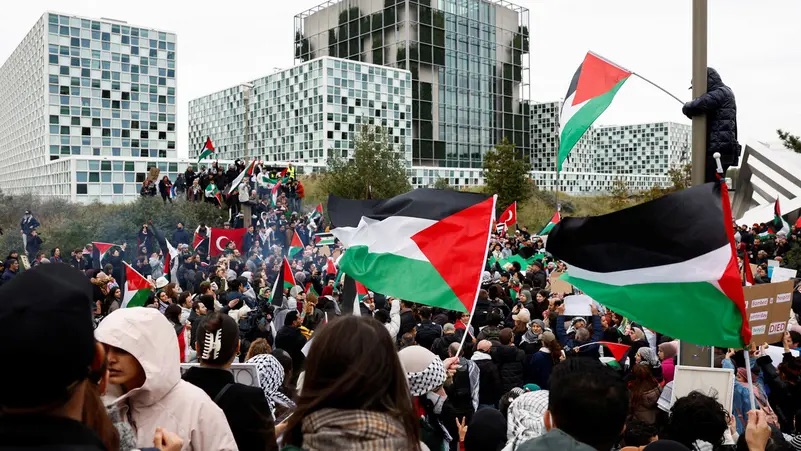
The International Criminal Court’s years-long investigation into crimes Israel committed in Palestine took its first step on Monday, with Prosecutor Karim Khan requesting the issuance of arrest warrants for Prime Minister Benjamin Netanyahu and Defense Minister Yoav Gallant and three Hamas military and political leaders: Yahya Sinwar, Ismail Haniyeh and Mohamed Deif.
Netanyahu and other Israeli figureheads rejected the decision and responded to the prosecutor’s request with disgust at being charged in parallel to the Hamas leaders, with Netanyahu calling it an “absurd” decision that “was meant to target all of Israel.” The Israeli reaction was echoed by US president Joe Biden and later Secretary of State Antony Blinken. The United Kingdom, Germany, Hungary, Czech Republic and Austria also joined the choir of rejecting or questioning the request for charging Israelis.
On the other side, Hamas also rejected the equivalence between its leaders and the Israeli government, calling it an attempt “to equate the victim with the executioner,” and demanded “the cancellation of all arrest warrants issued against leaders of the Palestinian resistance.” Other parties, like South Africa, Belgium and France, welcomed the ICC prosecutor’s decision.
Prior to the prosecutor's request being announced, US senators had threatened the ICC with sanctions should they issue an arrest warrant against Netanyahu or other Israeli leaders. “Target Israel and we will target you,” the senators wrote in a letter published April 24, threatening to sanction "employees and associates" and bar them and their families from the United States.
Following the American threats, the Arab Lawyers Union, which joined the ICC case on behalf Palestinian victims, issued a statement which criticized the stagnation of the court’s investigation. The statement urged the prosecutor to proceed with pressing charges and to call out the parties threatening him publicly. The union also warned of the potential additional war crimes the Occupation military may yet commit in its ongoing invasion of Rafah.
Before the warrant request was announced, Mada Masr sat down with the leading counsel of the ALU legal team representing Palestinian victims before the ICC, lawyer Yasser Hassan, to learn more about the progress of the investigations, the union’s position on the case and the implications of arrest warrants against Israel officials. The ICC prosecutor could still request additional warrants against other defendants in the case, Hassan added on Monday after the warrant requests came to light.
Can you tell us about the case before the ICC and how it began?
Yasser Hassan: The request to join the ICC and open the case was made by the Palestinian Authority in 2015. The case went through different stages, but in 2021 the ICC accepted Palestine as a member and decided that it has geographic jurisdiction. It also decided to investigate events starting from 2014. So, any events that could represent crimes and took place since 2014 fall under the court’s jurisdiction, as per the request of the PA. The court accepted Palestine as a state and decided that it has the right to investigate crimes that took place in this state.
The ICC prosecutes individuals, not states. It tries the political and military authorities as individuals, even the head of state, but not the state itself. The International Court of Justice is the one that can rule against a state.
Can you tell us what the Arab Lawyers Union team you are leading is doing in the ICC case?
YH: So far, we are working on representing Palestinian victims. Any Palestinian victims, whether individuals or organizations. For example, the Palestinian Journalists Syndicate has lost about 120 out of 174 journalists in Gaza — we can represent them individually or the syndicate as a whole. And we’re working with many victims already. We officially joined the case about a month and a half after October 7. I was involved and was following the case in an unofficial capacity before that.
So, the investigations into what is dubbed “the Situation in the State of Palestine” began in 2021. These investigations remain inside the prosecutor’s office. Now, the investigation into Ukraine led to an accusation of a defendant within three months. Why is the Palestine investigation taking three years so far?
So they have not been taking the investigations seriously?
YH: They only started the investigation after October 7, and they have only been dealing with specific events since then, too. He hasn’t been investigating the forced displacement or genocide, for example.
What changed after October 7?
YH: When October 7 took place, the prosecutor said that all the events around October 7 fall under the jurisdiction of the case. That means actions from both sides, not just one. He spoke of October 7 as in connection to both Israel and the Palestinian territories, and opened an investigation in both places.
He indeed met so-called Israeli victims in Jerusalem, he called them [victims], in December. And he also announced that he listened to Palestinian victims from the Shifa and Nasser medical complexes.
Here, it is important that the prosecutor does not ignore any crimes committed in Palestinian territories since 2014. This includes crimes against Palestinian prisoners, crimes resulting from the separation wall, resulting from kidnapping and torture, killing, forced and arbitrary imprisonment, displacement and any other crimes committed since that year.
That’s what you were saying in the union statement earlier this month…
YH: [The first point is that] he should not limit the case to what happened on October 7. This way he would be bypassing and violating the court decision, and failing to do justice to the victims. Like, if we have victims of illegal settlements since 2014, should they be not included because he is investigating October 7? No.
But his actions so far show that he is not doing that. That's important to us. Don’t say the case is about October 7, it starts in 2014. That's what we were saying in the statement.
The second point is to press charges against the real accused already. Do not bring in the wrong defendants or the wrong evidence and then end the case with acquittal. It must be investigated correctly. That was our second warning.
The third point is: Israel already committed many crimes, but if it enters Rafah, it will commit many more.
The fourth point is that if the situation results in Egyptian victims, we will act.
The ALU were accusing the ICC of inaction and laxity…
YH: This was directed at the prosecutor and his office. If he had acted earlier and named the accused, none of this would have happened. He did not work on the investigations, claiming that he was lacking funds. They don’t have money for Palestine but have plenty for Ukraine, apparently. I said in the text, “justice is not bought and sold.”
He’s saying, “we have no money” — what about the millions spent on the Ukraine investigation? Where did they come from then? And if he says donations, why isn’t he fundraising for the Palestine investigation? Because his response might be that these were donations directed at Ukraine. Okay, fine, but why not work on donations for Palestine?
Why did he go to Jerusalem to meet the Israelis released in the prisoner swap deal, but not meet the Palestinians victims in the hospitals when he visited Egypt? Why not visit the UAE? There are Palestinian victims in both countries, all of them people who got out for treatment, why didn’t he go to meet them? They’re currently in states that don’t have an issue and that opened their borders to him and which he visited before.
He also relied on satellite images as evidenced in cases such as Ukraine’s. Why not use the same techniques in Palestine?
And the Palestine case has been going on for longer…
YH: Way before Ukraine. The case first started in 2015, there was no Ukraine case back then. And the prosecutor has been involved in all court decisions since 2015 until today, and, since 2021, has an obligation to investigate, still before Ukraine, so why is he not working on the case?
You said in the statement that they’re very late to act compared to similar previous cases…
YH: Very much so. We’re relying on the example of the Ukraine case. [We want] them to do for our case all the things they did in the Ukraine case. That’s our goal.
But in light of this handling of the case, what is expected from the ICC and what are the limits on international courts’ actions?
YH: I mean, there are people who criticize international courts. Okay, attack them all you want. But in the end, this is a long road that requires a lot of effort. Either take it, or stay silent. And we decided to take up this battle. And if they fail to do their job, we’ll keep going after them. If they are negligent, we’ll keep bringing evidence. That’s how it works.
But Israel has ignored previous provisional measures and the UNSC resolution…
YH: That is true, but I don’t deal with politics, I only deal with the law. I have a crime, its victims and the affected. I represent the victims and affected. And I must take every legal path to obtain justice for them.
You told us before that an accumulation of rulings against the Occupation can weaken its position…
YH: There is no doubt about this. If the ICC does press charges against Israeli officials, it will be a serious crisis for them. Putin himself could not attend the BRICS summit due to the ICC arrest warrant, and skipped the UN General Assembly meeting as well. It would be the same for the Israeli officials. Israeli President Isaac Herzog canceled a visit to the Netherlands that was supposed to happen about three months ago. He was warned that any EU court with an international jurisdiction can press charges against him, such as what Belgium did to [former Israeli Prime Minister] Ariel Sharon.
A long time ago, Belgium charged Sharon for the Sabra and Shatila massacre and issued an arrest warrant, though the case was later legally settled. [Former Israeli Foreign Minister] Tzipi Livni was once also locked in her airplane and told she would be arrested if she stepped into the airport [in the UK] for war crime arrest warrants.
So, arrest warrants would mean a limit on the movement of Israeli leaders out of fear of arrest in other countries.
YH: Exactly. I am almost sure that no less than 15 to 20 top Israeli leaders will not be able to move around normally.
Is the ICC prosecutor’s slowness to act also related to the threats from US Republican senators?
YH: Not at all. He wasn’t facing any threats in 2021, the threat came in 2024. By the way, he also received threats from Putin in 2023, but still decided to press charges in the Ukraine case. It is the same scenario.
If you look through the ICC website, you’ll find statements from the court judges and the Assembly of States Parties directly naming and condemning the threats attributed to Russia. What about the threats attributed to the US?
The ICC did not address the US directly in the response to the US threat, right? You noted this in the statement.
YH: They did not say who made the threat in the statement, that is why we did not name them in ours either. We said it came from a state that has the right to appeal court decisions. But we ask him to name the state making the threats, like he did before. When Russia threatened them, they announced it and took counter measures. Why not do the same to the US?
Earlier in your statement, you mention while going over the destruction caused by the Occupation that lawyers were threatened for declaring solidarity on social media?
YH: That’s true. Lawyers who are 1948 Palestinians with Israeli citizenship are members of the Israeli Bar Association. When they started opposing [the war], they were notified that anyone who addresses the war on social media will be subject to disciplinary penalties.
And regarding representing future Egyptian victims, you mean in case the Occupation expands the Rafah operation?
YH: Let’s say there is a massive attack on Rafah and white phosphorus was used, accidental shooting [at Egyptians] took place or they destroyed or even invaded Egyptian Rafah. There would be Egyptian victims in this case, so we plan to represent them [before the ICC] as well. The effects of the military operation would represent harm to us, so it would give us the legal status to pursue the case.
تقارير ذات صلة

Gaza’s phase two arrives. Kind of …
Consensus over key questions lags behind the United States' announcement of progress.

Gaza’s child amputees

Israel finally approves Egypt’s gas deal after nail-biting battle
In an unexpected move, Israeli Prime Minister Benjamin Netanyahu announced on Wednesday Israel’s final approval of a controversial gas export deal with Egypt, months after Israeli hesitation following the initial…
Your support is the only way to ensure independent, progressive journalism survives.
You have a right to access accurate information, be stimulated by innovative and nuanced reporting, and be moved by compelling storytelling. Subscribe now to become part of the growing community of members who help us maintain our editorial independence.
Join us