
The question of intent: Discourse as evidence in the case against Israel
South Africa’s case accusing Israel of committing genocide in Gaza hinges primarily on the ability to prove intent. That is to say, the existence of a deliberate intent to commit genocide is the demarcation line between genocide and mass killing. While the latter is considered collateral damage, the former is the most egregious of war crimes, the plausibility of which should mandate an immediate and permanent ceasefire. Accordingly, the legal teams of South Africa and Israel have employed different strategies to prove and disprove, respectively, the presence of genocidal intent in the ongoing war.
'Netanyahu you can’t hide. We charge you with genocide.'
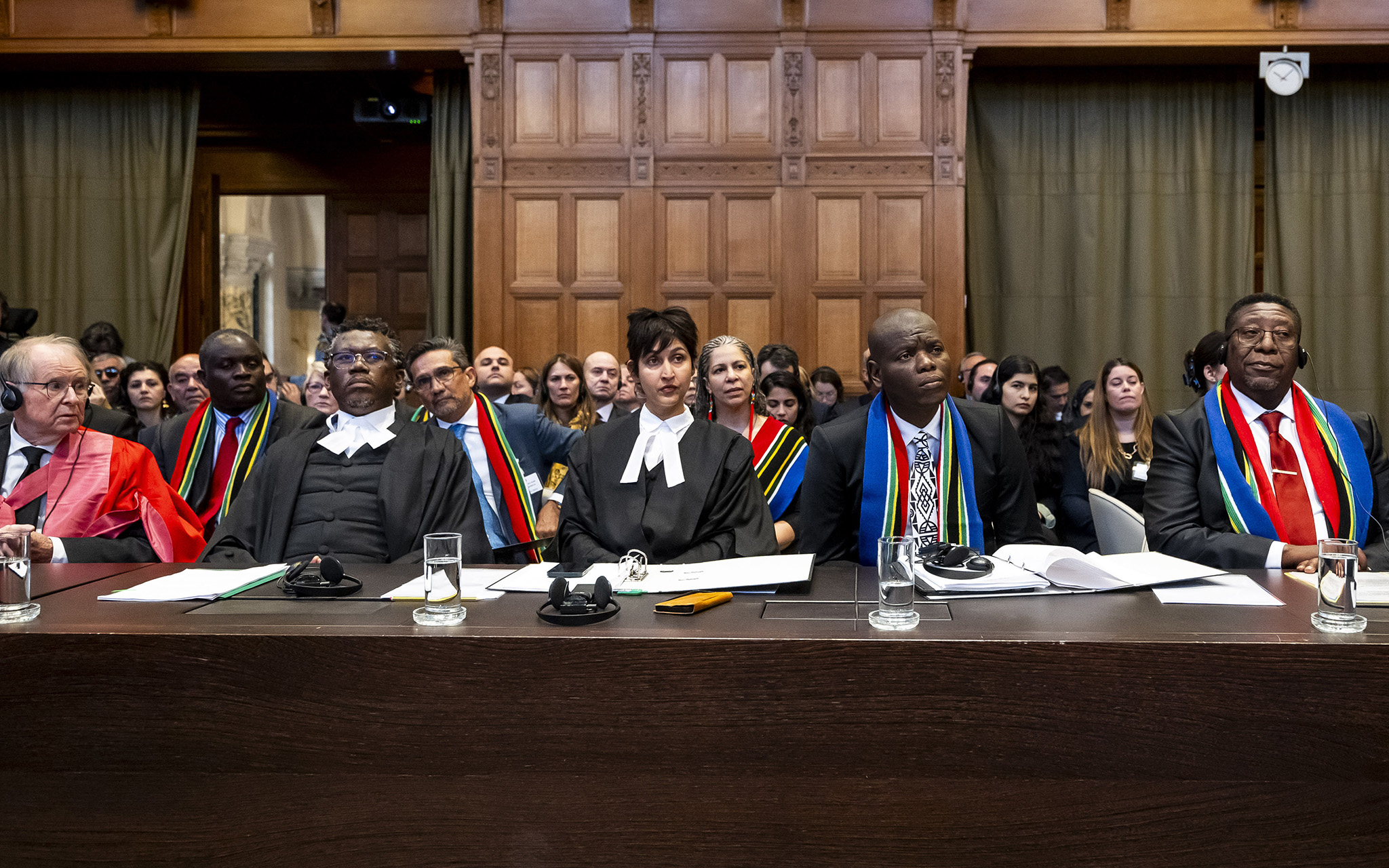
Long before South Africa filed a case at the International Court of Justice against Israel, protesters around the world accused Israel of genocide. The reason was simple: the intensity of air raids, the bombings, the mass killing, the wounding, and the targeting of hospitals, schools, alleged safe zones, UN premises, mosques, and churches spoke of the Israeli determination to drain life out of Gaza. Adila Hassim voiced this simple and straightforward observation in her speech during the first day of the court proceedings. Hassim illustrated the “pattern of genocidal conduct” that Israel has been inflicting on Palestinians in Gaza for the past three months. A pattern entails repetition: 24,285 Gazans killed, 61,154 seriously wounded, 1.9 million displaced, 290,000 homes demolished, 23 hospitals bombed, 104 schools damaged and tons of aid blocked, leaving 577,000 Gazans starving.
Hassim’s plea was followed and complemented by Tembeka Ngcukaitobi’s presentation, in which he emphasized the link between the genocidal statements made by Israeli officials and the actions of soldiers on the battlefield. Ngcukaitobi quoted statements made by the Israeli prime minister: “Remember what Amalek has done to you.” By the Israeli president: “This rhetoric about civilians not aware, not involved, is absolutely not true [...] We will fight until we break their backbone.” By the Israeli defense minister: “there would be no electricity, no food, no water, no fuel. Everything would be closed,” because Israel is “fighting human animals.” By the Israeli military’s coordinator of government activities in the territories: “Israel has imposed a total blockade on Gaza, no electricity, no water, just damage. You wanted hell, you will get hell.” By the Israeli heritage minister: “Israel must find ways for Gazans that are more painful than death.” By the Israeli national security minister: “when we say that Hamas should be destroyed, it also means those who celebrate, those who support, and those who hand out candy — they’re all terrorists, and they should also be destroyed.”
Down the hierarchy, Israeli soldiers echoed and responded to the message. Ngcukaitobi played a video of Israeli soldiers dancing and singing: “We know our motto: there are no uninvolved.” He showed them saying that they obey one commandment “to wipe off the seed of Amalek.” In various instances, they say: “May their village burn. May Gaza be erased;” “We will destroy all of Khan Younes and this house;” “We will blow it up for you and for everything you do for us;” and after destroying Al-Azhar University, “once upon a time there was a university in Gaza — and in practice a school for murderers and human animals.”
The list of quotes that Ngcukaitobi presented further includes statements made by Knesset members, journalists and singers, all of which explicitly demand wiping Gaza off the face of the earth. Most of the quotes are concerned with justifying the killing of civilians alongside armed combatants.[1] When you listen to Ngcukaitobi’s speech, you cannot help but feel that you are in the middle of a busy room whose occupants are enraged and thirsty for retaliation. The vocalization of these statements one after another speaks of a pervasive discourse that permeates the different layers of the Israeli state and Israeli society. The fact that soldiers echo and enact the statements of their leadership is evidence that such statements are, in fact, state policies targeted at the people of Gaza, irrespective of their civilian or military status.
In response, Malcolm Shaw from the Israeli legal team employed two strategies to counteract Ngcukaitobi’s argument. The first was shrinking the circle of accountability to the Ministerial Committee on National Security and the War Cabinet because, for Shaw, these entities were entrusted with setting the policy of Israel’s military operation on Gaza. He thus claims that the intentions of the Israeli state can only be determined by analyzing the statements made by these two parties.
The second strategy was to counteract the list of quotes presented by Ngcukaitobi by including some statements from what Shaw called “ official and relevant authorities.” These statements included the prime minister’s instructions in a national security committee meeting on October 29 to “the possible sorts of solutions that will ensure required supply of water, food and medicine: increasing the amount of trucks entering, [with] the necessary inspections” and to “promoting the construction of field hospitals in the south of the Gaza Strip.” Shaw also cited the Israeli Occupation Forces’ daily operational directive stating that “Attacks will be solely directed towards military targets, while adhering to the principles of distinction, proportionality and the obligation taking precautions in attacks in order to reduce collateral damage.” The directive continues: “the laws of armed conflict allow destruction to civilian property only when there is a military necessity to do so,” and “is necessary to treat enemy civilians with respect, they should not be treated in a humiliating manner” Shaw further emphasized two quotes by the prime minister, one from his speech on November 23 in a meeting with the Spanish and Belgium prime ministers, where he said, “Any civilian death is a tragedy. Anyone” and his statement on October 28, where he made the Biblical reference to the Amalek. Shaw accused Ngcukaitobi of not understanding the Jewish meaning of the Biblical reference, but Shaw did not make any effort to explain to the non-Jewish world the real significance of the Amalek in Jewish theology.[2]
But, the dispute over meaning is not limited to Biblical reference. The kernel of the dispute between Ngcukaitobi and Shaw is whether discourse plays any role in the battlefield. More important is the question of seriousness and consequentiality. Which utterances are more important and are likely to affect the soldiers’ actions, the minutes of a meeting of the national security committee or talk shows hosting the minister of heritage? It might surprise the reader that the answers to these questions cannot be found in law but are more proper to the fields of semiotics and literary studies.
'From the river to the sea, Palestine will be free.'
How do you understand the above slogan? This is a more complex question than you might have thought initially. If you copy and paste this slogan into Google Translate, the engine will translate each word to its equivalent in the language of your choice. If you translate it into Arabic, this is how it will read:
من النهر إلى البحر ستتحرر فلسطين
This literal translation assumes that the meaning of words exists in the dictionary, a stable system of signification or a language storehouse where you examine and select the words you need to convey your desired meaning. Note here that what makes this sentence communicable is the accessibility of the language system/dictionary/storehouse. If the dictionary were the private property of any one individual, this individual’s language would not make sense to others who can’t access this language’s storehouse. The important thing here is that the meaning of this sentence is external to it: It is only decipherable in a language system that belongs to everyone.
But if you are a native speaker of Arabic, this translation won’t satisfy you. First and foremost, the Arabic translation does not rhyme as it does in the English original, which is slightly unsettling. And it is unsettling because the rhyme in the English sentence is part and parcel of its function as a chanted slogan. Though the Arabic translation preserves the meaning, it does not translate the context. If you encounter this sentence written in Arabic for the first time, you might think it is a prophecy or a future plan, which it is not exactly. This means that meaning does not exist only in the dictionary but also in the context of the utterance, in this case, the protest.
Now, imagine that you are a tourist in one of the open-air buses touring San Francisco. You speak English fluently, but you know nothing about the Middle East. The bus passes by a protest, and you hear the people in the street chanting this slogan. Here, although you understand the words and can clearly see the context of their utterances, you won’t quite understand the meaning unless someone provides you with a map and points out the referenced river and sea. Also, once you locate Palestine on the map, you will need to look up the country’s history to know something about the conflict carried within the confines of the slogan. Here, the slogan, as a text, referred you to at least two other texts: geographical and historical. The meaning of the slogan does not exist in one or another text. It exists between texts, a concept that goes by the fancy name intertextuality. In the case of this slogan, you are lucky because you can locate the texts that contribute to the meaning-making. However, at some other times, the meaning of a text is embedded in a dense web of cultural references that cannot be easily mapped out.
Now, I arrive at the most important point in this theoretical background, which is the role of discourse in determining meaning. You are the same curious tourist and have decided to look up the chant you heard in the protest. The search engine will direct you to multiple entries from Israeli, Arab, and international media news agencies. Your first search result will explain that:
“From the River to the Sea, Palestine Will Be Free” is a rallying cry for terrorist groups and their sympathizers, from the Popular Front for the Liberation of Palestine (PFLP) to Hamas, which called for Israel’s destruction in its original governing charter in 1988 and was responsible for the October 7, 2023 terror attack on Israeli civilians, murdering over 1,200 people in the single deadliest day for Jews since the Holocaust. It is also a common call-to-arms for pro-Palestinian activists, especially student activists on college campuses. It calls for the establishment of a State of Palestine from the Jordan River to the Mediterranean Sea, erasing the State of Israel and its people.” [3]
As an impartial observer, you might be initially alarmed by the sudden presentation of information that incites feelings of urgency and threat. Then, maybe on a second reading, you will be surprised because this explanation bears little resemblance to the very words of the slogan. First, the explanation identifies specific and homogenous political groups that use the slogan and describes them as terrorists. It also singles out a particular text, the Hamas charter of 1988, and asserts that this text alone contains the true meaning of the slogan, even though the words do not establish or imply this connection in any shape or form. Additionally, it juxtaposes the attack of October 7 with the Holocaust, blurring the difference between a military operation and hostage-taking with concentration camps. It further claims that the slogan is a call to arms to destroy the Israeli state and people, although, again, the words can hardly be made to imply violence. But maybe the most astounding thing about this explanation is that it completely obliterates the word “free” and its opposite, “occupied.”
If you review every entry from Israeli and some international media outlets, you will read different iterations of this narrative. Together, these entries and others form a discourse. Roughly speaking, a discourse is a way that determines how we think and talk about certain things. A more theoretical definition of the word would identify specific elements that have to exist for a discourse to be created: (1) A discourse is constituted of “groupings of statements, which (2) have some institutional force, which means (3) that they have a profound influence on the way that individuals act and think.[4] What we have seen so far in this example is a grouping of statements, but, for these statements to become a discourse, two other conditions must be fulfilled. An example that best illustrates the institutional force of discourse and how it shapes how people think and act is found in the congressional hearing held last December for the presidents of Harvard and Penn Universities.
On December 5, 2023, the presidents of both universities were summoned before the House Committee on Education and the Workforce to defend themselves and their institutions against the allegations of antisemitism that their administrations faced after their initial statements on the war in Gaza failed to condemn Hamas directly. In her questioning, Congresswoman Elise Stefanik wanted to press the presidents of both universities to say that calling for the genocide of Jews violates both universities’ rules and codes of conduct. And when Claudine Gay, Harvard’s president at the time, said that there were no calls for the genocide of Jews on her campus, the following exchange took place:
Congresswoman: Let me ask you this: you are president of Harvard so I assume you are familiar with the term “Intifada,” correct?
Gay: I've heard that term, yes.
Congresswoman: And you understand that the use of the term “intifada” in the context of the Israeli-Arab conflict is indeed a call for violent armed resistance against the State of Israel, including violence against civilians and the genocide of Jews. Are you aware of that?
Gay: “That type of hateful speech is personally abhorrent to me.”
Congresswoman: And there have been multiple marches at Harvard with student chanting “There is only one solution. Intifada revolution” and “Globalize the Intifada,” is that correct?
Gay: I’ve heard that thoughtless, reckless, and hateful language on our campus, yes.
Congresswoman: So based upon your testimony, you understand that this call for intifada is to commit genocide against the Jewish people in Israel and globally, correct?[5]
Of course, the first thought that would occur to any Arab listening or reading this is that this is not what the word intifada means or what Arabs imply by it, but we will come to this in a minute. The critical thing to note, here, is that this grouping of statements we find in the media and the congresswoman’s speech actually has institutional power. In this example, we see how a certain definition of antisemitism had the power to summon Gay before Congress to defend herself. Moreover, this discourse had the power to force Gay to resign because the donors, on whose money the university sustains itself, threatened to withdraw funding the institution if Gay completed her term. Also, let’s briefly contemplate the figure of Stefanik, the congresswoman whom we meet briefly in those lines. Various news channels described Stefanik’s questioning style as “grilling” the presidents of both universities. Confidently and angrily, she attacked the presidents of two leading educational institutions when they “failed” to respond to her “simple” questions about genocide. Stefanik is a clear example of how discourse influences people’s thoughts and actions. Its power was on full display last month in Capitol Hall.
One last point should be made before I conclude this theoretical background, which concerns how any given discourse determines its territorial boundaries by exclusion. I have already alluded to this when I noted how the online entry that explains the meaning of “from the river to the sea, Palestine will be free” completely excluded the words “freedom” and “occupation” from the explanation. Similarly, in the congressional hearing, the congresswoman asserts that the word intifada signifies the desire and intent to genocide all Jews. This assertion totally excludes what the Palestinians and Arabs mean by intifada as indicating the desire and intent to resist occupation. Note how the Israeli definition of the word excludes its historical context, implying that the conflict between Israelis and Palestinians is both religious and eternal. This exclusion delimits the perspective by which the people who fall under the influence of this discourse can imagine, evaluate, think about, speak of, and act upon the conflict. The exclusion of “occupation” automatically obfuscates the word “resistance.” What we are left with, of course, is “the sons of darkness,”[6] who, in the prime minister’s speech on November 23, “are not fighting for this or that territory; they're fighting to eliminate the Jewish state in whatever boundary.”[7] To exclude the political reasons that led to the war is to exclude the political possibilities to end it. What remains is the biblical narrative of war, where God commands his people angrily to “to wipe off the seed of Amalek.”[8]
I started this theoretical overview by saying that the meaning of any statement is external to it. Throughout the 20th century, scholars have battled to try to locate the structures from which we derive meaning. In the example of this slogan, we have seen how the different structures of meaning, whether the language system, the situation of utterance, or the intertextual space, cooperate and overlap seamlessly for an utterance to have any significance. What the theory of discourse adds to such theories is that discourse limits the field of signification for any given utterance. The institutional force of the statements that comprise the discourse restricts the field of our vision and distorts the very meaning of the words we speak and interpret.
What the legal team of South Africa attempted to prove is the presence of a genocidal discourse, which is a grouping of statements that have the institutional power of the Israeli State, the IOF, the Knesset, and Israeli cultural institutions, that shape how the soldiers on the battlefield think and act. What the Israeli legal team, on the other hand, did was an attempt to undo the very idea of discourse. The argument of Israel’s legal team rested primarily on denying the existence of the genocidal intent by denying the existence of a genocidal discourse that first and foremost distorts the definition of “civilians.” As the statements quoted in Ngcukaitobi’s plea show, the word civilians is substituted for “terrorists,” “human animals,” and “murderers'' who should be starved, dehumanized, tortured, humiliated, and destroyed. These are not random quotes, as Shaw repeatedly claimed. These are groupings of statements that have the institutional power of the Israeli state and the world’s current empire, which vetoed the UN ceasefire resolution, allowing for the genocide to continue. And it indeed continued, and the TikTok videos that the Israeli soldiers filmed from the battlefield are evidence of how the genocidal discourse influenced the way they think about and act upon a particular understanding of the word civilian.
Shaw’s second move was to counter the effect and intensity of the statements quoted in Ngcukaitobi’s plea by presenting a grouping of other statements made by the prime minister and the leadership of the IOF that reflect their concern about civilians. By now, I assume that my reader has all the tools to assess if this grouping of statements qualifies as an anti-genocide discourse. The statements are made by top officials in the Israeli state. However, the institutional force of any statement does not emanate from the person who said it but from the actual force that converts those statements into conduct. So, when the prime minister instructs that more aid trucks should be allowed in, his statement is qualified as part of an anti-genocidal discourse ONLY if evidence is provided that the number of people dying of hunger and the lack of medical supplies has decreased. Anything short of this is lacking intent. In Shaw’s own words then, it resembles: “Hamlet without the Prince; a car without an engine.”
--
[1] For the full oral argument of South Africa, watch the public hearing of South Africa v. Israel at the International Court of Justice: https://webtv.un.org/en/asset/k11/k11gf661b3?fbclid=IwAR11xXugZk0yhoVGrLrAgwBcDT9NCE5_FPOetQdXXwifcL5pF7mXrLuTAgU
[2] For the full oral argument of Israel, watch the public hearing of Israel v. South Africa at the International Court of Justice: https://webtv.un.org/en/asset/k1c/k1c10lsjoq?fbclid=IwAR1oEZxfLsT2_ulOIuvF3kagdegKBlDtT-7Mm8Gz4z4kQyOyECvsZ5vpbE8
[3] “From the river to the sea,” in American Jewish Committee. Retrieved at: https://www.ajc.org/translatehate/From-the-River-to-the-Sea
[4] Mills, Sara. Discourse. 2nd Edition. Milton: Routledge, 2004. P. 62
[5] “BREAKING: Elise Stefanik Absolutely Explodes At Harvard's President And Calls For Her Resignation.” Forbes Breaking News. Retrieved at: BREAKING: Elise Stefanik Absolutely Explodes At Harvard's President And Calls For Her Resignation
[6] Netanyahu: "We are sons of light, they are sons of darkness." Euronews. Retrieved at: Netanyahu: "We are sons of light, they are sons of darkness"
[7] “PM Netanyahu meets with Spanish PM Sanchez and Belgian PM De Croo.” Ministry of Foreign Affairs. November 23,2023. Retrieved in: https://www.gov.il/en/departments/news/pm-netanyahu-meets-with-spanish-pm-sanchez-and-belgian-pm-de-croo-23-nov-2023
[8] “Israeli Soldiers Chant About Wiping Out Palestinians.” The Young Turks. Retrieved at: https://www.youtube.com/watch?v=-wY6GKu6jBc
تقارير ذات صلة

Gaza’s phase two arrives. Kind of …
Consensus over key questions lags behind the United States' announcement of progress.

Gaza’s child amputees

Israel finally approves Egypt’s gas deal after nail-biting battle
In an unexpected move, Israeli Prime Minister Benjamin Netanyahu announced on Wednesday Israel’s final approval of a controversial gas export deal with Egypt, months after Israeli hesitation following the initial…
Your support is the only way to ensure independent, progressive journalism survives.
You have a right to access accurate information, be stimulated by innovative and nuanced reporting, and be moved by compelling storytelling. Subscribe now to become part of the growing community of members who help us maintain our editorial independence.
Join us