
The Pylos shipwreck, the disappearing blue rope, and the trial ‘to determine the kind of world we want to live in’
Recounting the events of the horrific summer night he and nearly 750 others lived through in the middle of the Mediterranean in 2023, Magdy* was still shaken not only by the shipwreck he survived a few months before, but also by what caused it.
“How can a boat that claims it came to save us drag us like that and throw us into the water? It’s just common sense — how do you tow a boat carrying 750 people?” Magdy said, describing what the Greek coast guard’s vessel did in the minutes before one of the deadliest shipwrecks to ever take place in the Mediterranean.
“The boat arrived and began pulling us with a rope. After just one pull, then another, I was thrown off balance — and the next thing I knew, I was deep in the sea,” he continued, speaking over a payphone from a Greek prison one year after the shipwreck, after he was initially accused, along with eight other Egyptians, of causing it.
While the charges against Magdy and the others were eventually dropped, over the course of a year on from the wreck, his account of the coast guard’s responsibility in the boat’s capsizing was ignored by the investigating authorities. In fact, Greek authorities turned a blind eye to similar testimonies by many of the 102 other survivors in the months following the wreck, where they explicitly said that the coast guard tied a rope to the Adriana, their fishing boat in distress, and it was the rope that eventually led to its capsizing.
Met by these accusations, the Greek coast guard has made systematic efforts to reject and, at times, silence witness testimonies.
The Adriana sank off the coast of Pylos, a town in southwestern Greece, in June 2023, carrying nearly 200 Egyptians, some Syrian and Palestinian nationals and hundreds of other migrants. Other than the survivors and the 82 bodies recovered, more than 500 others are still missing and have now been presumed dead.
As migration has become an increasingly charged political issue in Europe, European countries have resorted to paying North African states and other countries along the Mediterranean to crack down on the rising number of people attempting to cross into Europe by sea over the last decade.
When that form of external migration control fails, many of these European destination countries engage in pushbacks.
Recorded examples of pushbacks in recent years point to recurring patterns, often involving the construction of physical barriers such as fences or walls or the towing of migrant boats away from a destination country’s territorial waters.
These practices, carried out by European authorities and external border agencies, also usually involve excessive use of force, inhumane treatment and sometimes arbitrary detention of migrants, with the aim of forcing them back to the countries they departed from and thus preventing them from making asylum claims in Europe.
In those first moments after the ship sank, concerns over the possibility of a pushback swirled in the press. Those concerns were pushed aside by Greek authorities, who urged caution and for the need to carry out a proper investigation. Even as they took to formal channels to amplify this impartiality, however, accounts were already beginning to emerge from survivors that the coast guard had played a role in the vessel’s sinking.
Crucially, there was no material documentation of a pushback in the period following the shipwreck, a gap in evidence that was highlighted by the fact that the coast guard did not record its operations on the night of the shipwreck.
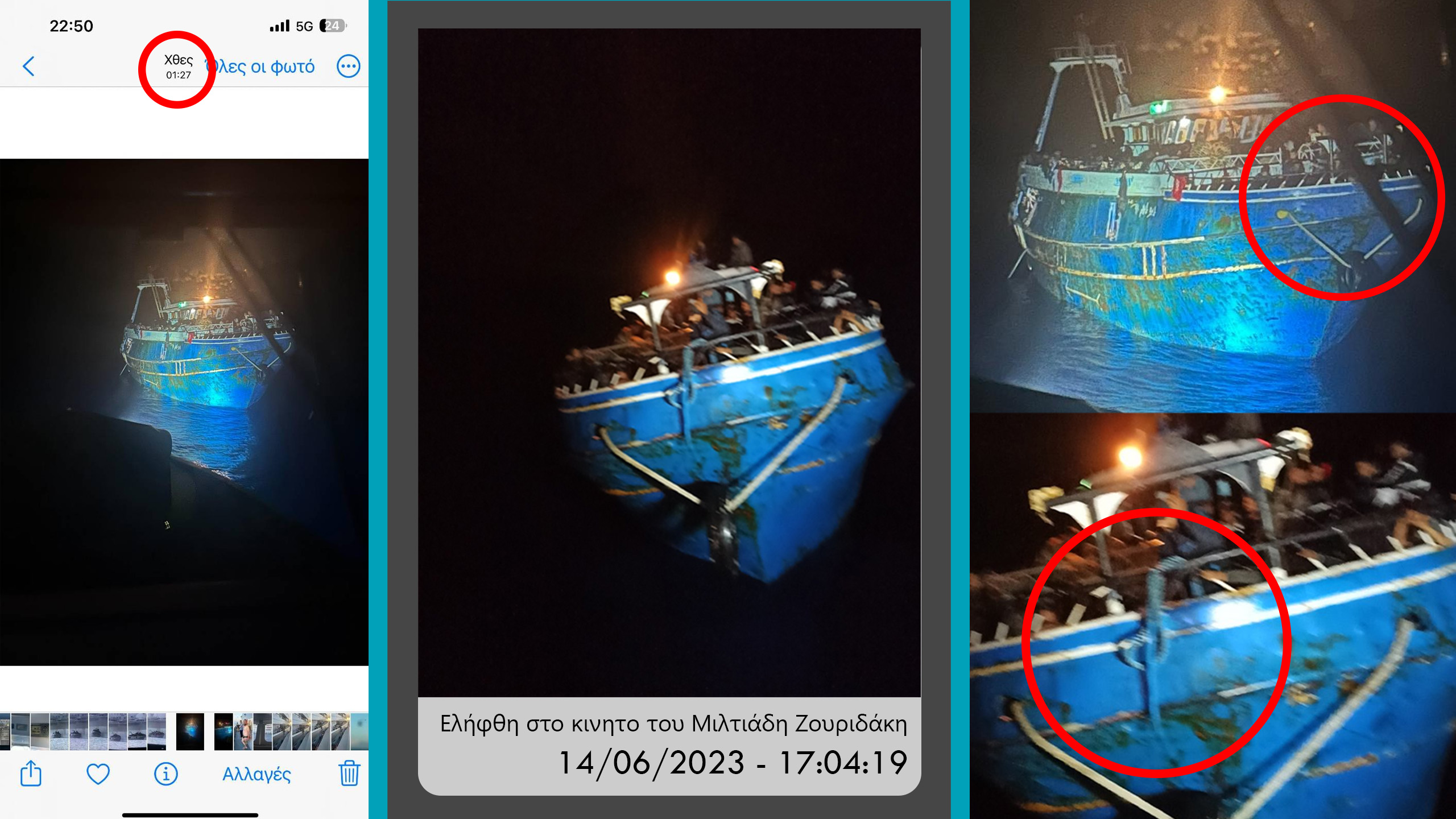
But all of that changed with the publishing of a photo showing a blue rope tied to the front of the Adriana, released by Greek outlets OmniaTV and Efsyn in February. The rope provided definitive evidence supporting witness testimonies and implicating the Greek coast guard.
Mada Masr has re-assembled the timeline of the Adriana’s capsizing and the investigations that followed to put the blue rope image in context and unpack the significance of its revelation.
The question of whether the coast guard was involved in a pushback attempt that led to a horrific drowning hinges on what exactly happened that night in June 2023, as well as the discrepancies between the accounts of those who were aboard the Adriana and the coast guard.
Despite the coast guard’s increasingly clear role in the catastrophe, the official account of what exactly happened remains significantly limited.
Given numerous incidents of pushbacks in the past and the public outcry that has ensued, lawmakers in Europe have mandated certain regulatory policies that the coast guard has to follow.
In 2021, recommendations were issued for the Greek coast guard to record all operations made by Frontex vessels or vessels that are funded by Frontex, either partially or entirely.
Though the vessel sent by the coast guard to the ship in distress was in fact partially funded by Frontex, the coast guard claimed after the shipwreck that the recording system was out of order at the time.
That didn’t stop Frontex itself and others from accusing the maritime authorities of having delayed rescue options until the last minute. But without material evidence, coast guard spokesperson Nikos Alexiou claimed with plausible deniability that cameras were not operating because the crew was focused on rescue operations.
“Making some crew members ‘inactive’ so that they can record a video, you understand, is unethical,” he said a day after the shipwreck, justifying the lack of documentation.
Thus, the public account of what happened on that night is largely limited to the coast guard’s official statements in the wake of the wreck.
In the Greek Shipping Ministry’s official account of the events, released the day of the shipwreck, the maritime authority said the coast guard vessel sailed close to the Adriana at 10:40 pm on June 13, but remained “at a distance,” observing “discreetly” as the boat moved at a steady course.
It only approached, the ministry said, at 1:40 am on June 14, to “determine the problem” after one of the distressed boat’s passengers informed the operations center of an engine malfunction.
Providing no information about what happened between the approach and the shipwreck, the ministry concluded that, at 2:04 am, an official on the vessel informed it that the Adriana “took a right, then a sharp left and another right so great that it resulted in the fishing vessel overturning.”
The official account made no mention of coast guard authorities tying a rope to the Adriana, which survivors said happened in fact twice.
Speaking to several Greek and international news outlets in the days after the shipwreck, some of the survivors described the events as follows: the coast guard vessel tied a rope to their boat to try and tow it out of Greek waters, which caused it to overturn and capsize.
But the coast guard was determined to convey its own version of the events.
Collected by coast guard officials, initial testimonies made by nine survivors in the days following the wreck were carbon copies of each other and did not contain any mention of towing. Though in later testimonies to the Kalamata court, six of the same nine victims said that the coast guard's rescue vessel towed the Adriana shortly before it capsized.
These accounts were furthered in situated testimonies conducted in the joint investigation by Solomon, Forensis, the Guardian and ARD, which saw survivors walk through the moments before the wreck with an accompanying 3D model of the Adriana. When they got to the last moments, they identified the very spot where the image released by OmniaTV showed the blue rope tied to the boat.
Several of them also said that two towing attempts were made, according to the investigation, with the rope breaking the first time. On the second towing attempt, they recounted, the coast guard vessel picked up speed, causing the fishing vessel to rock from side to side before flipping and capsizing.
The coast guard vessel’s log, which was submitted to the investigative authorities and was exclusively published by Reuters several weeks after the shipwreck, recorded both approaches as well as the tying of a rope, though only on the first approach.
According to the coast guard’s log, they approached the vessel twice in the hours before it capsized, first at 11:40 pm on June 13, when its crew tied a rope to the Adriana to “assess the situation.” According to the log, those onboard untied the rope and said “they wanted to continue to Italy.”
The second approach, according to the logbook, was made upon instructions by the operation center at 1:40 am on June 14 to inspect conditions on the Adriana after it stopped moving. The coast guard vessel then approached the boat at a distance of around 70 metres and “heard a lot of shouting” before the ship capsized minutes later.
The discrepancies between the Shipping Ministry’s account of the events and that of the coast guard vessel are among several other examples of the contradictory nature of coast guard statements in the wake of the sinking.
Another striking example involved the coast guard spokesperson.
To fend off accusations that the coast guard had towed the Adriana, Alexiou claimed on June 15 that there was no rope. However, that story began to shapeshift, with the coastguard spokesperson acknowledging the next day the existence of a rope but stopping just short of saying that it was used to tow the ship. Thus, in Alexiou’s updated version of events that night, the rope was used to "stabilize" the boat to “check on” it, but it was the migrants themselves who untied it “hours before” the Adriana capsized.
The captain of the rescue vessel echoed Alexiou’s account in testimony to the Kalamata authorities, telling the court during the May 2024 trial of the nine survivors that Adriana’s passengers were given a rope at 11:50 pm, but that they unhooked it themselves and restarted the boat’s engine.
Turning a blind eye to the contradictions between survivor testimonies and the coast guard’s statements, the Kalamata authorities, who launched initial investigations after the shipwreck, were quick to impose immediate punitive measures on nine Egyptian survivors, without issuing a subpoena to seize the coast guard’s phones.
The phones of all 103 survivors were confiscated immediately after the wreck by the coast guard officials themselves.
After nearly a year in pretrial detention, the nine accused Egyptians were released and the charges against them dropped, which meant that the Pylos investigation had to go back to square one.
That investigation nearly stalled and we were almost left in the dark, until nearly six months later, when the Piraeus Naval Court finally decided to seize the coast guard members’ phones in September 2023.
The court order for their phones to be seized was at the request of lawyers representing those who died and survived the sinking. The measure was taken during the preliminary investigation into a lawsuit that was filed by the victims themselves.
The picture of the blue rope then appeared.
It was retrieved from the phone of the coast guard vessel captain, after being examined by the Greek police, and stands in contrast with two other pictures that the captain did submit to the authorities, though with no trace of a rope.
The three pictures, which Mada Masr reviewed, provide crucial material evidence and may finally shed light on the coast guard’s actions on that horrific night.
We compared the timestamps on the submitted pictures with the coast guard’s claims and survivors’ testimonies.
One of the submitted pictures with no rope showing was taken at 1:27 am on June 14, or nearly half an hour before the Adriana capsized, according to a screenshot on the phone of the coast vessel captain.
The second, taken at a closer distance from the Adriana, was shot shortly afterwards.
These timestamps challenge the coast guard’s own log, which said that the second approach toward the Adriana was at around 1:40 am, and points to the possibility that the coast guard vessel was already near the boat before the officially reported time.
The image of blue rope, though undated, also exposes contradictions in the coast guard’s account of that night. Sources told Greek outlets Omnia TV and Efsyn that the image was sent by a crew member of the rescue boat to its captain at 5:04 pm on June 14, hours after the shipwreck.
Yet, while the captain submitted two other images to investigators that did not show the rope, he withheld the one that did.
The image, which shows a piece of cut or snapped blue rope with a knot at its end, also contradicts coast guard claims that the rope was untied by the passengers themselves.
Instead, it suggests that it was forcibly snapped or roughly cut off as a result of the towing attempts. It could therefore correspond to the first towing attempt described by the survivors, in which the rope reportedly broke, and therefore confirms their testimonies of pushback by the Greek coast guard.
While Greek authorities continue to deny these practices, many pushback operations carried out by the country’s coast guard were documented in the past years. These unlawful measures often involve the removal or damaging of migrant boats’ engines, casting boats adrift, or towing them away from Greek territorial waters, among other tactics.
Despite the growing number of pushback allegations, Greek authorities’ criminal investigations into these violent border practices have resulted in few concrete outcomes, with actual trials remaining exceptionally rare. In several of these cases, victims often turn to the European Court of Human Rights (ECHR) to seek justice.
This is what happened after the deadly Farmakonisi shipwreck in 2014, when the Greek coast guard similarly towed a fishing boat, killing 11 people who were on board. While the Greek government immediately denied any wrongdoing by the coast guard and the court case was dismissed twice by judiciary councils in Greece, ECHR ruled against Greece in 2022, finding it in violation of the European Convention on Human Rights in relation to the incident.
The European authority also ruled against Greece in 2025 over what it described as “a systematic practice” of illegal pushbacks of third country nationals, citing two cases of dealing with refugees in which Greece’s “brutal” border control operations were found to have been in breach of the European Convention on Human Rights.
Meanwhile, doubts persists over how the Piraeus Naval Court will handle the Pylos case, especially after lawyers representing the survivors and the families of the dead, as well as independent investigations, have pressured it into a second round of preliminary investigations due to evidentiary gaps and lack of accountability in the first round.
After only the captain and crew of the coast guard vessel were accused in the first round, criminal proceedings are currently underway against senior coast guard officials as well.
In what she called a “legal, political and social fight,” member of the survivors and victims’ legal team Evgenia Kouniaki tells Mada Masr that while the main investigation has already begun into the actions of several coast guard members and officials, it is unknown whether the case will proceed to trial, “let alone result in conviction,” she said.
“We are aware that from the very first moment the so-called ‘search and rescue operation’ began, there was an effort to cover up the pushback attempt,” she said. “We know that this is a criminal process that places Greece’s border policies under scrutiny. Yet, the trial of those responsible for the Pylos shipwreck is more than just a legal case, it is a trial that will determine the kind of world we want to live in.”
تقارير ذات صلة
What was the Greek coastguard doing instead of rescuing 750 people?
Recordings reveal the coastguard was busy preemptively staging its own impunity before the ship sank
Greek migrant boat tragedy: What do we know so far?
Many of the passengers went through a hostage-like situation in Libya, their families told Mada Masr
The privileged, violent stunt that is the Venice Biennale boat project
Artist Christoph Büchel’s project, Barca Nostra, brought the hull of a fishing boat to the biennale
Your support is the only way to ensure independent, progressive journalism survives.
You have a right to access accurate information, be stimulated by innovative and nuanced reporting, and be moved by compelling storytelling. Subscribe now to become part of the growing community of members who help us maintain our editorial independence.
Join us