
The art of Adelita Husni-Bey: Gentle reminders to be self-reflexive?
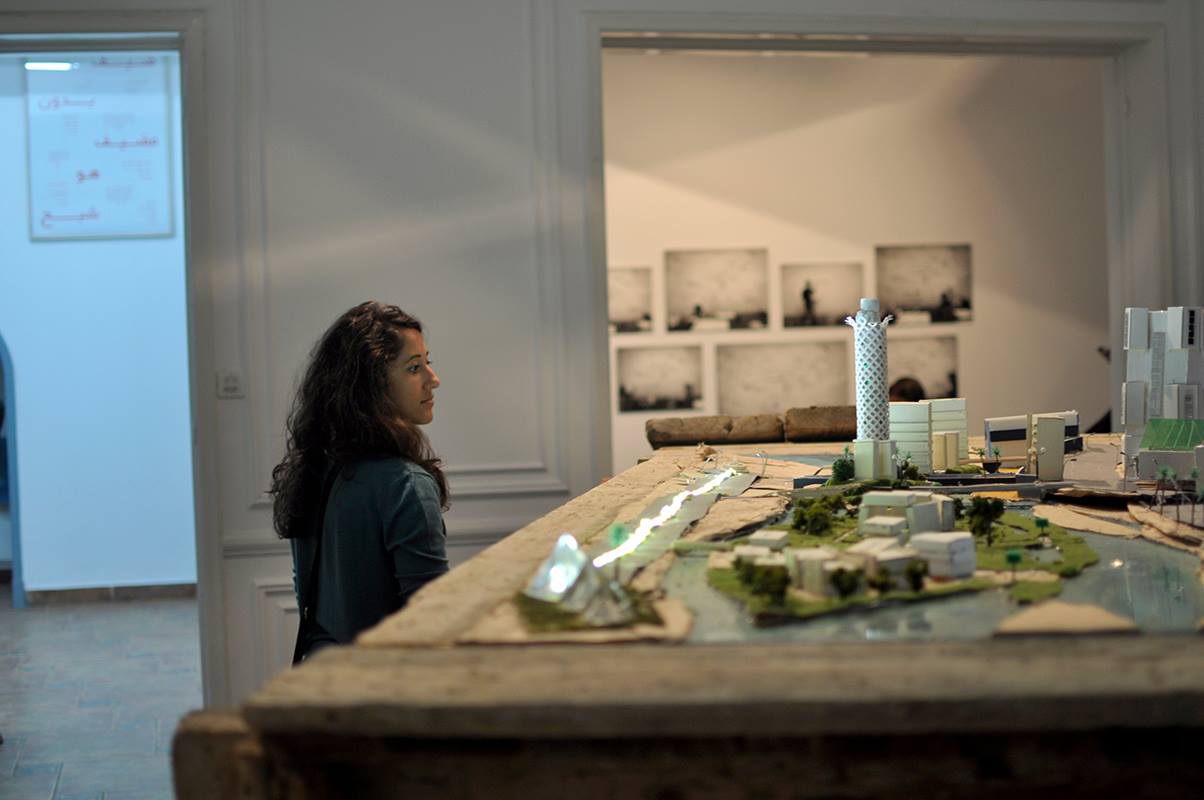
In Beirut’s villa, you stand in front of a maquette. It’s about shoulder level and doesn't appear to be well-made, but like a puzzle assembled over time. White cardboard buildings with miniature billboards, bright LEDs for street lighting and wooden cubes painted white with Arabic words such as “hospital” written on them all evoke different feelings.
It stands on a chunky wooden frame that resembles those found at construction sites in Egypt, complete with a wooden ramp that extends downward through the wide doorway to the next room. Loud voices speak in Arabic, their words booming through the space, about the government, investors and displacement.
As you circle around to the other side of the maquette, you find a bench. Sitting on it, directly ahead of you, attached to the wooden construction supports, you see a video piece titled Ard (Land, 2014). This is where the sound comes from.
The maquette is in the middle of the frame. Around it men and women sit and discuss plans to demolish their homes in the informal neighborhoods of Gezirat al-Qursaya and Ramlet Boulaq in order to build two new Nile towers.
The exhibition “White Paper: The Land” is the culmination of Adelita Husni-Bey’s yearlong project in collaboration with Beirut in Cairo. In collaboration with Casco in Utrecht, it will travel to Europe with the addition of new works made there. The video, made in collaboration with filmmaker Salma El Tarzi and legal activist Nazly Hussein, documents a workshop organized by Husni-Bey and led by Hussein. It’s one of three works, each reflecting on how the Egyptian state is involved with a different sets of people.
What the citizens refer to in the videoed workshop are the plans set by the government-backed initiative Cairo 2050. The residents struggle to find their homes on the model, and a man points to miniature foam trees, saying “This is where my home should be.”
Past the ramp, in the next space, two pairs of headphones rest on a bench facing a wall. On the wall seven black and white photographs show a word map in the process of being constructed.

It’s immediately clear that the map is discussing Egypt’s recent political state: At the center it says “Tahrir is not a square.” It is the documentation of a workshop led by Husni-Bey with the staff of Mada Masr in October 2013. Putting your headphones on, you enter into a long animated conversation, complete with dictionary checks, resulting in words such as “propaganda,” “coup,” “pollution” and “xanax” being added to the map. You unintentionally look up at the photos and try to find your place on the map, tracking the words as the map expands.
By listening to a group of journalists discuss such words, you begin to understand the way in which language has been used within the greater narrative of Egypt, how it has developed and morphed in parallel to political events.

The third piece is a seven-minute video, hidden in a corner above a tight staircase and only detected when there is a wave of silence in the space. The first shot is of a bicycle whizzing through a Cairo street, and what follows is a collection of activities that range from admiring ceiling fans to climbing on rooftops with friends. It’s clear when looking at the whimsical collection of homemade snippets that Husni-Bey’s involvement was fairly limited.
Through an open call in 2013, Husni-Bey compiled footage of people spending their evenings under the state-imposed curfew, inviting them to be witnesses. The work, Time Under Siege (2013), is set apart from the other works both physically and in execution.
Husni-Bey (1985) is a Libyan-Italian artist who has studied both fine art and sociology and urban cultures. She presents herself as an artist and a researcher, focusing on self-organization and alternative forms of learning and existing in contemporary political and cultural settings, illuminating small communities that self-mobilize as a form of pedagogy and resistance.
Audiences at Beirut in Cairo are often a mix of young artists, writers and thinkers, all relatively aware of the subject matter that Husni-Bey addresses — it’s often a part of their everyday life. So one must ask if the artist wishes to shed light on moments in Egypt’s recent history that are systematically being kept out of sight (or the collective memory of a nation) on a more public platform? Is she validating the subjects’ attempts at resistance by documenting and making this information accessible in the form of small vignettes? Is it a gentle reminder that these events have unfolded and a reminder to be self-reflexive?
Husni-Bey’s involvement in each of the three works varies, from data collecting and editing footage, to orchestrating workshops and painting on walls. The installations took over a year to complete, and are set to travel to the Netherlands and Spain. When visiting moments in time and culture, is it an advantage to have an outsider’s fresh glance, to follow her instincts and stories as they unfold? Is this how she positions herself as sort of a fact checker and researcher using an art context to bring depth to the works?
Husni-Bey presents us with works that speak to specific event or moment in history. The context in which she had to assemble these works was a rather hostile one, both politically and socially.
In this sense we must consider in what context is the work most effective, most challenging. If this exhibition were in Europe, the mood would likely be very different. When the work is taken out of its Egyptian context and put somewhere foreign, it becomes a primary source of information for the audience. They become exposed to these people and events through the frame that Husni-Bey has constructed, as an international human rights issue.
And in Egypt, the moments of tension may have been more present for the artist making the works and collecting data than they were present for the Beirut audience. In Cairo the work may be just another reflection of the heavy hand of the law, which can be problematic: When the state is being painted as “oppressor,” it is difficult for the subjects to be something more than the “oppressed.”
The Qursaya residents, Mada Masr staff and curfew filmmakers were all aware of the events unfolding: Husni-Bey puts them into a narrative through several mediums. Journalists, for example, are just the appropriate people to talk about political language as they are constantly exposed to it and work with it. It’s difficult to tell if the process will have affected the participants beyond the workshops, or if that really matters.
"White Paper: The Land" is showing at Beirut until January 10, 2015.
Correction: This article originally implied that the show was a culmination of the artist's collaboration with Beirut and Casco; in fact the Casco collaboration will continue in 2015. The was corrected on December 17, 2014.
تقارير ذات صلة
‘A Guest Without a Host is a Ghost’
Out-arting the art with artful narrative does not, ultimately, do anything for the actual artwork in space.
Malak Helmy at AUC: Back to the academy
Malak Helmy’s show adds a new beam to the inquisitiveness that surrounded AUC’s move to the desert from Tahrir Square six years ago.
A certain moody power
I have no issue with cryptic works, if there’s enough to tantalize a committed viewer, says Mia Jankowicz about Wael Shawky's Al Araba Al Madfuna.
Your support is the only way to ensure independent, progressive journalism survives.
You have a right to access accurate information, be stimulated by innovative and nuanced reporting, and be moved by compelling storytelling. Subscribe now to become part of the growing community of members who help us maintain our editorial independence.
Join us