
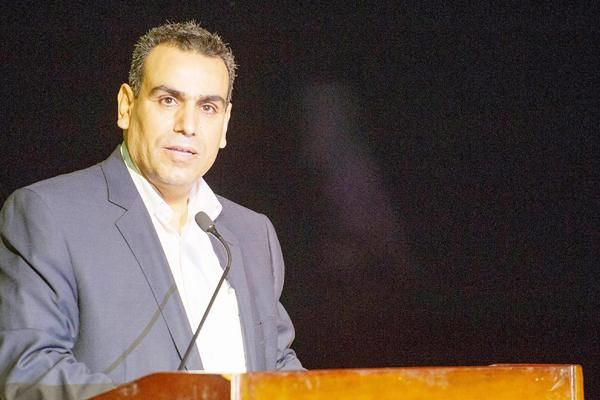
The 3-month mark: What has the new culture minister achieved and provoked?
This week seems like an appropriate time to step back and look at Egypt's state culture. It’s been three months since Abdel Wahed al-Nabawi took office, the seventh culture minister since the 2011 revolution saw the end of the 24-year tenure of Hosni Mubarak-era minister Farouk Hosni.
And it’s also the second anniversary of cultural producers’ take-over of the Culture Ministry for a sit-in in 2013, during the lead up to the June 30 overthrow of Muslim Brotherhood-affiliated President Mohamed Morsi.
Taking over the Ministry of Culture's leadership is no easy task. Since the revolution, Egypt's artists and intellectuals have voiced dismay at every minister who has taken the position, with the exception of Emad Abu Ghazi, who was welcomed. But Abu Ghazi's tenure, back in 2011, only lasted six months — he resigned during the Mohamed Mahmoud Street clashes between those protesting the government's actions and the Central Security Forces that November.
For the past 10 years, Nabawi had been head of the National Center for Documents. He oversaw the establishment of a new site for it in the southern Cairo district of Fustat, funded by the governor of Sharjah, Sheikh Sultan Ben Muhammed al-Qassemi. It hosts a large selection from Egypt's national archives, in addition to departments for document restoration and maintenance, spaces for symposia, and a public museum.
During his tenure, Nabawi also oversaw the digitization of the national archive of architectural plans for Cairene buildings from the 19th and 20th centuries. He was working on a plan to digitize the National Archive's valuable documents too, and helped organize the restoration of the Scientific Institute of Cairo documents burned during the Cabinet clashes in December 2011, according to the Ministry of Culture's website.
Criticisms and controversies
On top of all this, Nabawi is a history professor at Al-Azhar University, an institution with which he’s strongly affiliated. This is a point many of his critics hold against him, and several cultural figures expressed dismay at his ministerial appointment because he has not been involved in cultural production.
His predecessor, secular intellectual Gaber Asfour, engaged in media battles with Al-Azhar. Minister from June 2014 until March this year, as well as for one week during the 18-day protest that toppled Mubarak, Asfour wrote an article in state-owned newspaper Al-Ahram in June 2014 discussing the history of religious discourse in Egypt. He emphasized the importance of a secular state and called on Al-Azhar to keep religion out of it, maintain its political neutrality and end sectarianism between Islam's factions and between religions. The seat of Sunni learning rebutted with a statement refuting some of his historical facts and criticizing his calls for a European model of secularism.
Asfour’s statements on television against women wearing veils and his acceptance of the personification of prophets in cinema — such as with the cases of Darren Aranofsky’s Noah and Ridley Scott’s Exodus — and nude portraits in visual arts angered Al-Azhar clerics and the more conservative Salafi sheikhs.
It is widely believed that Asfour's collisions with Al-Azhar were related to his removal during the March cabinet reshuffle, especially as the safer, more conservative choice of Nabawi was made for his replacement. Some felt that the country’s military rulers were effecting a reconciliation with Islamic institutions after having used secular intellectuals such as Asfour to help smooth the way before and after the overthrow of the Islamist president.
Nabawi has made it clear that censorship would prevail in its responsibilities, but that as minister he would not interfere in the process. He has said that Al-Azhar does not have the authority to ban cultural production, but merely give its opinion.
“Some things are rejected because they don't match Egyptians’ taste,” he said to TV host Magdy al-Galad on privately owned channel CBC’s “Lazem Nefham,” right after he was sworn in. “If a film attacks a nationalist symbol, wouldn't Egyptians reject this?”
Jordan-based Al-Bawaba reported in April that several Egyptian cultural practitioners they had spoken to opposed Nabawi’s method of running the ministry. They claimed that his leadership lacked strategy and that he did not have the necessary understanding of the current needs of culture practitioners.
A social media uproar against the minister occurred in April when Azza Abdel-Moneim, a curator at Alexandria’s Mahmoud Said Museum, released a Facebook statement demanding his apology for making a joke about her weight during a field visit. Abdel-Moneim wrote that Nabawi told her to run around the garden and up and down the museum stairs to lose weight, when she was trying to address the problem of bureaucratic centralization in Cairo. She later announced that he apologized to her over the phone, though she had demanded a public apology.
On Nabawi's priorities and achievements
Nabawi also told Galad that he had several mandates from President Abdel-Fattah al-Sisi. He’s tasked with collaborating with the Ministry of Religious Endowments and the Ministry of Youth and Sports to create platforms to recenter the religious tone in the country to fight extremist ideas and terrorism. He is to investigate corruption and other issues facing Egypt's 575 “culture palaces,” or local arts centers. He is to find ways to include young people in the arts, as well as produce a generation of new artists.
He told Galad that he believes external powers want to weaken the Egyptian state, and culture has a role to play in uniting factions and empowering it.
Another main pillar of his work is art education, he has said. In May he launched the initiative, “Our Children's Summer,” for art education summer programs, in coordination with the cultural palaces and the Arts Academy — the country’s main art teaching institute. He also launched a poetry prize in honor of Abdel-Rahman al-Abnoudi, who died in April, and is encouraging innovation in the Arts Academy curricula, he said on state TV’s “Sabah El-Kheir Ya Masr,” adding that the curricula are outdated as they were constructed in the 1960s.
Nabawi is very concerned with the problems facing the culture palaces, which were also on the agenda of his predecessors for the past four years. He told “Sabah El-Kheir Ya Masr” that out of 575 palaces (which include libraries and cultural apartments) around the country, only 300 are functional. He also said that they are not fairly distributed according to each governerate’s population.
He added that he had met with the cultural palaces’ leadership and explained that there would be accountability and follow-up. He has reshuffled the leadership of several districts. In May, for example, he fired the manager of Giza’s cultural palaces and the head of the 6 October cultural palace on a surprise visit, due to oversights in reporting on the renovation of the space.
He also clarified on the program that the Ministry of Culture employs almost 40,000 people and that almost 90 percent of its budget goes toward their salaries. This is one issue he plans to work on, to make sure more budget is allocated to the ministry's projects — another vow made by his predecessors.
Privately owned Al-Shorouk newspaper reported in May that Nabawi is in contact with the governor of the large south-western governorate of Wadi al-Gedid to re-open an open-air cinema in the Kharga Oasis for the summer cinema season.
Nabawi still has a large heap of files to look after. The legacy of stagnation and lack of productivity under Farouk Hosni's 24-year tenure has still not been dealt with four years on. After the revolution, artists and intellectuals urged radical grassroots changes to the ministry's role in culture, but these requests were in vain. Like his predecessors, he is yet to deal with overstaffing, centralization and rigid structuring, while simultaneously reviving the culture palaces’ operations and decentralizing culture as a whole away from the capital.
While Nabawi started off strong, making drastic changes to the leadership of some culture palaces and launching programs for young people, only time will tell how serious he is about both his mandates from Sisi and in serving the cultural sector's ever growing needs and issues.
Timeline of culture ministers since the 2011 revolution
- January 31-February 8, 2011: Gaber Asfour (literary figure, former head of the Supreme Council of Culture and founder of the National Translation Center). He resigned during the 18 days of revolution, citing health reasons. When Mubarak stepped down he ascribed it to the revolution.
- February 20-February 27, 2011: Mohamed El-Sawy, founder of El-Sawy Culturewheel and businessman. Cultural practitioners released a statement against him running the ministry and held a protest. He was removed and a new cabinet, headed by Essam Sharaf, brought in a new minister.
- March 6-November, 2011: Emad Abu Ghazi. Assistant then secretary general of the Supreme Council of Culture, Abu Ghazi was a strong supporter of revolution, freedom and democracy, and a published author and academic. He resigned due to dismay at the government's role in Mohamed Mahmoud clashes.
- December 2011-May 2012: Shaker Abdel Hamid. Sworn in with Egypt's new cabinet under Kamal al-Ganzoury, Abel Hamid was also secretary general of the Supreme Council of Culture and a professor at the Arts Academy. He has published several studies on the effect of art on the human psyche. He was removed in a cabinet reshuffle.
- May 2012-May 2013: Saber al-Arab. A history professor, and from 2006 until May 2012 chairperson of the General Book Organization and the National Library and Archives, Arab resigned in June 2012 to be eligible for a state prize for social sciences worth LE200,000, but returned when he did not win. He resigned again in January 2013 to protest the state's crackdown on protesters in the aftermath of former President Morsi's controversial constitutional declaration, but returned at the request of the prime minister. Eventually he was removed in a cabinet reshuffle.
- May 2013 – July 2013: Alaa Abdel-Aziz. The most controversial minister to date. In the lead-up to the June 30 protests, Abdel-Aziz's affiliation with the Muslim Brotherhood did not sit well with many in Egypt’s cultural communities. A cinema professor and previously a film editor, he participated in protests at the Arts Academy. Reasons for removal: There was an uproar after he decided to fire Cairo Opera House director Ines Abdel-Dayem. Following strikes at the opera, some artists took over the Ministry of Culture in June for almost a month, hosting events for the public outside of it.
- July 2013: Saber al-Arab returns, and was removed in June 2014, following a cabinet reshuffle.
- June 2014-March 2015: Gaber Asfour returns.
- March 2015-present: Abdel Wahed al-Nabawi.

Rowan El Shimi
Rowan El Shimi is a culture journalist from Cairo, but she often finds herself working on stories all over the country, especially Alexandria. She covers a range of topics in culture, mostly…
تقارير ذات صلة

More hurdles to clear: What a new committee organizing festivals means for the future of artistic events in Egypt
A decree issued last week imposes severe restrictions on the organization of art events in Egypt
Whose surrealism? On When Art Becomes Liberty
There is no liberty in revolutionary art existing according to the whims of the art market and a security state.
The art disasters that led to a ban on unauthorized work on public statues
Jano Charbel looks back at a few of the kitsch, offensive and bizarre public statues that have graced Egypt's governorates of late.
Your support is the only way to ensure independent, progressive journalism survives.
You have a right to access accurate information, be stimulated by innovative and nuanced reporting, and be moved by compelling storytelling. Subscribe now to become part of the growing community of members who help us maintain our editorial independence.
Join us