
Searching for the stars in Bahareya
“Look out from your windows very soon,” said Badry, our local Bedouin guide, as we reached a bumpy and sandy path. “You’ll see a sight you will not want to miss.”
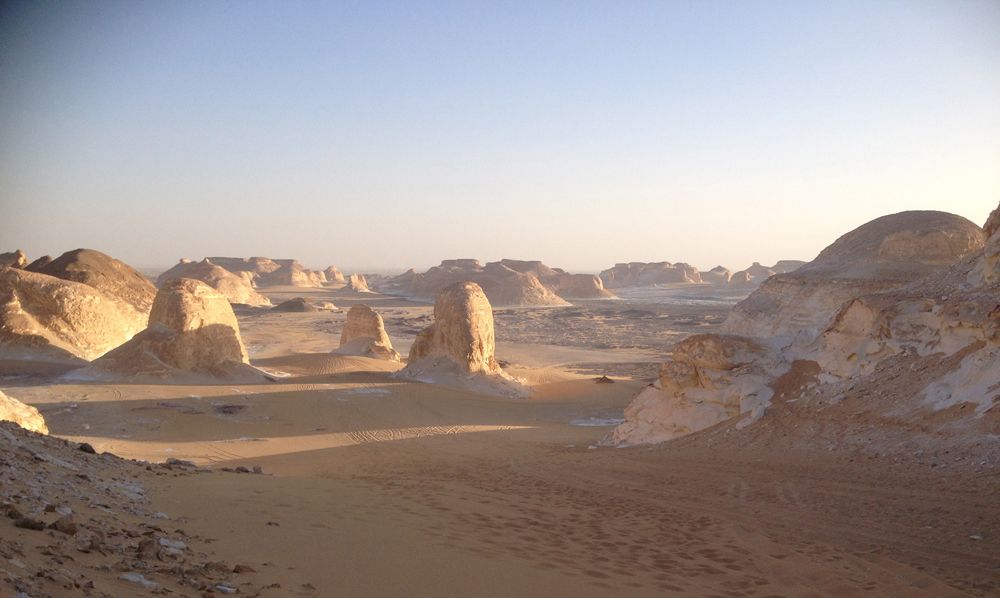
I focused my attention away from the car and into the distance. The panoramic view was reminiscent of images I had seen of the Grand Canyon in Arizona, only a miniature version and more haphazard and sparse.
We were on the tip of the Agabat Valley, or the Valley of Obstacles, at the beginning of the White Desert National Park. White and yellow mammoth-like rock formations — seven meters high or more — looked like petrified giants overlooking the never-ending desert.
At that moment, on day two of my four-day trip to Wahat Bahareya (northern oasis) — a depression in the middle of the Western Desert only 360 km from Cairo — I realized it had been too long since I had witnessed a serene landscape in total silence. Cairo’s constant noise pollution does not allow for that luxury.
Badry explained that the name Agabat — or Aqabat, in mainstream Egyptian dialect — refers to the many obstacles one faces when attempting to leave the valley. They include the rock formations, heavy sand, and gravity pulling one back towards its basin.
Fossil remnants and wave formations point to the valley’s prehistoric history. Almost 50 million years ago, the entire area was submerged under sea level. Several dinosaur fossils have been found here, including the ‘Bahariasaurs’ named after the nearby Bahareya depression.
We chose to set up camp in the valley. Badry was not short of resourceful ideas. Years of isolation forced Wahati Bedouins to figure out ways to survive the desert’s freezing nights and boiling days. Combining technology with tradition, Badry parked his Jeep and opened his trunk, which resembled Mary Poppins’ bag or even Aladdin’s lamp, because anything and everything one desired could be found within it.
We were fortunate to witness a full moon that night, illuminating the entire desert’s white and yellow landscape with a light blue tint.
Except for occasional visits from foxes and bats we had almost the entire desert to ourselves. I thought how such an empty setting would usually feel dark and eerie in the curfew-imposed streets of Cairo, yet it felt safe and comfortable here.
Badry disappeared for a few minutes and returned with a light bulb, which had been powered to the car’s battery. As he slow-cooked and prepared the group’s dinner on a portable stove, we each talked of our aspirations and points-of-view. Naturally, politics came up.
“Sisi, Morsi, Mubarak — it really doesn’t matter who’s president,” said Badry. “We [the Wahati Bedouin] are aware of politics and it affects us, but only from a distance.” He said his only concern was that the army provide security and protect borders.
Badry talked about the importance of pondering, conversing, and properly thinking ones actions. “Cairo is the complete opposite of everything we stand for,” he added. “It’s dirty, angry and full of rash decision-making.”
He told us that village sheikhs and leaders would often meet to deal with the pressing issues in his community, and one such gathering led to a unanimous decision to ban public displays of political opinion in order to prevent civil strife.
Many Cairenes often call Cairo “Egypt,” due to the common view of it being the center of the country’s politics and culture. Many Wahati Bedouins also call it Egypt, but in their case it’s because they want to distance themselves from what it traditionally means to be Egyptian.
“We live in Egypt, but we are not Egyptians,” he adds. “We have no borders.”
We proceeded to eat our dinner, which tasted similar to Cairene food but richer, fresher and spicier. Badry then made us tea using fresh tea and mint leaves he had picked earlier that day. The Wahatis drink their tea in several steps, with the first cup more concentrated and bitter, and the following two more diluted and sweeter.
As we slowly sipped our tea, the stars glistened above us, filling up the sky like flickering fireflies. Badry told us about using constellations and stars as a natural compass and clock. Before GPS and compasses, when no mosque was in sight calling for prayer, Bedouins relied on the stars. Three types of stars, Badry said, helped them know the time: The Badareya star, appearing at dusk; the Nos al-Leil star, at midnight, and the Fagr star at dawn.
We ate some local “Saeedi” dates, picked from a palm tree in the morning. The yellow of the dates was like that of the sand dunes, but with hints of black and brown. Their sweetness and ripeness was incomparable to that of the dates available in the city. I thought I didn’t want to go back to Cairo.
Two days later our trip came to an end. I realized why Badry despised Cairo so much. As the bus drove into the city, the driver’s attitude instantly changed and it was almost as if he had been intoxicated by a mad Cairene crowd disease. His driving became careless, his mood angry, and his voice coarse. Cairo slapped me in the face with car exhaust, piles of rubbish, and brownish decaying buildings. I sought comfort by remembering the vast landscapes of Bahareya, where I felt comfortable and my mind could wander.
تقارير ذات صلة
Tips from the leisure desk: 5 top budget trips
Trips to shake up a stagnant mind and routine that won’t interfere with paying rent
Tips from the leisure desk: 5 ways to get an adrenaline rush in Egypt
Egypt has plenty to offer in terms of adrenaline rushing, heart-racing, blood pumping activities
Not going straight to college: An atypical year
Instead of going straight to university, 19-year-old Jaida El Shimi spent a year working and travelling. She shares how she spent her gap year, and why she highly recommends all…
Your support is the only way to ensure independent, progressive journalism survives.
You have a right to access accurate information, be stimulated by innovative and nuanced reporting, and be moved by compelling storytelling. Subscribe now to become part of the growing community of members who help us maintain our editorial independence.
Join us