
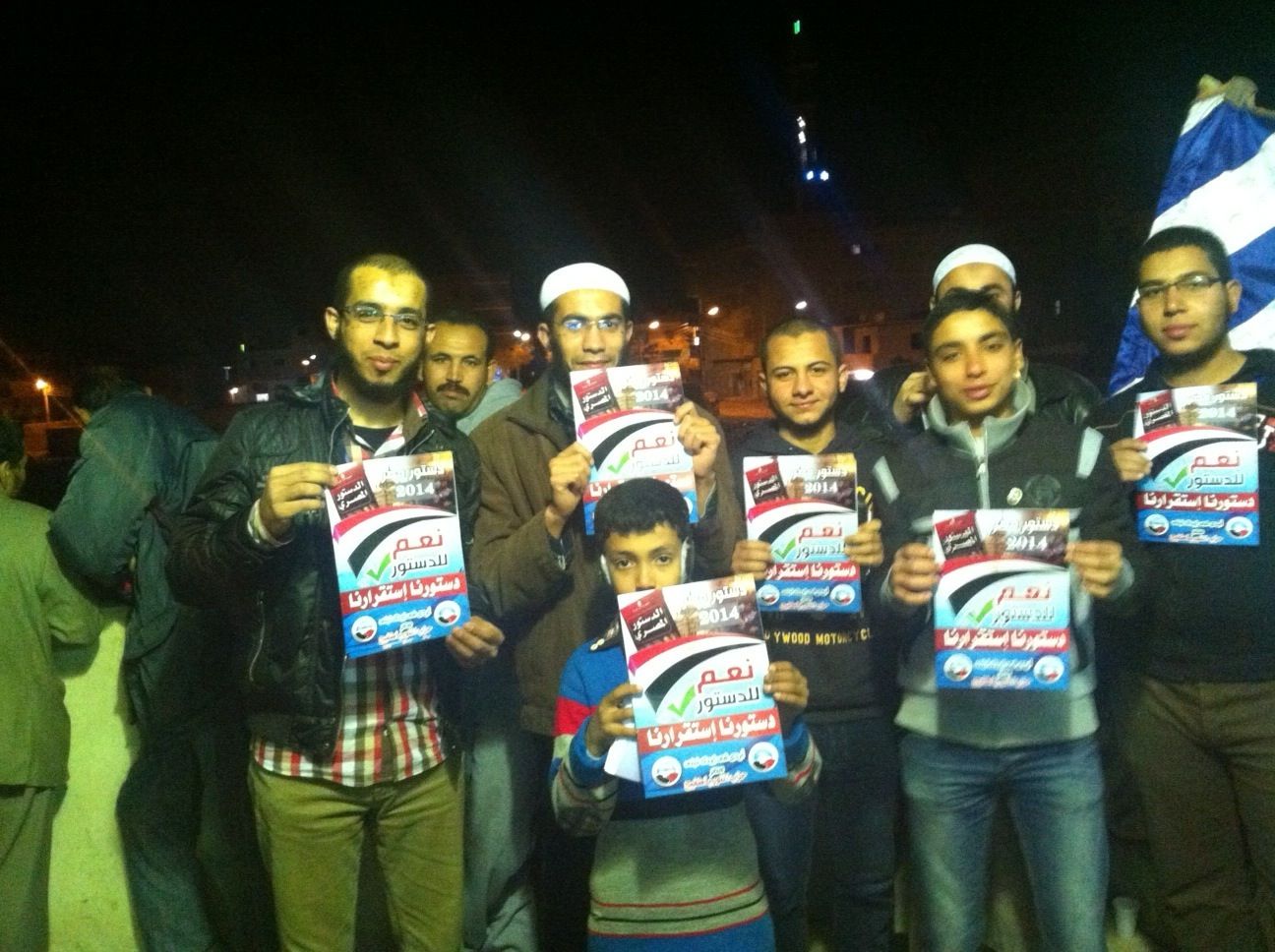
As Ashraf Thabet, an official from the Salafi Nour Party, was going through a number of talking points on the draft constitution, the audience was listening quietly. But when he moved to speak about immunity for the defense minister, their attention clearly picked up.
On Thursday, Thabet was in the provincial town of Saf to convince voters to vote “yes” in the two-day referendum, to begin Tuesday. Support for his party once ran strong here, but since most of electorate cast its votes for the Nour Party nearly two years ago, support for the party has fallen. Followers are considered less supportive of the Nour Party’s military allies.
“I want to know if the defense minister who’s present now will be around for another eight years,” one politely interrupted, as Thabet tried to move on to another topic.
Bearded men sitting in one row, one by one, rephrased the question. Interrupted again and again, Thabet finally asked the audience to wrap up the point.
“No, let’s have a conversation,” a young man in the front row says. “It’s better.”
Thabet brushed off their requests, and moved on to the question of whether Shia Muslims, a group often vilified by Salafis, will be recognized by the current constitution. He says they will not.
Thabet’s attendance is part of the Nour Party’s push to educate people on the constitution and push the 200,000 voters in the area to vote for its ratification. It is the only notable Islamist party to support the draft constitution, which will replace the one the party helped pen only a year ago, in which it marked up a significant victory for the inclusion of Islamic identity.
The Nour Party’s support for the constitution has raised multiple question marks. The party was the Brotherhood’s most trusted ally and ideological counterpart when the 2012 Constitution was drafted, and it penned articles relating to Islamic law that were a major victory for those seeking to utilize the state to Islamize Egypt.
When the Nour Party decided to support the military’s July ouster of President Mohamed Morsi and later support the constitution sponsored by it, it risked losing key support from a base it has cultivated for years, mostly organized through the Salafi Dawah, the party’s parent organization.
Just hours before the Salafi Dawah’s Shura Council voted on whether or not to support the draft constitution, the council was leaning towards a “no” vote, Ahmed Hamdy, a member on the council said at a recent lecture.
The Salafi Dawah was founded in the 1970s in Alexandria, and is the backbone of the Salafi movement. Since its inception, it has sought to push Egypt towards an ultra-orthodox Islamic society, one that emulates that in Medina at the time of the Prophet Mohamed.
But the Thursday seminar in Saf shows why the Dawah and the party decided to change its mind and risk alienating its own base. It believes it can continue to play the long game when it comes to Islamizing Egypt. To do that, it will have to continue to exist as a party and avoid being shut down by a security state that has not only forced the Brotherhood political apparatus underground, but its charity and religious services, considered key to the conversion of Muslims to their brand of Islam.
“It doesn’t achieve all we hoped for. We wanted a more clear connection with the Islam we believe in,” says Abdel Salam Hosni Mansour, a 26-year-old student and member of the Salafi Dawah. “But there has to be compromise and the constitution will allow for amendments over time.”
Thabet also repeatedly emphasized that, “God willing,” the draft constitution will be amended soon, and went on to list a number of possible changes.
The Nour Party surprised observers in the first parliamentary elections, winning more than 20 percent of the seats. The Dawah was able to convince religious voters to support the party, but that support is weakening in Saf, according to Mansour.
Ihab al-Beheiry, the party’s social outreach coordinator in Saf, disagrees, and says that the party is stronger than ever in Egypt’s small villages.
“There was a disagreement, not a difference between the leadership and the base,” he says. “We are the only ones with a presence in small villages, and the leadership has completely connected with the base.”
The Nour Party will play a key role in increasing turnout for the referendum across Egypt. Beyond those Egyptians hoping the constitution will push the country in a more stable direction, the Nour Party’s support lends a powerful identity aspect to the constitution.
A large part of the perceived legitimacy of the draft constitution, especially when compared to public support for the 2012 document, will rely on the Nour Party’s ability to bring people to the polls. Public transportation and quality infrastructure is weakest in villages in places like Saf, where the Nour Party is strongest.
In Saf, Beheiry says the party will coordinate core members’ individual efforts to bring people to the polls. He is working with a large team of volunteers who are organizing other seminars in neighboring villages. He claims that as many as 1,000 people attend each of the seminars, a claim corroborated by perhaps the only woman in the 150-odd crowd, who said she had attended another seminar. Beheiry blamed the lower turnout on this occasion on rain earlier that day, which turned the dirt roads around the youth center hosting the conference to mud.
At the conference, teenagers took email addresses and phone numbers from the participants who had reached the center, in preparation for the upcoming elections.
Being able to continue to participate in the political process is important, says the student Mansour.
“After January 25 all Islamists hoped to have a role in politics, and we are afraid of the door closing more,” he says. “If the door is closed, people will revert to other ideas, perverse ideas, like takfirism, which was refuted philosophically in the 1980s,” referring to the brands of radical Islamism that excommunicate more moderate Muslims.
Nour Party head Younes Makhyoun has said that under no circumstances can the party accept the formation of another constituent assembly without elected officials from the Nour Party. He was speaking to Ana Salafy, an important Salafi online forum. In the same exchange, he said there were a lot of influential forces in Egypt that the party cannot ignore.
Analysts have interpreted articles in the new constitution banning religious parties as equally applicable to the Nour Party, but Thabet emphasized that the language was the same as under which the party was established in 2011, and party literature said the same.
“Praise be to God, religious reference is not problematic in the constitutional proceedings. We are a party with an Islamic reference, not a religious party, meaning theocratic,” read the Nour Party literature distributed at the conference alongside copies of the constitution.
For the moment, as the Nour Party prepares for the next elections, it hopes its decision to participate will allow it to stay in the political process, unlike its former allies, who are now banned and branded terrorists. Campaigning for the constitution allows it to maintain and even expand its electoral infrastructure, which delivered it a significant number of seats the last time around.
Still, anecdotal evidence suggests the party’s alliance with the military carries risks. Opposition to the military is believed to be growing. Mada Masr saw only one photo of Defense Minister Abdel Fattah al-Sisi displayed in the town of Saf.
Mansour says that following Morsi’s ouster, there were more of posters of Morsi, but they were taken down after security forces attacked the Muslim Brotherhood sit-ins at Rabea al-Adaweya and Nahda squares.
For now, the party, for its own survival, sees no alternative to participation. “What’s the substitute for not participating? It would be catastrophic,” says Mansour.

Jahd Khalil
Jahd is a Cairo-based journalist who has contributed to the Los Angeles Times, Al-Monitor, Deustche Welle, and other outlets.
تقارير ذات صلة

Socialist Popular Alliance’s Haitham al-Hariry becomes latest candidate disqualified from 2025 House election
The list of nominees disqualified from the 2025 ballot is growing
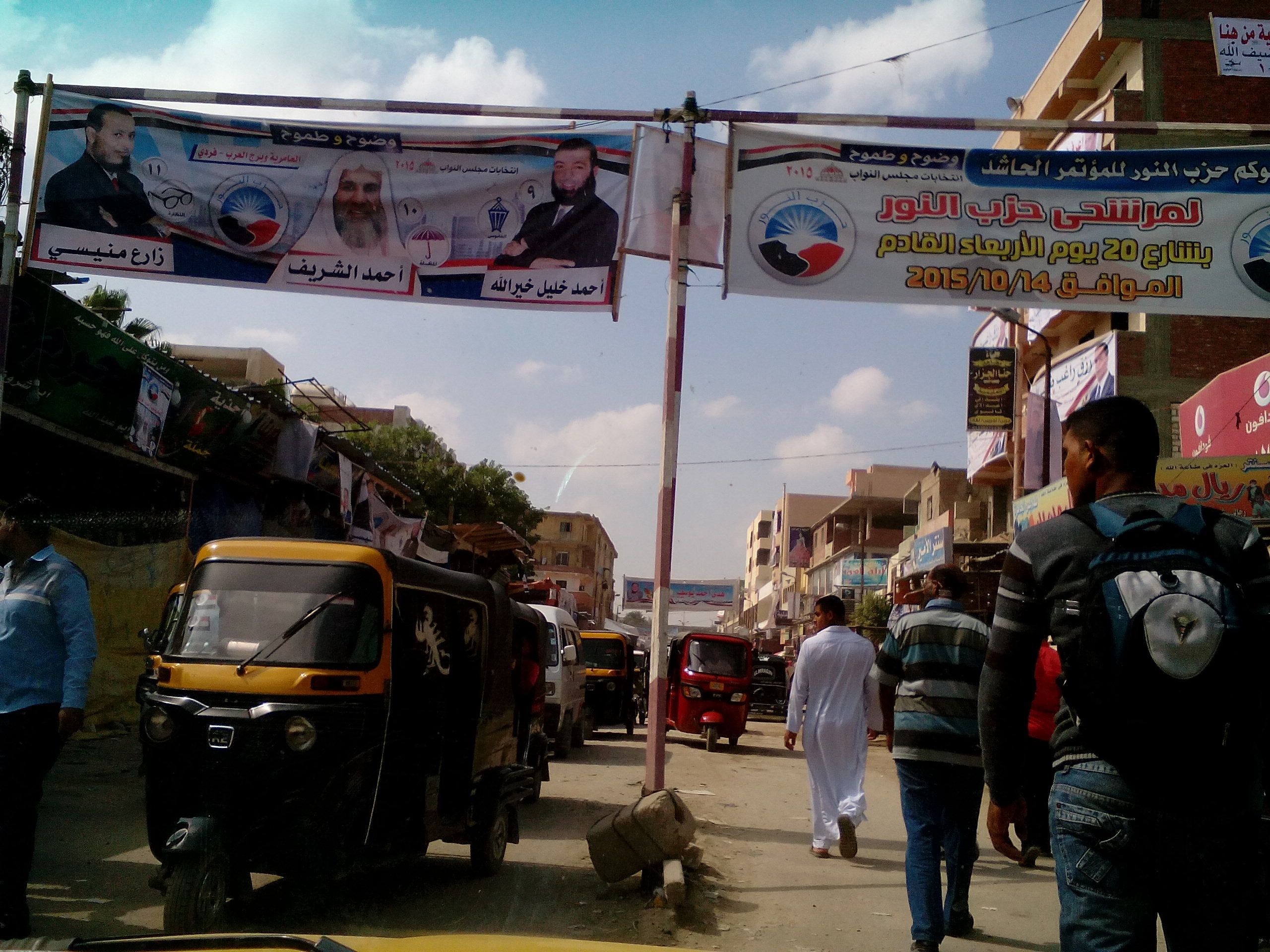
Salafis today and the question of withdrawing from politics
The Alexandrian Salafi Dawah group and its political arm, the Nour Party, have struggled to fulfill their political and religious functions since 2013, despite their support for the military regime. Now the question of their withdrawal from politics is making a comeback.
After staggering defeat, is it lights out for the Nour Party?
“God willing, the Nour Party from the first round!” the Salafi party’s supporters chanted during their parliamentary elections campaign. But their hopes were crushed when the results of this week’s…
Your support is the only way to ensure independent, progressive journalism survives.
You have a right to access accurate information, be stimulated by innovative and nuanced reporting, and be moved by compelling storytelling. Subscribe now to become part of the growing community of members who help us maintain our editorial independence.
Join us