
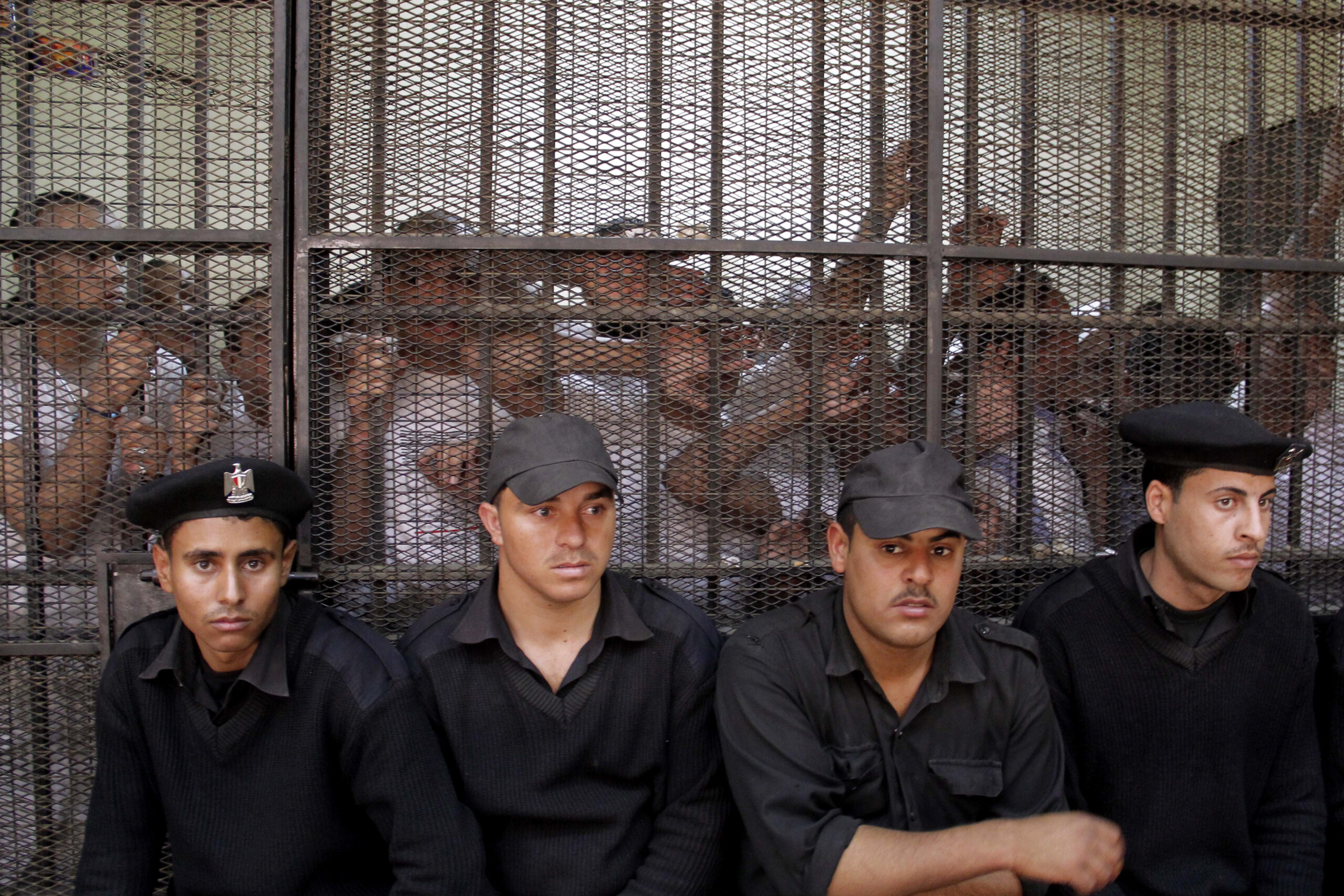
Reformist push fails to break through undercurrent of security concerns dominating rewrite of criminal procedures law
Lawmakers approved the criminal procedures law on Thursday in the House of Representatives, again. Members of the Egyptian Social Democratic Party left the hall in protest, again. And the law, so fundamental a basis for the conduct and accountability of law enforcement authorities that it is sometimes called a “second constitution,” was referred to the presidency for ratification, again, with only a few minor changes since it first landed on the presidency’s desk earlier this year.
The law’s loop back through the legislature was only the latest chapter in a cycle that has defined the bill’s lifespan; a push and pull that two informed sources tell Mada Masr reflects competing ambitions attached to the law by different camps within the state, one concerned about security challenges and the other keen to give at least the appearance of a reformist direction.
After Thursday’s session, lawmakers and lawyers, some of whom had sought to seize the opportunity to introduce reforms to the law, express frustration at their failure to shift the envelope.
However, even those advocating for reform have acknowledged at other points that the entire philosophy underpinning the new bill is flawed, with the text reflecting an overall desire to empower the same law enforcement authorities already willing to exploit legal loopholes and deploy brutality when handling defendants.
***
The first informed source, an independent figure familiar with discussions around the law since its drafting, told Mada Masr that the bill’s initial text reflected what the source described as a current within the state who hold a perspective on security that originated around 2017, when heightened restrictions became more prevalent.
Security agencies, particularly the Interior Ministry, were determined to see the law enacted in line with this current, according to the second informed source, a member of the National Council for Human Rights (NCHR). The same agencies, the source said, had observed growing public tensions driven by the economic conditions and submitted reports on the issue to higher authorities.
A proposal for changes to the law, first prepared by the government in 2017 and submitted to the House’s special committee on legislative and constitutional affairs, was fast-tracked in 2024 when the committee worked through the House’s summer recess to present the completed bill to the general assembly at the end of the year.
There was a rival set of ambitions, however. The first informed source described another current within the state that viewed the new law as an opportunity to advance some reforms.
From the launch of the National Human Rights Strategy in 2021 to the National Dialogue the following year, the state has taken multiple steps in recent years to promote a reformist image, steps that sources close to both processes informed Mada Masr at the time were intended to appease critics both inside and outside Egypt during an economically challenging period.
This same reformist direction was reflected when critics, opposition figures and even former prisoners were invited to discuss issues in the justice system under the National Dialogue, addressing issues including overly used security practices such as remand detention, and probing the potential of using presidential pardons to release imprisoned activists and opposition politicians.
The rights council source, too, says that some sovereign bodies viewed the restrictive language in the bill as detrimental to state interests when the state was promoting human rights reforms.
***
As the bill journeyed through the legislature, the two ambitions for its text continued to pull it in different directions.
When the bill was presented to the House, it was immediately greeted with an outcry against its failure to incorporate long-held recommendations. A wide backlash ran among civil forces from syndicated journalists and lawyers to the Judges Club and the more liberal of Egypt’s political parties.
Alongside the objections to the content of the law and its empowerment of both investigative and enforcement authorities, criticisms included anger from opposition figures and critics who had been invited to take part in the National Dialogue sessions, framed as a step toward political inclusion, and who were now being sidelined.
Ahmed Ragheb, a defense lawyer who was an official rapporteur in the 2024 dialogue sessions, noted that the bill disregarded even those reforms that were a matter of consensus in the talks, including reforms that would have put limits on the overuse of remand detention and travel bans as security restrictions on political opponents.
The bill progressed, however, with only minor changes, leaving opposition MPs to express their dissent by withdrawing from the July House session where the law was approved.
Parliament then broke for summer recess, the House’s last before general elections at the end of 2025.
But the tussle was not over. Instead of ratifying the law, President Abdel Fattah al-Sisi returned it to Parliament in September, a move that he has deployed only once or twice in his 11 years at Egypt’s helm.
A review was needed, a presidential spokesperson statement read, for the achievement of “additional guarantees for the sanctity of the home and the rights of defendants before investigation and trial authorities.”
As House Deputy Speaker Ahmed Saad Eddin put it on Thursday, most of the presidential objections centered on the need to introduce additional safeguards to protect public rights and freedoms.
Nevertheless, according to the rights council source, the influence of former justice minister and current head of the president’s office Omar Marwan was evident in the presidential memorandum that accompanied the bill back to the legislature. The source describes the memo as displaying a final attempt to limit the scope of amendments to the law by promoting the idea that changes should be confined to just the eight articles cited in the memo, even though, as the president noted, those examples were not exhaustive.
When a specially formed committee held an extraordinary session to review the law in light of the presidency’s comments, the committee proved unwilling to make major changes. Critics on the committee withdrew before the committee session closed and sent the law back to the House plenary.
***
As such, no major reforms were introduced, despite the presidency explicitly indicating that Parliament should review the law’s provisions for the “rights of defendants.”
The presidential memorandum specifically noted an inconsistency between Article 64 and Article 105 of the bill.
Article 64 granted law enforcement officers leeway to question defendants upon arrest without a lawyer being present in certain situations, while Article 105 did not grant the same space to the Public Prosecution.
Article 54 of the Constitution stipulates that “no investigation may begin with the person (whose freedom has been restricted) except in the presence of their lawyer. A lawyer shall be seconded for persons who do not have one.”
Instead of introducing reforms to reinforce defendants’ right to legal defense when being questioned by law enforcement officers, the government, represented in the House by Constitutional and Legislative Affairs Minister Mohamed Fawzy, accepted on Thursday instead a proposal from majority party MP Atef Nasser to empower prosecuting authorities — in cases where there is concern that time necessary to uncover the truth is running out — to interrogate defendants without a lawyer, in the event that there is fear for their life, and after requesting that the relevant branch of the Lawyers Syndicate urgently assign a lawyer to attend the questioning.
The amendment stipulates that if no lawyer is present at the appointed time, the interrogation may go ahead, but that the appointed or assigned lawyer has the right to join the session if they arrive before it ends and to review the procedures that took place in their absence.
The government had argued during the special committee session that urgent security matters in remote places, such as the Helayab and Shelateen area between Egypt and Sudan, would require such flexibility.
Egypt has toughened security measures at the border since the outbreak of the Sudanese war in 2023.
Opposition MPs and the head of the Lawyers Syndicate, however, denounced the step as unconstitutional, with the syndicate head arguing the feasibility of providing lawyers regardless of location.
MP Diaa Eddin Dawoud even called on Thursday for House Speaker Hanafy Gebaly — the former president of the Constitutional Court — to step down from the podium and offer his constitutional opinion on the amendment.
Lawyers Syndicate head Abdel Halim Allam said Thursday that the new Article 105 stood in contradiction to the president’s memorandum, which called for increased safeguards and reviewed wording. He stressed his rejection of any exceptional circumstances that would allow a defendant to be interrogated without their lawyer present and argued the initial wording had granted sufficient space to law enforcement officers to question defendants in the event of concerns about haste.
Members of the Egyptian Social Democratic Party once again walked out of the session in protest.
No major reforms were made, either, to Article 48, on the powers granted to law enforcement to enter private homes. The version passed Thursday says that “public authorities have the right to enter homes and other inhabited premises in cases of distress or danger resulting from fire, drowning or similar situations.”
Gebaly rejected a proposal by Egyptian Social Democratic Party MP Sanaa al-Saeed to delete the phrase “or similar situations.”
Article 58 of the Constitution stipulates that “homes are inviolable, and except in cases of danger or distress, they may not be entered, searched, monitored or eavesdropped upon except by a reasoned judicial warrant specifying the place, time and purpose, in accordance with the law. Residents must be notified when their homes are entered or searched and shown the relevant warrant.”
MP Maha Abdel Nasser, a Social Democratic Party MP who opposed the articles during Thursday’s session describes the House assembly as “a bad session” in comments to Mada Masr. When asked about the prospects for securing further reforms to the law before its ratification, she says, “we’ve done everything possible, to be honest.”
Ragheb is also angry at the lack of movement in the House. “In my opinion, Parliament did nothing,” he says, describing MPs as maneuvering around the objections without addressing them, determined to push the bill through, and ignoring opposition and differences in opinion.
For Hossam Bahgat, director of the Egyptian Initiative for Personal Rights (EIPR), the House missed an historic opportunity to pass the law in line with a reformist direction, rather than affirming a draft that has been widely criticized both domestically and internationally.
Bahgat adds that the House could have scored a legislative victory that would have contributed to an important political gain for the current government. Internal conflicts and disagreements over roles undermined, and even destroyed, that opportunity, he concluded.
The EIPR director even argues that a more reformist law would not have hindered security agencies, who he says already grant themselves wide latitude in enforcing the current criminal procedures law, Law 150/1950. EIPR regularly documents various violations of this law’s provisions, Bahgat says, a fact that, in his view, clearly demonstrates that the law does not stand in the way of security bodies acting as they see fit.
There was therefore, Bahgat concludes, no need to rush through a new law stripped of any real reforms — one that, in fact, moves in the opposite direction.
Both Bahgat and Ragheb also indicate that Parliament rushed its final approval last week despite the fact that late amendments to the law postpone its implementation until October 2026.
Under edits introduced following the president’s referral of the bill for review, the law is set to take effect on the October 1 that follows its publication. The new date is in accordance with a government request put forward by Justice Minister Adnan Fangary for delaying enforcement until it could be confirmed that the courts — which require efficiency upgrades — are prepared, that the digital infrastructure is in place and those tasked with enforcing the law have received necessary training.
This delay, Ragheb argued, meant that the new House of MPs selected in the general elections due next month, could have reviewed the law instead, rather than the current Parliament rushing to push it through at the end of its cycle.
Bahgat, too, said it would have been wiser to leave the matter to the next Parliament, so that the law could be handled comprehensively, ensuring that it aligns with the state’s reform pledges, both domestically and internationally.
Instead, in its current form, Ragheb concludes, the law will be “a mine in legal and political life.”
تقارير ذات صلة

Execution country: How the death penalty became rampant in Egypt
Hundreds of prisoners are languishing on death row, waiting for their sentences to be carried out.
Closing up shop: Will courtroom press coverage continue under new criminal amendment?
Is a new amendment to Egypt’s Criminal Procedure Code an excessive legal restriction or a necessary temporary measure?
Parliament approves amendments to criminal procedures, discusses Tiran and Sanafir agreement
Parliament claims the amendments will expedite prosecution in terrorism-related cases
Your support is the only way to ensure independent, progressive journalism survives.
You have a right to access accurate information, be stimulated by innovative and nuanced reporting, and be moved by compelling storytelling. Subscribe now to become part of the growing community of members who help us maintain our editorial independence.
Join us