
On the day of Morsi’s trial, Egyptians long for stability
Two ousted presidents behind bars in two years can be more than one country’s transition to democracy can handle. But in Egypt, the trials of former President Mohamed Morsi and his predecessor Hosni Mubarak are two quite different affairs and resonate differently with the public.
On the first day of Mubarak’s trial, in August 2011, the country stood still. Egyptians huddled around their television sets as they watched their ruler of 30 years being wheeled into the dock. The mere sight Mubarak in the dock, regardless of the details of the proceedings, was one that many previously thought inconceivable.
Today as Morsi stands in the same cage, the anticipation and revolutionary zeal that the prosecution of a former ruler once brought has given way to fear and disenchantment — and, for some, complete indifference.
The Police Academy in New Cairo has been the setting for both trials, occurring in a broader setting that is quite different. Lawyers involved in the Mubarak trial say that the prosecution only half-heartedly investigated the case against him. In this case, Morsi faces trial by a judiciary that is hostile to him.
While Mubarak remains a defendant of very few words, hiding behind his sunglasses throughout his court sessions over the past two years, Morsi, detained in an undisclosed location for four months, took the opportunity to address his supporters and rail against the injustice of the court.
The court session had barely begun Monday before it was suspended, twice, before it was adjourned due the ruckus caused by the defendants who chanted “Down with military rule” from the dock.
A defiant Morsi gave an impassioned yet brief speech urging the judiciary not to serve the coup that ended his presidency, emphasizing that he is still the country’s legitimate president. In Morsi’s last speech before his removal from power, when mass protests were calling for early presidential elections, he used the term legitimacy so many times that it became a joke among his opponents.
Morsi, alongside another 14 defendants, stands accused of inciting murder during the December 5 violence near the presidential palace last year, which left 11 people dead and scores injured.
Demonstrators converged on the palace in opposition to Morsi’s constitutional declaration which put his decisions beyond judicial review. Clashes ensued between the protesters and supporters of the Brotherhood, and video evidence surfaced at the time of detained protesters being beaten on the grounds of the presidential palace.
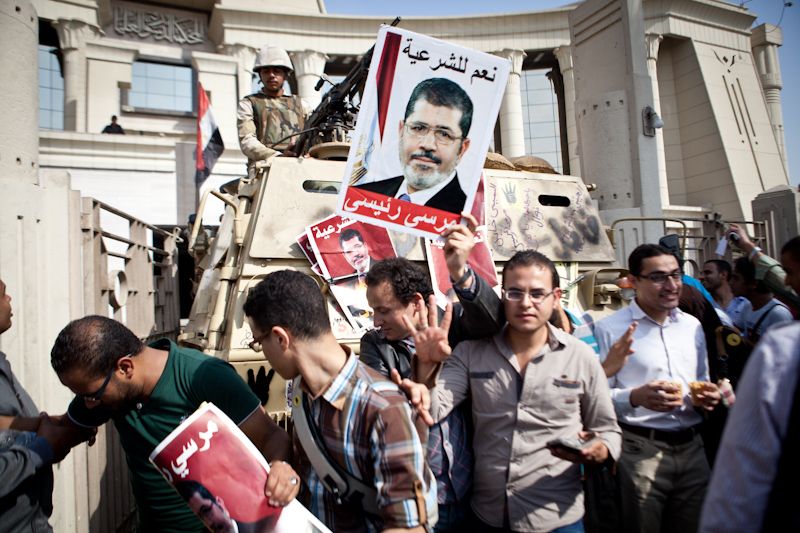
On Monday noon, when clashes broke out between supporters of Morsi and supporters of Commander-in-Chief Abdel Fattah al-Sisi in Ramsis Square as the trial took place, those working nearby sprung into action, following a routine that they have grown accustomed to.
Street vendors scrambled to remove their merchandise from the street, nearby coffee shops gathered the chairs and tables and other shops immediately rolled down their protective metal doors down. Located in a hot spot for protests, they have learnt over the past two and a half years that angry crowds can turn on them at any second.
Pro-Morsi protesters held up four fingers, symbolizing Rabea al-Adaweya, the sit-in calling for Morsi’s reinstatement that was violently dispersed on August 14, leaving hundreds dead. They were defiant and confident that Morsi belongs in the presidential palace and not behind bars. Supporters of the current military-backed government stood across the street demanding the death sentence for Morsi, holding up two fingers signaling victory over the Muslim Brotherhood.
As he was closing down his car parts shop, Ahmed Mohamed was less concerned with the trial than with the possibility of violence.
“When Mubarak was tried I wanted him a harsh sentence for him, but now I'm just tired of the instability,” he says.
His opinion as to what the outcome of the trial should be has little to do with Morsi and his missteps during his time in power.
“I want him to have a real trial so that some stability is restored but I don't want the verdict to be too harsh so that it angers his supporters. I want a middle ground that will please all parties," he says.
On the day of the trial, the streets of Cairo were relatively empty, mainly out of fear of the eruption of violence rather than out of interest in following the court session.
Gamal, who sells soft drinks, sits on the Corniche smoking a shisha as the session proceeds.
“We've been sitting here all day, we don't know anything about the trial. The most important thing that we want is for the country to be fixed, we want to be able to walk in the street without fear and to see the affairs of the country running smoothly,” he says.
“The trial doesn't concern us,” he adds.
Hassan Ahmed, a government employee, also expresses concern over reactions to the court session rather than the verdict itself.
“People are more preoccupied with the reaction of the Brotherhood to the session than they are with the trial,” Ahmed says shortly after the session is adjourned, unaware of the outcome.
Others have learnt from Mubarak's trial not to hold their breath. Two years on, the trial is still ongoing.
Mubarak was convicted in June 2012 of failing to prevent the killings of more than 800 demonstrators during the January 25 uprising and was sentenced to life in prison. However, an appeals court ordered his retrial in January.
“We know that it's going to drag on like Mubarak's trial, we're now aware that a case takes a long time in our judicial system, we were sure that nothing would happen in the first session,” Rania, an employee in a private company, said.
For some people, their lack of interest in the trial is simply because it has lost novelty.
“We're used to it by now, it has become a normal thing,” lawyer Ahmed Bahaa says. “Any president that does not please us we will send him to the Police Academy.”

Heba Afify
Heba Afify, known in journalistic circles as H, is a news reporter who traveled between working for local and international newspapers. She covers a variety of topics from high to…
تقارير ذات صلة
Hosni Mubarak (1928–2020): The rise and fall of Egypt’s longest-ruling president
Mubarak used fear of Islamists to justify a repressive police state.
The Mubaraks’ quick turn through the jailhouse turnstile
Alaa and Gamal’s brief stint in detention points to government dissatisfaction with their political standing
Back to the palace of corruption: Mubarak is freed
Ousted president to return to mansion his wife was accused of illegally acquiring
Your support is the only way to ensure independent, progressive journalism survives.
You have a right to access accurate information, be stimulated by innovative and nuanced reporting, and be moved by compelling storytelling. Subscribe now to become part of the growing community of members who help us maintain our editorial independence.
Join us