
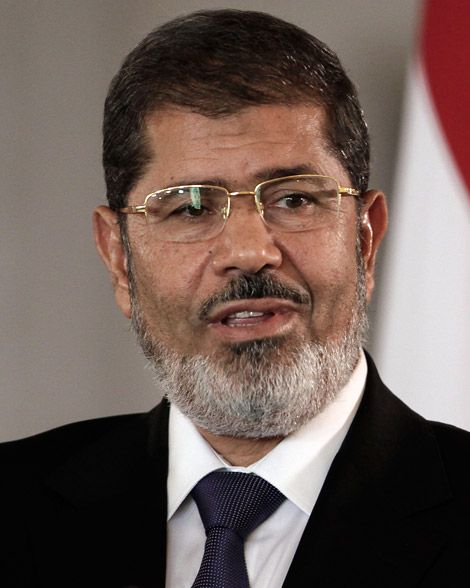
Of ousted presidents and their appetites
After covering former President Hosni Mubarak's “trial of the century” in 2011, local media are now reporting on a second ousted president behind bars. This time around, it seems that the press is most interested in the purported mental health and food habits of the once-VIP prisoner, Mohamed Morsi.
Since his trial started on November 4, media coverage has mostly revolved around the ruckus caused by the defendants inside the dock, and the fact that Morsi arrived to court in a microbus rather than a helicopter. But there was an important and fascinating secondary focus: Morsi’s prison meals and speculation about his mental state.
A comprehensive report published on November 6 in the privately owned daily Al-Masry Al-Youm (AMAY) tackled the deposed president’s time in prison thus far, focusing mostly on his appetite.
The headline read: “Morsi’s wife visits him in Borg al-Arab . . . His security: ‘He has an appetite for shrimp and fish.’” The subhead continued, “Morsi consumes large amounts of food and prefers shrimp and chicken meals.” The report listed the meals he ordered from the prison cafeteria during his first three days in prison, claiming that they cost LE2,000 and were paid for by Morsi.
The report goes on to quote prison guards saying that they were surprised at how big Morsi’s appetite was. The guards were also reportedly unimpressed by what they called Morsi’s “fake laugh.”
This is not the only instance of behind-the-scenes coverage readers have been treated to when it comes to Morsi’s stay in prison. On Sunday, AMAY’s front page carried exclusive pictures of the deposed president wearing a white prison uniform. In his first appearance in court, Morsi wore a suit rather than the uniform, while the other defendants in the dock wore the white prison garb. The story that ran with the photos boasted that the newspaper had evaded police and army security to get the photos.
This type of coverage is worlds away from the tone adopted by the media for Mubarak’s trial. Then, the press mirrored the public’s shock at seeing the man who had ruled Egypt for 30 years behind bars. The August 4, 2011 headline for AMAY’s report on Mubarak’s trial offered a remnant of the esteem the public once had for its former ruler: “The pharaoh in the dock.”
The privately owned Al-Shorouk newspaper referred to Mubarak’s fall from grace with the headline: “So you become a model for those who would follow you.”
Less than two years ago, newspapers called the 2011 post-revolution defendants “Mubarak and his regime.” Today, the defendants are referred to in a more patronizing tone, with some newspapers labeling them as “Morsi and his brothers.” In another article, AMAY described the courtroom exchanges between Morsi and his co-defendants as a “soap opera.”
In the days following Morsi’s brief appearance in court, it seemed that every psychiatrist and his mother weighed in on the apparent state of the former president’s mental health.
The privately owned Al-Watan newspaper opted to re-release what it said was an exclusive video of Morsi in detention, shot prior to the trial, on its website. This time, however, they published a lengthy psychological analysis titled, “A disaster called Morsi.”
Based on observations of Morsi’s behavior in the video, the “analysis” concluded that the Brotherhood figure was driving Egypt into “a disaster.”
The psychiatrist, Yousry Abdel Mohsen, first comments on the clothes Morsi is wearing — a blue tracksuit — and attempts to show how Morsi’s sartorial choice reflects his short-lived presidency. According to the psychologist, the choice of blue shows that Morsi leans more towards traditional colors — a clear indication of Morsi’s conservative nature and his “hatred” for “development,” Mohsen claims.
The psychiatrist does, however, consider the possibility that Morsi himself might not have chosen this particular tracksuit, “in which case, there is not much analysis to be made.”
Morsi’s body language also indicated that he was nervous, the psychiatrist says.
In the video, Morsi overestimates the death toll of the dispersal of the Rabea al-Adaweya sit-in last August, saying that 5,000 were killed on the streets, although a recent official forensic report put the death toll at 627. The psychiatrist claims that he is “subconsciously convinced of the wrong information.”
Furthermore, Morsi’s insistence that he is still the country’s elected president is evidence that he has an inferiority complex, according to the analysis.
Alas, all these conditions do not warrant medical treatment, the psychiatrist says. Instead, the doctor’s orders were that Morsi should steer clear of politics and lead a life that matches “his simple and random personality.”
Mostafa Hussein, a psychiatrist, tells Mada Masr that for medical professionals to really diagnose a case, it has to be done through a proper session — and even then, a code of ethics forbids doctors from publishing such information without the patient’s consent.
"To be able to diagnose someone, we have to sit and talk with them," he explains. "Without a proper session, this diagnosis is as good as astrology.”
Any analysis of Morsi’s state of mind is neither scientific nor accurate, he adds.
He criticizes what he called “the political employment of psychiatry,” explaining that such media-led initiatives tarnish the profession.
Following the trial, several articles purporting to give a psychological analysis of the former president’s mental condition following his speech in court were all in agreement that Morsi was delusional, paranoid and in denial about his ouster.
These claims fuel the stigma associated with mental health patients, Hussein cautions.
“Mental illness is part of the human condition,” he explains, “but people are afraid of the false stereotype of the mental health patient, that they’re violent or unpredictable.”
In court, Morsi insisted that he was still the legitimate president of the republic, leading psychologists to believe he is disconnected from reality, according to the privately owned Al-Tahrir newspaper.
While Morsi’s claims were interpreted as evidence that he is in a state of denial, a similar gesture by Mubarak was seen as an act of defiance. When Mubarak was transferred to Tora Prison last year by helicopter, he refused to disembark. According to Al-Shorouk, those present at Mubarak’s act of “defiance” responded with “a handful of smug smiles, and far more teary eyes on the faces of the prison guards and police officials.”
Mubarak remained seated in the helicopter after it had landed, demanding to know how this could be the fate of “the hero of the October War, the air force commander and lifelong military leader,” according to the newspaper.
For many, Mubarak continues to be seen as a military leader of long and distinguished service. The public perception of his civilian successor is reflected in the less-than-dignified coverage of his trial and imprisonment.

Dalia Rabie
Dalia has a pragmatic perspective on things and has a way of telling it just like it is. This informs her professional practice, with all the humor and wit that characterize…
تقارير ذات صلة
Mental health and coronavirus: Negotiating isolation and fear
“The second wave of coronavirus casualties will be primarily psychological."
Distraction and narcissism in confinement: Q&A with Stephen Frosh
"That’s the danger of all this material, I think we need more time alone with our thoughts."

COVID 19 and mental health: A Q&A with psychiatrist Mostafa Hussein
We call it “social isolation,” but we should actually think of it as “physical” isolation only.
Your support is the only way to ensure independent, progressive journalism survives.
You have a right to access accurate information, be stimulated by innovative and nuanced reporting, and be moved by compelling storytelling. Subscribe now to become part of the growing community of members who help us maintain our editorial independence.
Join us