
‘New pattern of warfare’: Dangers of attacks on Persian Gulf’s desalination plants
Black streaks of oil cut through the seas along Kuwait’s coastline, the residue of millions of barrels of crude pouring into the Persian Gulf, a nine-mile slick that fanned out in the saltwater. This was the most striking image from Iraq’s 1991 invasion of Kuwait and the world’s largest ever oil spill.
Though the ecological disaster was deemed of “little military significance” in media at the time, the spill caused by Iraqi forces constituted a weeks-long threat to people’s lives in Kuwait and Saudi Arabia, which depended heavily on desalting plants along the Gulf’s western coastline to turn the seawater — which was contaminated by the spill — into drinking water.
Fast-forward 30 years and some of the same plants have once again come into the crossfire of a Gulf conflict, this time launched 13 days ago by Israel and the United States.

As Tehran has returned fire toward Israel and US military bases in the Gulf, debris from the intercepted attacks has rained onto ports, logistical centers, industrial zones and energy facilities along the Gulf coastline once again — the sites that form the backbone of the desert cities that host millions of residents and laborers.
Desalination plants on both sides of the Persian Gulf have been affected this time. Iranian Foreign Minister Abbas Aragchi stated on March 7 that the US had targeted a water desalination plant on Qeshm Island off the Iranian coast, where port and logistical cities are also thought to have been damaged. The blow, he said, impacted the water supply of 30 villages.
A spokesperson for US Central Command has denied that the military hit an Iranian desalination plant.
Less than 24 hours later, fire from Iran would cause “material damage” to a desalination plant in Bahrain, according to the Interior Ministry in Manama, which also pointed to “indiscriminate” attacks from Iran targeting civilian sites.
Amid strict media bans in Iran and the Gulf countries, it is difficult to verify the degree and nature of the attacks, whether the facilities were intentionally targeted and what the impact was for the populations who rely on the plants.
But the pattern of damage to these and other desalination plants in the war poses a clear threat to the water-poor, oil-rich countries that depend heavily on desalination.
To unpack the nature of risk and situate the emerging pattern of damage at the Gulf and other water facilities, Mada Masr spoke to Jauad El-Kharraz, head of the Water Energy Climate Expert Network, and Mark Zeitoun, professor of water diplomacy at the Graduate Institute of Geneva and director-general of the Geneva Water Hub, a research and policy institute focused on water-based diplomacy for peace.
***

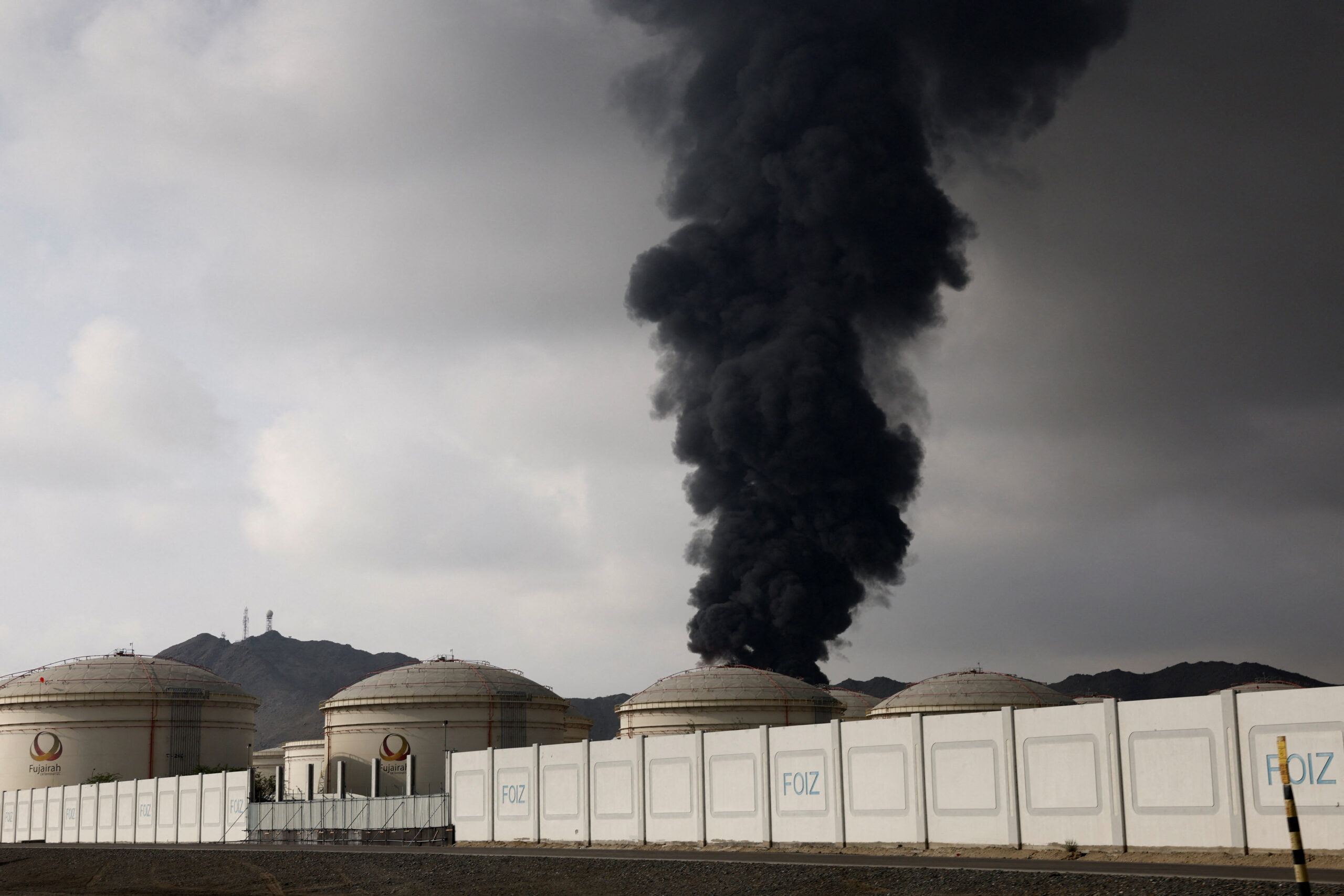
The initial days of the war saw billows of smoke rising above Oman’s Duqm commercial port and Dubai’s Jebel Ali, one of the region’s busiest marine hubs, located just 12 miles from a desalination plant that supplies the entire city. Next, was the Fujairah Oil Industry Zone, adjacent to another desalination facility.
Wherever you find logistical zones and energy facilities jut through the Gulf’s parched landscape, often on the coast for easy access to shipping, Kharraz says, you will often find desalination plants nearby. The huge processing units require steady access to a constant feed of oil and gas, in order to produce fresh water in turn.
Kharraz explains that it is standard for these types of energy, logistical and desalination sites to be clustered together along the coastline.
Each desalination plant may have millions depending on it solely for drinking water, given the scarcity of water in the harsh climate of the Gulf countries.
Groundwater reserves have deteriorated, says Kharraz, meaning desalination is “the only sustainable source for urban life and economic growth,” in the countries of the Gulf Cooperation Council.
Saudi Arabia’s Jubail desalination plant, for example, provides around 90 percent of the drinking water used in Riyadh.
“Production [is] concentrated in massive facilities,” he says, noting that this makes their exposure to attack particularly dangerous. “Targeting a single major plant in small countries like Bahrain or Qatar could lead to the immediate loss of most of their limited strategic reserves,” he explains.
Desalination provides for 96 percent of non-agricultural and non-industrial fresh-water needs in Bahrain, about 42 percent of the UAE’s, 70 percent in Saudi Arabia, 86 percent in Oman, 90 percent in Kuwait and 61 percent in Qatar.

The plants’ heavy reliance on oil and gas consumption also means that “any strike on oil and gas facilities would automatically halt water production” says Kharraz, adding that their proximity to power plants makes them vulnerable to fires.
The heavy dependence of civilian populations on the facilities means that targeting desalination plants constitutes a blatant violation of international humanitarian law, says Zeitoun.
Even beyond the norms of international law, targeting a supply of water would “breach the unwritten norms of war,” he adds, which would typically see an aggressor hold back from damaging infrastructure that is of vital importance to life due to concern that such attacks would animate opposition.
Nonetheless, there has been a slow pattern of similar attacks in the region over recent years. Yemen’s Houthis said that the Saudi-led coalition had bombed desalination plants in 2016, while Saudi-run media returned the accusation a few years later.
Israel, too, has repeatedly targeted freshwater infrastructure in its aggressions, using the Gaza Seawater Desalination Plant as a military base after the 2023 invasion of the Gaza Strip and eliminating 90 percent of the plant’s capacity, according to the Palestinian Water Authority.
Thirty Israeli attacks, meanwhile, targeted water infrastructure in Lebanon from 2023 to 2024, according to a report from Lebanon’s National Council for Scientific Research.
Kharraz says that these past wars and the Iraqi invasion of Kuwait have delivered “harsh lessons” for Gulf states, heightening their awareness that “destroying water facilities is an effective military weapon the impact of which goes beyond the loss of any other commodity.”
Some countries have taken steps to mitigate dependence. The UAE, for instance, stores water sufficient for 45 days as part of its 2036 strategy, while more recent attacks on energy and water infrastructure have also accelerated the unified water connection network project linking Gulf states, designed to allow water sharing in emergencies.
Still, the Gulf’s fragile water situation requires “comprehensive shift in the management model,” Kharraz says, pointing to strengthening advanced cybersecurity protections to evade attacks of this kind, and diversifying energy sources. Plugging desalination plants to solar or wind power could be crucial in reducing reliance on fossil fuels, which is highly combustible during military attacks, he adds.
Expanding water reuse by developing markets for treated wastewater for agricultural and industrial use would also ease pressure on large plants while providing a local “distributed” non-coastal water source, the researcher says.
But the recent damage to desalination plants in Saudi Arabia, Qatar and Bahrain underscore how such facilities have become “hostages” in a battle to establish deterrence between the opposing camps in the war, Kharraz says.
Regardless of reserve capacity, he concludes, “the psychological impact may be the deepest of all. The fear of water disruption could trigger mass panic and erode confidence in economic stability and growth” — the reputation Gulf states have spent half a century building, atop sands rich in oil but scarce in water.
For Zeitoun, the concern is that adaptation to such a pattern of attacks with no action to stop them quickly establishes a new norm. “If nothing is done to confront this pattern of warfare, then it will become the starting point for future conflicts — as we are already seeing.”
تقارير ذات صلة

Iran and US claim victory in a war that hasn’t ended. The biggest loser? The GCC
Day 40 of the war between Iran and the United States and Israel was going to be decisive, one way or another. That is because it was the day US…

To jump into the unknown: Egyptian laborers stranded in the Gulf in the time of COVID-19
The COVID-19 crisis comes as the GCC countries attempt to reduce reliance on foreign labor
Yemenis stranded in Egypt yearn for return to war-torn country
Estimated to number nearly 10,000, the Yemeni community in Egypt remains divided over the political upheaval tearing their country apart. Yet they are also overwhelmingly united in the goal of…
Your support is the only way to ensure independent, progressive journalism survives.
You have a right to access accurate information, be stimulated by innovative and nuanced reporting, and be moved by compelling storytelling. Subscribe now to become part of the growing community of members who help us maintain our editorial independence.
Join us