
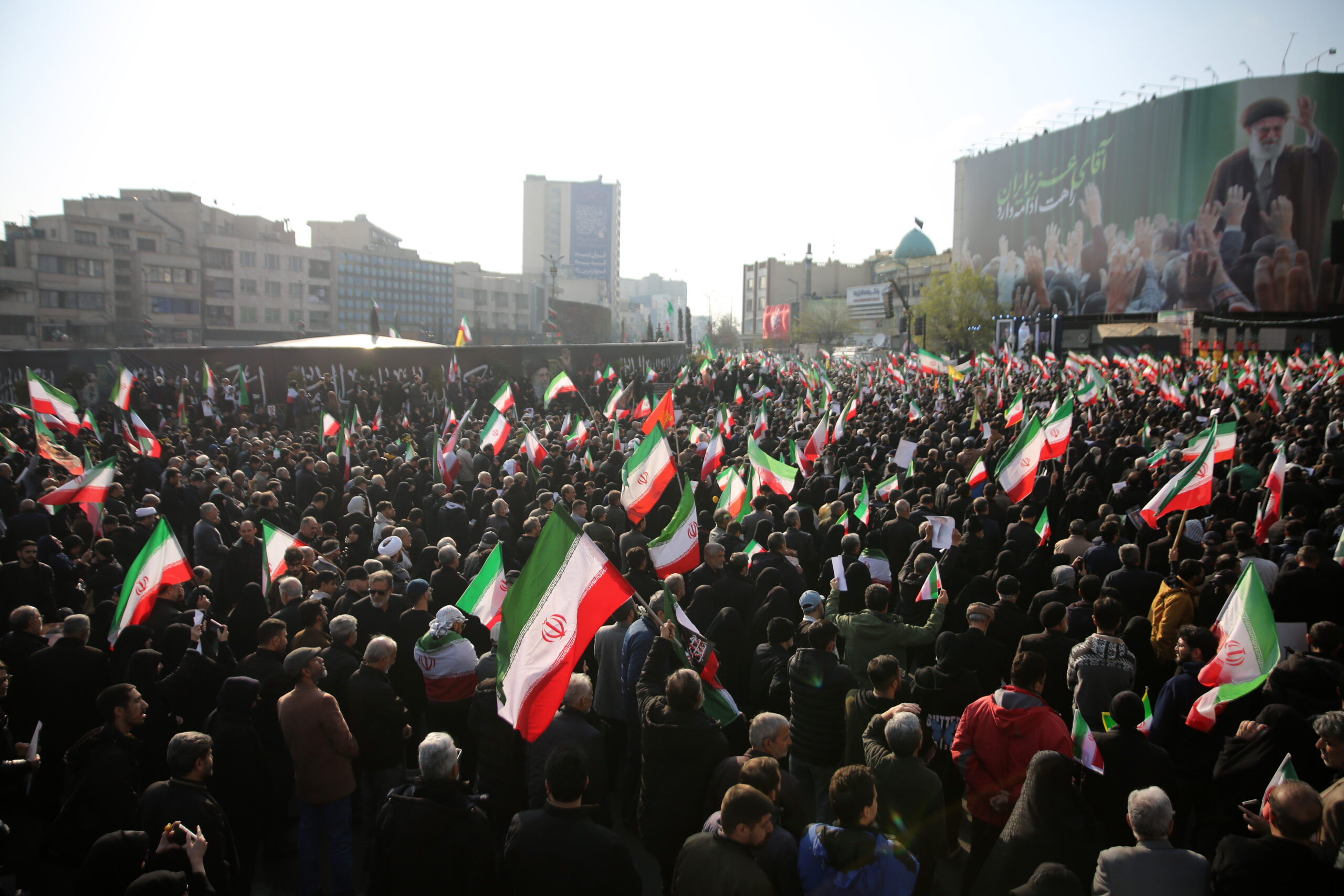
Iran under attack: Steadfastness, nostalgia and human shields
Almost two weeks have passed since the US-Israel war on Iran started, following weeks of anticipation. The earliest wave of attacks killed senior Iranian officials, the most prominent being the supreme leader, Ali Khamenei. Amidst speculations about regime weakening, the day after showed that the Islamic Republic held itself together, while also retaliating, hard. Its targets were located in Gulf states hosting American military bases, triggering a war at a regional scale, threatening international trade routes and critical oil and gas transfers, as well as the safety haven that Gulf cities have prided themselves for being.
In this conversation, we tap into the collective intelligence of five Iranian academics, journalists, artists and activists, to understand what stands behind the facade of the Islamic Republic and its institutional steadfastness so far, especially in the wake of growing internal dissent in the past years. With them, we unpack the intricate reality of a theocratic rule, dire economic conditions, monarchic nostalgia and the most recent US-Israeli assault in their ongoing quest for permanent security. Along the way, we trace the thread of history, that of the 1979 revolution, what it was, what it became and how it is re-written to produce the moment we are in.
Our guests, who were raised in Iran and left because of persecution, spoke to us on a Wednesday evening, giving us graciously from their time and mind, in a moment of uncertainty. They were:
Bahar Noorizadeh: a writer, artist and founder and organizer of Weird Economies, a platform that traces radical economic imaginaries extraordinary to the financial arrangements of our time.
Iman Ganji: a writer and researcher who focuses on political theory.
Niloufar Nematollahi: a writer and curator.
Alireza Saraf: a former prisoner, journalist and researcher who focuses on the legacy of the left in Iran.
Samaneh Moafi: assistant director of research at Forensic Architecture.
Mada Masr: What is being communicated to you from the ground from family and friends?
Iman Ganji: What is happening is mostly underreported, especially in the coastal cities in the south of Baluchistan, which are hit very hard. In those cities, many of the facilities, like medical facilities, are close to the places where military personnel live. And because these are poor areas, many people use these facilities. This is the case with the primary school in Minab, where they killed 160 children.
We have bombings in at least 19 provinces, and in the peripheries, these bombings are more intense. In Tehran, they are also very intense. The threat to life is getting worse and worse.
A lot of local police buildings are being targeted in Tehran, and like in Europe, local police are beside people’s buildings, in their neighborhoods, so we have other normal buildings being damaged too. Of course, they are targeting some infrastructure, some roads. The images coming from Tehran are apocalyptic.
Bahar Noorizadeh: In the border military posts that are being targeted, the majority of people dispatched are very young conscripts. Iran has mandatory military service. A lot of the time, these are 17 to 18 year-old conscripts. Not only is the urban fabric of the cities dense, but also the social fabric of society is much more entangled than the right-wing media portrays. “Precision strikes” are as convenient a fiction as they were in Gaza and Lebanon. There are hundreds of health, medical and cultural facilities whose contractors or shareholders are the army or the government. There’s no easy separation between “military personnel” in these sites when so many are part of the administrative staff, service workers and salaried employees across these departments.
Iman Ganji: My friend is from Bijar, and they tell me a whole neighborhood is bombed. Not only military posts in the periphery in Baluchistan or Kurdistan, but residential areas are being targeted too.
Niloufar Nematollahi: Also, radio and television centers of different cities are being targeted, and they are often located in the city center. In historical cities, they are in the older parts of town that are very highly populated.
Samaneh Moafi: When the strike on the school in Minab took place on February 28, Israeli military spokesman Lieutenant Colonel Nadav Shoshani told reporters, "At this point, not aware of an Israeli or an American strike there... We're operating in an extremely accurate manner." A few days after, the New York Times published an article that foregrounded a Planet Lab satellite map, with annotations that marked the school on the north-east corner of an Iranian Revolutionary Guard Corps base. Its title read: “Analysis suggests school was hit amid US strikes on Iranian naval base,” suggesting that the target of the strike would have been the naval base, that the school used to be part of it and was targeted based on outdated information. Many Iranians who identify themselves in opposition to the state began circulating this article with notes like, “there must be a reason they chose this school for studying,” “they must be related to the military personnel," “there is a price to liberation,” “the state had been using these children as its human shields.” Human shields are of course one of the most contested concepts in discussions about the genocidal campaign of the Israeli military in Gaza and its war on Lebanon. Israel continuously claimed that civilian casualties occur because Hamas and Hezbollah embed military activity in civilian spaces, meaning Israel bombed hospitals and entire neighbourhoods and claimed it was attacking alleged underground tunnels beneath them.
We are talking about cities here; what makes the fabric of a city is the very proximity of one building to another, one program next to another. What is a city, if not buildings beside buildings, schools beside homes, hospitals beside streets? If we, as Iranians, have not learned how to lock arms with Palestinian and Lebanese comrades to confront Israel’s language of “human shields,” if instead of confronting it we have learned to adopt it, what is there to be done now?
MM: The killing of Supreme Leader Ali Khamenei prompts us to question: How does the Iranian state operate? What kind of balance of power is there, keeping the state held together so far?
IG: I don’t think any serious analyst would say that the killing of Khamenei will trigger state collapse. If you look at the formation of the Islamic Republic as a state in the first period following the revolution, when Ruhollah Khomeini, the founder, was alive, there was some sort of a libidinal relation between the masses and the leader. Khomeini was a revolutionary spiritual leader, living in his bayt in Jamaran; he was not an institutional leader. But Khamenei, the next supreme leader, was not Khomeini. He was not a spiritual leader, but rather an institutionalist who turned the bayt of the supreme leader into a huge institution. The overall structure is of a modern state with all the theocratic elements. It is not a medieval order of some sheikhs. It is a state.
The bureaucracy during the Pahlavi era was one of the targets of the revolution because it was corrupt and ineffective. One of the demands of the revolutionaries was to de-bureaucratize the state; so you had all these grassroots initiatives, mostly by the Islamists. You had the Construction Jihad, the Farming Jihad, the IRGC were a militia, not an official army. The new regime started to de-bureaucratize the state and create its own bureaucracy.
The government wanted to centralize the bureaucracy in their hands. We ended up with two parallel systems. We had the Sepah (the IRGC) becoming an institution inside the central government, while we had an army. We had the Construction Jihad becoming a ministry. We had all these foundations. We had these seven-member committees dividing land that became institutions confiscating property of corrupt families of the monarchy, as they would say. We ended up with a government and all these parallel institutions. It is a very institutionalized country.
There was a constitutional reform after Khomeini died that clarified some of these ambiguous parts of the power structure of the Islamic Republic. We had a prime minister, a president and a supreme leader. And the supreme leader could be a council of three persons. In the reform, the prime minister and the council supreme leadership were eliminated.
It is not surprising that the death of Khamenei doesn’t topple the Islamic Republic. If the Islamic Republic is going to go away, it is because of a huge war, maybe after very vicious attacks in a short time. But I don’t think it will go away because of a civil war.
MM: It seems like a perfectly calibrated system to prevent one institution from taking over the others in a moment of vulnerability.
SM: What we saw with the massacre in January [2026 protests that swept Iran and where thousands of protesters were killed by security forces] was a striking uniformity of responses from different factions of the state. There was a single message coming from the entire establishment; it was clear, they were aligned and acting in concert. This is not something that we saw during the Jina uprising in 2022 [protests following the death of 22-year old Mahsa Amini in morality police custody]. At that time, the state’s response was more fragmented. Different factions within the establishment appeared to speak in different registers. The kind of uniformity we saw this time was new.
NN: There is no way to definitely assess the degree to which this balance is held at this point. There seems to be this very question: Will the Sepah organize a coup? Even monarchists are entertaining this question. That shows that there might be an imbalance behind the scenes that has not reached the surface.
But if we were to assume that there is a balance, it might be useful to return to the Iran-Iraq war in the 1980s. It is this war that consolidated the Islamic Republic. By deliberately continuing the war, Khomeini managed to create a facade, and behind that facade, he eliminated all internal threats to his throne, whether that was the Left or other revolutionary groups. Simultaneously, grassroots organizations were institutionalized after the war in a way that was owned by the Islamic Republic. They were very shielded. Also after that war, President Akbar Hashemi Rafsanjani came to power, and then Mohamed Khatami became president, and neoliberalization started in Iran. The way neoliberalization unfolded in Iran was like the sepahfication of Iran. So you have the development of the Sepah, and it starts to take over the economy, at the same time these grassroots organizations start transforming into more official institutions. If there is any balance between these different institutions, it is because their benefits lay in the continuation of the Islamic Republic. It is a certain monopoly that is secured only if the Islamic Republic continues to exist. Of course that balance will be disrupted as soon as there is an avenue for another kind of accumulation.
MM: What are the prospects of the state keeping it together at this point?
IG: There were always those expectations that maybe there would be a coup by the revolutionary guards, maybe not, because they don’t seem to be the agents that would do a coup.
The main crisis that triggered this unification we are talking about now is the 2009 movement [protest movement triggered by electoral fraud that led to the re-election of Mahmoud Ahmadinejad]. In 2009, we had this division between two main camps of the revolutionaries who survived the 1980s and were in the government after the war: the reformist camp and the conservative camp. After that, little by little, the state is getting more into this kind of internal purification, trying to get rid of the antagonisms between these different factions. In 2009, the Revolutionary Guard Intelligence was established. Before then, the Intelligence Ministry was the main agent up to that time that would arrest political prisoners. You would hear a few cases where someone is arrested by the Intelligence Ministry but then the Revolutionary Guard Intelligence wants to arrest the same person. So they compete over which one of them arrests this person. There was all this competition between these institutions, but the regime managed to make them more unified by pushing some of the older allies out.
This process of unification was intensified after US President Donald Trump went out of the Joint Comprehensive Plan of Action of the nuclear deal in 2018. Meanwhile, you have the uprisings in 2017 and 2019 [a series of protests and strikes held against dire economic conditions and the regime], Ebrahim Raisi becomes president in 2021 and the Woman, Life, Freedom uprising [Jina uprising] in 2022. There was a process toward a more coherent, more unified state, with less inner competition.
Masoud Pezeshkian, the new reformist president, has come to power with the slogan: not etihad, which is unity, but wefaq, consensus. They are all in consensus now. The massacre in January showed they are all in consensus now.
At the same time, the structure of the revolutionary guards is decentralized. The decentralization is partly a strategic war effort, so now each province has its own autonomy. The same happened with the provincial governments, Pezeshkian gave them more autonomy; if war happened, they could conduct their affairs more autonomously. They were expecting war after the previous war in June [2025, in which Israel and the US attacked Iran and ended with a ceasefire after 12 days]. They were doing innovative organizational things to survive this situation.
At the moment, I am not sure. But it seemed they had a very unified state there.
SM: At a symbolic level, the Shia way of life is organised around the idea of prosecution: the existence of an external enemy and the community’s identification with the figure of a victim, a martyr. The paradigm for this, is of course Hussein, who was martyred in Karbala, together with his family while standing for justice.
What could be more powerful, more unifying than the symbol of a martyr at the break of an unjust war waged by settler colonial and imperial powers? A martyr killed during a holy month like Ramadan, while working where he would always work, and alongside his family, women and children. This martyr, as a symbol, is politically potent. It can organise people, mobilize them emotionally and toward collective action, create legitimacy, and also, it can give meaning to violence. The state, today, is using this symbol to mobilise its population, get them to occupy the streets for long hours and until late into the evening. The burial of the Minab schoolgirls had a similar symbolic and political texture: there was something almost theatrical about the way it was set up and broadcasted. I'm thinking of the harrowing drone image that I'm sure you have seen, of over 150 holes dug into the ground.
Iran had witnessed political mourning only a couple of weeks earlier, on the 40 day wake of the victims of the January massacre. The bereaved families of the victims mostly adopted a language of mourning, theatrical and filled with nuances from tradition. This mourning, too, carried the symbolism of martyrdom, though with a different name, in an attempt, I think, to take distance from the religious connotations of it. The bereaved families were organizing these unique mourning sessions on the 40th day.
There is something to the role of the victim, and mourning as a ritual, and what it plays in the Iranian psyche.
MM: We actually wanted to ask you about mourning as an affective site of political mobilization in Iran, and other realms of unification at play today.
BN: The Pahlavists are rebuilding a language of martyrdom with a new vocabulary. For example, they are trying to take the language to a purified Farsi form. There is this dynamic of appropriation and variation on the theme of martyrdom, which is exactly in congruity with the state’s cultural centralization project in the past 50 years in repressing all local languages in the educational system and establishing Farsi as the national language. So now instead of “shaheed” they say “jāvīd nām.” Let’s not forget the century-long history of the word “shaheed” before its appropriation by the current state, where all leftist resistance movements, including the Kurdish guerillas, had a claim to it. So this linguistic purification operation is working in tandem with the Pahlavist slogan: “Death to the three fools: Mullah, the Left, Mujahed,” by bypassing the past hundred year history of resistance in Iran and returning to their fantasies of ancient Persia.
We also saw the extrapolation announcements of the number of the killed in January. While the internet was cut, many claims of the number of the dead were spreading virally. The function of these numbers that are spreading is to disclaim the number of the dead in this war. Now there is this game, where the Islamic Republic killed 2,000 people in one day, but Israel killed 500 so far, so it seems legitimate to still carry on. It is the depraved practice of pulling one dead against the other. This is the precise dehumanization operation happening on the ground, through the claim to the dead, that’s happening on both fronts. We must insist that each life perished in the hands of the Islamic Republic is similarly precious and irreparable as each life lost in the Israeli-American assault on Iran, and the former by no means justifies the full-scale imperialist invasion of a sovereign country as we’re witnessing today. Justice for the repressers in Iran is a right reserved only for the people, not for the foreign militaries of genocidal states.
IG: We have this manufactured disconnect that was done by a huge propaganda machine for years; this idea that the state in Iran is an entity that has occupied Iran. It also relates to the racism inherent in these ultranationalist, fascist Pahlavists, who consider the clergy in Iran as Arabs and Islam a religion of Arabs. In the 12-day war in June, people were saying the US was attacking the Islamic Republic, not Iran. This is something Trump, his Vice President JD Vance and Israeli Prime Minister Benjamin Netanyahu were saying, thus actively erasing the people who are being killed, the normal people. In the June war, 1,000 people were killed.
You have this process of erasing the 1979 revolution by calling it fetne [unrest or rebellion] and weirdly, fetne is the same thing that the Islamic Republic calls every protest movement. So the monarchists use the same language of the Islamic Republic against Woman, Life, Freedom, against 2009, etc. They call 1979 a fetne — 1953 [when Muhammad Reza Pahlavi consolidated his rule] was not a coup, which the US, during Bill Clinton’s presidency, apologized for. It is strange how this historical revisionism becomes mainstream even among the liberal intelligentsia inside Iran. There was a famous slogan in the 1979 revolution after the signing of the peace agreement with Egypt’s Anwar Sadat. “Death to three: US’ Jimmy Carter, Sadat, Israel’s Menachem Begin.” They adopted that same slogan and are chanting death to three corrupts: Leftists, Mullahs and Mujahedin al-Khalq, the Islamist marxist group that is now a shell of its previous form and hated by most Iranians.
This process intensified after 2016, where royalists were going into refugee camps in Europe to recruit Iranian refugees into their ranks, which was something Mujahedin al-Khalq was doing for years. We have huge social media campaigns, popular media. They were also smart. It is through an entertainment channel that they started historical revisionism. They made this satellite TV that all families inside Iran were watching when they were eating lunch or dinner. They were showing them entertainment, really nice graphics, very nice series and, at the same time, an alternative revisionist version of the 1979 revolution and the Pahlavi kingdom, where everything was beautiful, everybody was free, and then these Islamists came with the Left and made us backward.
In Woman, Life, Freedom, this discourse wasn’t dominant, and the mourning back then was a heritage of the 1979 revolution. We had that mourning as a site of politics in 2009, in Woman, Life, Freedom. But now, even collective mourning is not possible. If we call a protester killed in the street shaheed, which is a tradition, the left would call them shaheed, Islamists would call them shaheed, Kurds would call them shaheed, everyone would call their martyr shaheed. And now the Pahlavis are calling them jāvīd nām, which is very close to javid shah [a phrase in support of the monarch]. They are making collective mourning impossible. It is very dangerous in terms of social cohesion.
Alireza Saraf: If we understand this war as a regional war, what regionalized it was the mourning for Khamenei, the killing of the supreme leader of Iran. Several times, Hezbollah said that if you are going to attack the supreme leader of Iran, we are going to attack Israel. This made this war regional. This is the context of the revolution in 1979, its regional context, or at least part of it. It was a Shia uprising, of political Shia. We had this kind of uprising in Lebanon in 1978, and then in Iran in 1979. The position of Hezbollah, al-Hashd al-Shaabi in Iraq, the declaration of Jihad from Shia Muslims, is their understanding of this war as part of the war on Shia. And it started after Khamenei was killed, not after Iran was attacked.
MM: This brings us to the question of Iranian geopolitics and its investment in proxies for deterrence. What are the limits of this doctrine, which crumbles down in the single moment when a decision to go to war has to be taken?
IG: There is this book by Dirk Moses, The Problems of Genocide: Permanent Security and the Language of Transgression, on this paradigm of wanting to have permanent security and how the idea of security as an obvious turning point after the war on terror is tied to this genocidal behavior. At the same time, there was a threat of war before the nuclear deal; 13 years ago, a commander said if they attack Iran, we will set fire to the whole region.
But we should be careful: this is an imperialist war, it is the most naked imperialist war. It doesn’t mean that the Islamic Republic didn’t kill thousands of people in January or didn’t suppress people. But this imperialist war has been in the making since the 1990s. In 1996, Edward Said wrote that the new target of imperialism is now Islam and at the head of this Islam is Iran. He said that after the Cold War, the new enemy is now Islam, which is political Islam. And all these terms are homogenizing terms. What is political Islam? Which political Islam are we talking about? The political Islam of 1979? Or the one that took over Saudi Arabia? Or the Muslim Brotherhood? Or the one that the Houthis have? These monolithic views of political Islam are the same monolithic views of communists and the red threat.
And if you have in Israel and the US the idea of permanent security as Moses says, you have in Iran the idea of permanent instability. It is enough to look at all the US military bases dotted around Iran. I guess we arrived at this moment because of an imperialist war.
AS: It was an imposed war. It is the name of this war. It was the US and Israel that attacked Iran, in the third imposed war against Iran and the second war by Israel and the US, the third one if we add the war with Iraq in the 1980s. If Iran was a normal state, this war would have been avoidable. Iran didn’t behave as a normal state, it played with all these non-state actors. The head of Houthis and one representative from Hezbollah in Lebanon were all in Tehran the day after Hamas’ Ismail Haniyeh was killed there.
What Iran did, after Israel and the US attacked it, was attack the logic and order of the security of financial capitalism in the Gulf. It is not only a strategy of war in Iran. Iran is attacking that logic because we all know Saudi Arabia was behind many of these conspiracies against Iran.
NN: I think what you are saying stands really far from the general sentiment and the exchange between people of my generation, who are a generation younger, inside Iran. We can sit here and make thorough analysis, but the reality of it is that the identity of the Islamic Republic follows the same logic of the Karbala story [where Imam Hussein, the grandson of Prophet Mohammad, was killed in 680 AD, a foundational event for Shia muslims]. We are the axis of resistance. We are the sad Shias that are being suppressed. We are the leaders of the anti-imperialist war. The Iranian state has created this identity, not only on a national scale, but also internationally. Following this logic, it has provoked the emergence of the war. It took one idiot, Donald Trump, to be willing to go for it. It just required one man in power, this villain, saying: “Are you threatening me with your little axis of resistance that is falling apart? Well, let’s see how far this can actually go.” You are giving too much of a symbolic anti-imperialist value to the strategy of Iran in this war. Yes, you can say by hitting the centers of financial capital within the Middle East, Iran is opposing the new financialization logic of the world that is moving to the Gulf states. But you can also say that they are hitting anything that is close enough to hit.
Being in conversation with people who live in Iran, who believe in leftist ideas and who are living this reality, I sense that they are almost allergic to any kind of vocabulary that glorifies this war, and that they have this urge to find a new kind vocabulary to stay closer to what is actually going on and take a bit of a distance from leftist vocabulary and history, in order to reckon with this extremely dark moment.
I have a resistance to perceiving what is happening by remaining in the continuation of leftist history.
AS: In terms of acts of aggression, do you see Iran as responsible as the US in this war? Do you consider Iran to be the initiator of the war like the US and Israel? And do you think all these imperialist concepts are completely meaningless? Because there is the question of why we don’t have a movement against the war?
NN: I feel there is this identitarian aspect to it: We are leftists, this is the history we come from and we must explain what is going on by positioning ourselves in this continuation of history. Speaking to friends in Iran, who are putting up with extremely aggressive monarchists, they are considering some of the ideas coming from this leftist history, but also grappling with the reality they are living in at the same time. It is a different kind of approach. This question of whose fault it is: Even if we are to say Iran is an imperialist state in its own respect, it is very different in scale and nature to the US and Israel. But I think we are victimizing the Iranian state to a certain extent, if we are putting all our attention on asking who is the biggest imperialist power. Of course it is the US. But I do not think, as the left, this is the question we should be responding to. Insisting on this identity is contributing to a very big divide between the intellectual left and the left on the ground, unionizing, bringing women together, distributing the little resources that are there.
MM: We don’t want to divert from this important tension, but we also have a question about residues of organizing in Iran, and the extent to which grassroots organizing, which has an important history and went through several turning points after the revolution, has an audible voice today?
BN: I feel this is the critical conversation at the moment between different parts of the left, from different understandings. I avoid reducing it to a generational dynamic though, between the youth of Iran and the older left, as we know today from our families and environments, there are parts of this old left that also have gravitated towards the Pahlavist discourse simply due to the success of the right-wing media channels, Iran International and Manoto TV.
But to really understand the left’s defeat in Iran, we should try to look at the history of the annihilation and the repression. There's something particular in the case of Iran, which is the idea of execution. It is not just an idea, it is a practice, a tool of the state in the past 40 to 50 years, as well as the previous monarchist regime. So the left of Iran has been very much under attack, there are the massacres of the 1980s for instance. There has been ongoing repression. At some point, along this history, the practices ascribed to the left shifted to the civil realm, so the question of human rights and civil rights started to become the form that leftist practices could manifest themselves in and survive. So if we claim that a part of the society is alienated from the leftist discourse, it is also important to ground it in history. I wouldn’t blame this entirely on the left per se, I would put the blame on the double force of the state and the heavy investments in Zionist propaganda machine: foreign satellite media like Iran International and Man-o-to TV that were initiated since before the Green Movement in 2009. The left of Iran is weakened due to this long durée of state repression and Zio-monarchist investment that has caused this situation we are in. All of us are in exile in some way or form for this reason.
At the same time, it is extremely important not to go by these statistical observations to draw a general conclusion whether the people in Iran are in favor of regime change “by all means” or not. We are not here to use the extremely limited data we receive from our close circles to draw such consequential conclusions for the fate of an entire country. I would like to stress this point in closing: Many pro-intervention accounts build their argument on the basis of the supposed popularity of their position. This claim to “representation,” of being the voice of “the majority,” first of all, is a media delusion and fabrication. But even if such claims hold (again, an impossibility as there are no verified statistics or data), it is crucial for any progressive force to be on the side of those who do not want war to destroy their land, life, homes, loved ones and future, whether they’re in the minority or not. War is not a question of majoritarian democracy, a simple statistical question (like Instagram polls) on how many are for or against, this is a dangerous logical fallacy that must be opposed by all means. None of my friends I still have contact with in Iran support the war and they’re baffled and enraged by how the diaspora is whether seeking or normalizing “freedom bombs” on their behalf.
IG: In terms of organizational rights, freedom of association, freedom of assembly, they don’t exist in Iran. You had the revival of the syndicate of bus drivers, committees for organizing the working classes, a lot of civil society organizations, all of them were suppressed, activists were imprisoned or went to exile. Part of the problem we are witnessing now is that there is no discourse that could at this moment resist the more reactionary part of the opposition. Of course, it is mainly the state’s fault. But when it comes to the question of war, I would refer to the UN special rapporteur for human rights and terrorism who just said this is an obviously illegal war that Israel and the US started against Iran.
There have been, despite all the repression, teachers, nurses, workers and pensioners protesting for a long time. We had a lot of strikes, but because of this war, all these protests stopped. In the 12-day war, they stopped as well. Otherwise, we were witnessing eight to nine protests everyday. We have repression inside and the constant attack on working class organizers, teacher’s organizers, pensioners’ organizers, but also the attack by the ultra-right opposition, even on liberal opposition, like Nobel Peace Prize winners, lawyers and all the liberals in jail. All these attacks from media propaganda and social media campaigns against these figures tried to discredit them. This war has not started with a simple attack. You have this discursive preparedness, voices asking for bombardment. The main culprit in suppressing the civil society and working class organizing is the Islamic Republic, but you also have the external war putting a harsh stop on these activities, making a lot of people unemployed. You see how this foreign aggression can kill all these civic attempts.

تقارير ذات صلة
‘Typical negotiating lines’: Assessing the 1st round of US-Iran talks
Regional diplomats and officials in US foreign policy quarters say talks will likely resume.

Iran’s insistence on Lebanon ceasefire a test for regional sway
After authorizing the deadliest strikes on Lebanon in years on Wednesday, Israeli Prime Minister Benjamin Netanyahu took to the podium in a national address to assure his audience that Tel…

Iran and US claim victory in a war that hasn’t ended. The biggest loser? The GCC
Day 40 of the war between Iran and the United States and Israel was going to be decisive, one way or another. That is because it was the day US…
Your support is the only way to ensure independent, progressive journalism survives.
You have a right to access accurate information, be stimulated by innovative and nuanced reporting, and be moved by compelling storytelling. Subscribe now to become part of the growing community of members who help us maintain our editorial independence.
Join us