
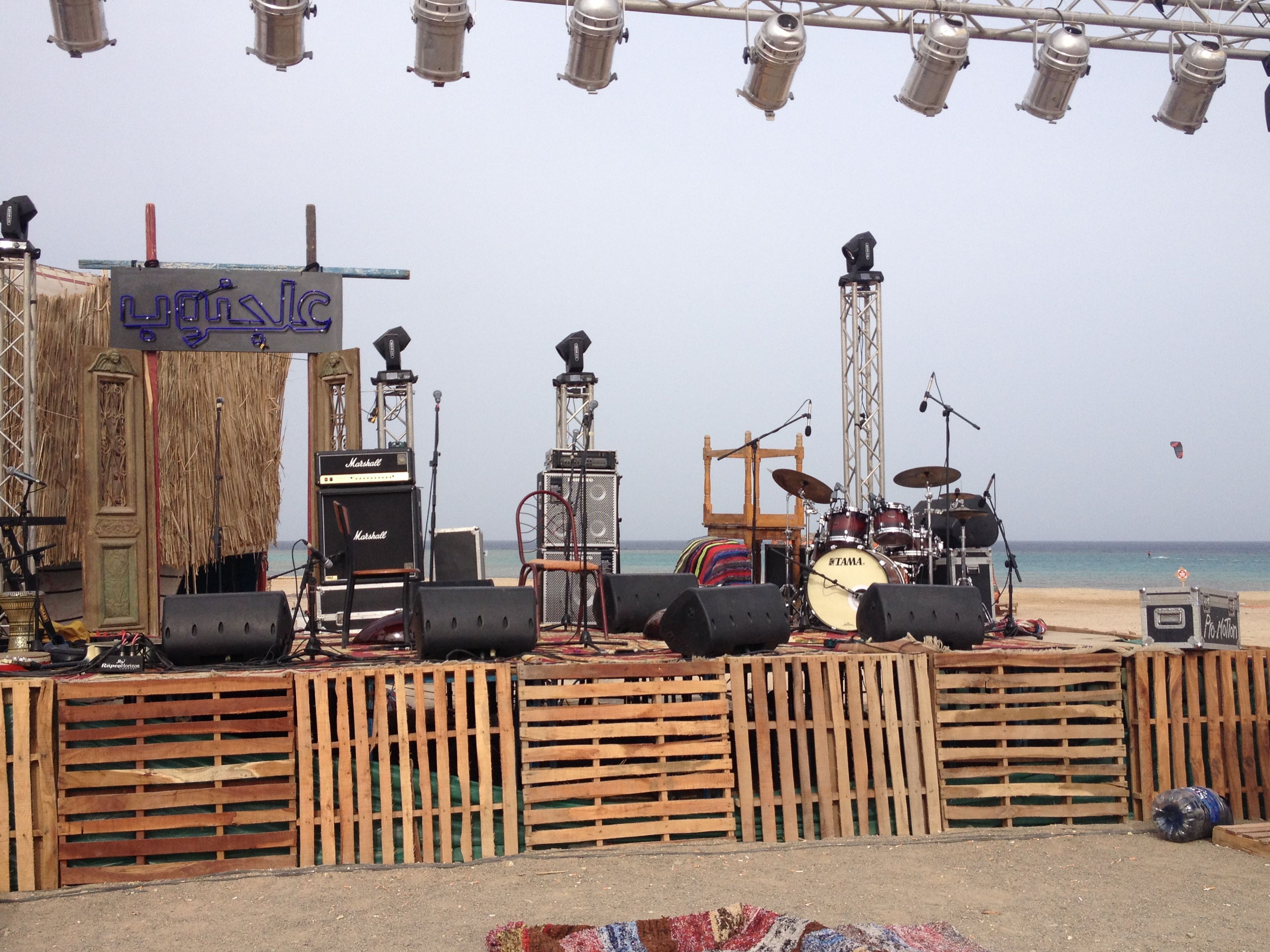
Hippy hypnosis at 3alGanoob music festival
On the last morning of the 3alGanoob festival, a massive windstorm blows over the campgrounds. After three days of unavoidable sun, the wind is welcome. But then a tent flies into the windshield of our car, smashing the glass into a million cracks. Some say it’s an act of God. I say it’s a bad place for a parking lot. But we’re here for music and nature, and it’s only fitting that the latter eventually has her say.
There’s not much we can do — it’s Easter — so we go and dance. First band of the day is Baheya, a Sheik Imam cover band from Cairo. They sound alright, your typical Arabic folk with a couple ouds and some eastern percussion, but I can’t get into them.
By the time Meshwar, an Arabic reggae band, make it on stage, we’re a quarter way through our warm gin and feeling better. Meshwar is an eight-man band fueled by peace-driven messages and an energy that infects everyone in earshot. The trumpet and saxophone are brilliant. The sandy dance floor is quickly covered with hundreds of bare feet. Bodies in bathing suits and hippy gear move their outstretched arms and take lazy two-steps with snaky back bends and bobbing heads. They’re the best band yet out of 19 acts in the festival.

On previous days, the perfectly playful DJ Eskalob’s mix of reggae, swing and ska was a top performance. I also heard Safi and his band had a great show playing their special brand of indie, jazz and soul. Like Jelly was, as usual, a crowd master — the group's satirical music sketches executed with professional showmanship. Nadah El Shazly was dynamite with her one-woman live-electronic show. Maurice Louca, one of the best live-electronic DJs in Egypt, proved that he deserves the hype.
Abo and Sennary, though, utterly depressed me with their hyper-literal “revolutionary” songs that seem strangely placed: People on a beach sang along to hooks about Mohamed Mahmoud Street clashes and the Muslim Brotherhood. Maryam Saleh and Zeid Hamdan performed songs from their trip-hop, psych-rock-styled Arabic album, but the vocal levels were off and Saleh’s voice seemed oddly loud over the music. Eka3 founder Tamer Abu Ghazaleh was vibrant onstage and a machine on the oud;— he plays it like a rock star — but his vocals were also too high and a bit intrusive.
But today it’s all about Meshwar. We fall into a hippy hypnosis as clouds of smoke swirl into the gold, orange and purple hues of beach-side sunsets. We forget our sunburns, the wild wind and the car. We’re reminded what we came here for.
That said, it’s always difficult to remember the cause when forced to enter any of the bathrooms. For the women residing in the Deep South camp, they look like a crime scene of bodily waste that piled up disastrously over the three days. The ratios are off. There are simply not enough bathrooms for the amount of people.
Later, Alexandrian Arabic rock band Massar Egbari attempt a Pink Floyd-textured set that drives people off the dance floor. Skilled, but not very experimental. Fulltone then steals the show with a guitar-based deep techno and deep house. The green, blue and white spotlights from the stage illuminate a hedonistic dance frenzy, then the final act, instrumental electronic house band Soopar Lox, takes us late into the evening, rattling the dusty dance floor. By this point, I’m laying on the periphery on kaleem rugs falling in and out of sleep. Three days of camping, trudging across sand, in and out of water, music and the brutal sun eventually fell the best of us.
In the cheap Coleman tent we fall onto our sleeping bags like warriors. Like Jelly’s performance from the previous evening reverberates through my head and their catchy “brarapppa, barappaapaas” lull me into a deep slumber. But only for a few hours, because soon the sun will brutally beat through the nylon, forcing us to face our inevitable return to the city.

Two days later, I call Amr Ramadan. He sounds exhausted.
He co-founded the festival with Youssef Atwan and Muhammed El Quessny from Like Jelly in 2013. Ramadan and friends had been staying at the Deep South camp in Marsa Alam when the generator caught fire and self-destructed. For camp owner Karim Nour, this was a devastating blow — a new generator was out of the question financially, and he couldn’t run the main utilities such as water and electricity.
Ramadan suggested holding a festival to raise money, while also implementing more environment-conscious energy solutions to lessen dependency on diesel to run the generators. This enabled Nour to purchase solar water heaters, giving him more flexibility and environmentally friendly options.
They sought advice from friends working in environmental NGOs and awareness groups to find green solutions and figure how to keep the festival from having a negative environmental impact.
At the first 3alGanoob, which also took place during Easter, four bands performed: Like Jelly, Abo, Youssra El Hawary with her nifty accordion, and Baheya.
Ramadan says it was much smaller, about 400 people rather than the 1,000 who came this year. It was more of a gathering of friends, musicians and the environmentally conscious to raise money over three days of film screenings, music and beach-side activities.
This year, Atwan and El Quessny beefed up the program with 19 bands (120 musicians) while bringing in Gezazy, a home accessory company that uses recycled materials, as art directors. They created sculptures and facilities, including the stage and several bathrooms. Their most prominent sculpture was a tree planted between sea and stage, ornamented with Stella bottles that became radiant with moonlight. Artist Kareem Osman created visuals for the performances using a mini-tent lit by multicolored projections.

This year’s festival expanded from last year’s Deep South to include the adjoining Aquarius and Bedouin Village campsites. Guest either rented a tent from 3alGanoob for LE950 or pitch their own for LE750 (both included the festival ticket). Straw huts were available for those who booked early enough.
While the first 3alGanoob barely broke even financially, this one made a slight profit, says Ramadan. The bands semi-volunteered, acting more as “partners” — they got accommodation, transport and a per diem. The organizers say they plan to pay full fees next time, though many of the bands told me they were eager to help this year to build the festival and mobilize domestic tourism to Marsa Alam.
“Most of the costs were attributed to the renovations and maintenance of two of the campsites that were previously inoperable: Deep South and Aquarius — the latter was closed for the past couple of years,” says Ramadan. “They’d been having a really hard time rebuilding and maintaining their essential utilities including electricity, sewage, running water.”
He says additional costs included sound and light equipment, tents and rugs. Last year, the festival was operated entirely by volunteers, but this year there was a staff of 10 paid employees and about 30 volunteers.

“We’re working on building a culture of camping, and environmental consciousness when camping, which will come slowly. Last year people used water extensively. This year they did as well. Still, people don’t really get desert usage of water — sparingly. We also have a part to play in that — we couldn’t get the briefings to everyone because we had limited time. A lot of people came at once.”
This could also have been made easier through more literature or signs readily available for guests to understand the environmental rules and cleanup essentials. More waste bins and ashtrays would also help.
“One of the things we have to improve on each year is the environmental impact,” says Ramadan. “We have a clean up with the volunteers after the fest, and they’re still cleaning now — it’s been two days.”
I imagine the clean up was tiresome. When we left the campsite and beach was trashed. Many festival-goers helped to haphazardly sweep the beaches, but two rounds of organized clean up might be better than leaving it all to the last day.
Cleaning was organized in partnership with Cairo art center Darb 1718 as part of their Out to Sea? The Plastic Garbage Project, aimed at building awareness about the negative effects of plastic on nature through a traveling exhibition.
Ramadan makes sure to inform me of one more crucial factor during our telephone interview before hanging up.
“There are no commercial sponsors, and that was a decision made by the team as to keep it more organic,” he says. “So essentially, everyone who came, whether they rented our tents or brought their own, were actually the sponsors of the event — of all the building, refurbishing, and revamping of these camps.”
3alGanoob has a long way to go. The logistical planning, programming and environmental consciousness could improve. That said, it came to represent a precious sanctum for many attendees, uncontaminated by the poisons of Cairo. A sense of freedom, resistance and community hung in the air — suspended in the bass lines and melodies, invisible yet tangible to all that cared to touch it.

Maha ElNabawi
After graduating from the American University in Washington, DC with a Bachelors degree in Business, Maha began her publishing career in NYC with indie pop culture magazines, the likes of…
تقارير ذات صلة
In discussion: On 3alganoob, jamming and beautiful beaches
3alganoob give culture reporters Habiba Effat and Maha ElNabawi, and – of course, Ziggy the dog – the details on this year’s festival.
In discussion: On Oshtoora, bunnies and music festivals
One recent evening, Maha ElNabawi, Rowan El Shimi and Ziggy the dog met with the core team behind the much-anticipated Oshtoora festival — Heba El-Sherif, Muhammad El-Quessny, Youssef Atwan and…
Sofar Sounds fits snugly in Cairo’s DIY culture trend
Short-lived artist-run spaces, imaginary schools, newspapers set up by groups of journalists, rooftop supper clubs and online metal concerts — DIY initiatives seem to be all the rage in Cairo…
Your support is the only way to ensure independent, progressive journalism survives.
You have a right to access accurate information, be stimulated by innovative and nuanced reporting, and be moved by compelling storytelling. Subscribe now to become part of the growing community of members who help us maintain our editorial independence.
Join us