
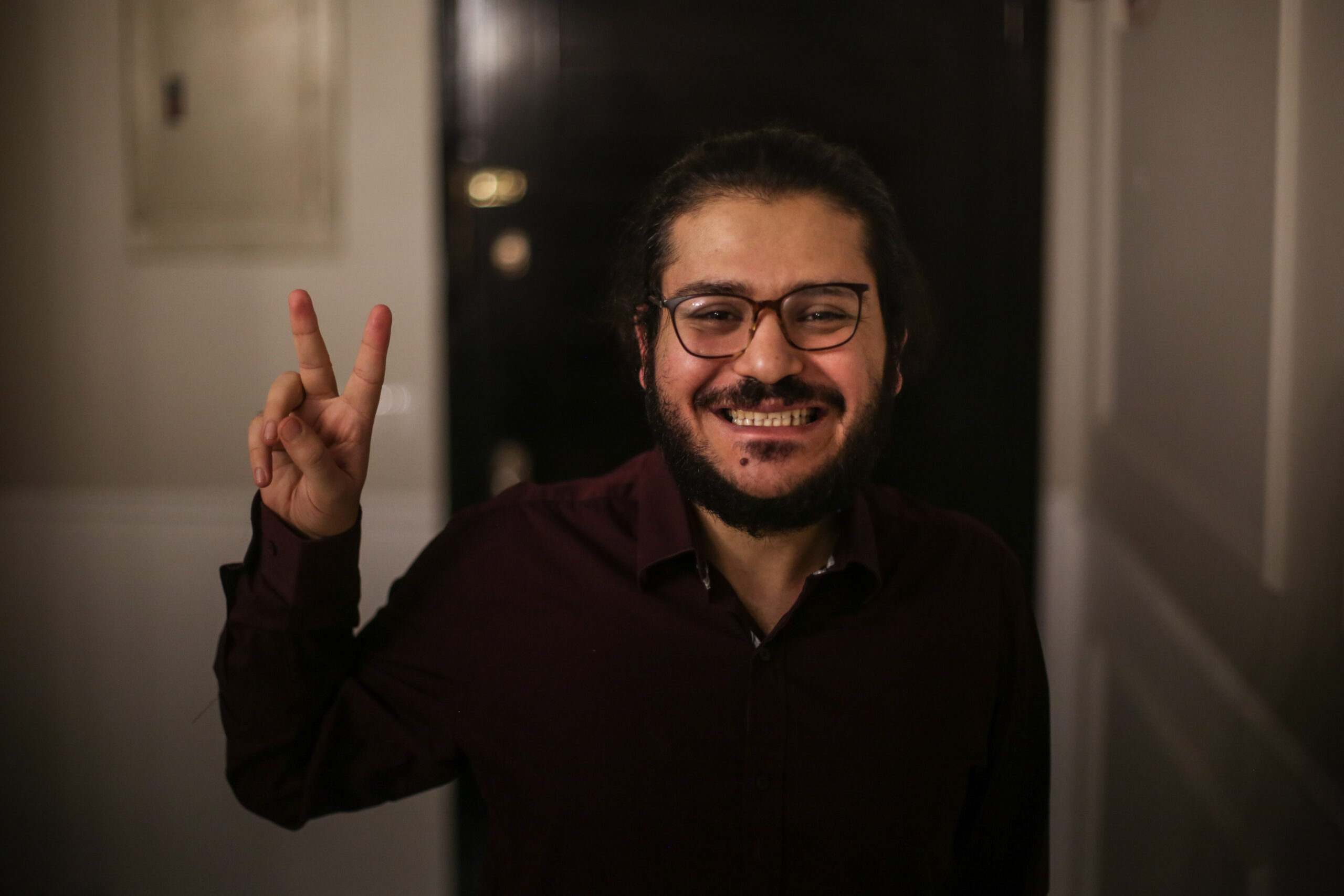
Dozens of Zamalek matches in detention: A profile of Patrick Zaki
Before the surprise release of 30-year-old researcher Patrick George Zaki, some of us traveling the road from Cairo to the city of Mansoura to attend Zaki’s trial discussed different scenarios for what might come out of the trial set to take place on the morning of December 7 before the Mansoura Emergency State Security Misdemeanour Court.
Zaki, a researcher specializing in religious and gender discrimination issues at the Egyptian Initiative for Personal Rights, traveled to Italy in 2019 study for a postgraduate degree at the University of Bologna.
In February 2020, returning to spend a vacation in Egypt after the first year, he was arrested upon arrival at Cairo International Airport.
Zaki was held in remand detention for 19 months before he was referred to court on false news charges in relation to an article he penned for the Lebanese news outlet Daraj summarizing a week of events affecting Egypt’s Coptic Christian population from his point of view as a Copt.
Dreaming up an end to this nightmare, the best-case scenario we came up with was that Zaki would be sentenced to two years in prison, which he had already spent in custody within the investigation wards of Tora Prison Complex, meaning he would be eligible for immediate release. The worst-case scenario: incessant postponement of the trial hearing, as is usual in this kind of case.
“Many times, waiting for the disaster is more difficult than the disaster itself,” Zaki once told his mother during one of her visits.
A week before Zaki left for Italy, a friend invited me on a weekend night to join a gathering of their friend group, the Multi Hawks, at their house. A skilled player of football video games, Zaki was also there.
I didn’t know him very well before that night. With overlapping professional circles, we’d only crossed paths briefly, yet he was among the few in those circles that I remember well. He was young, a diehard Zamalek fan and a Christian, too, had studied pharmacy at the German University in Cairo and worked in a human rights organization: a set of experiences that are rarely concentrated in a single person.
Zaki was by far the youngest of the Multi Hawks. After a while, he succumbed to the easy vibe of the gathering, abandoning etiquette to show a bit of juvenile behavior that prompted us too to bring out our childish competitiveness alongside him. He would provoke one of us, gloat when he scored, or make fun of his opponent after beating him — behavior that could only come out of a stubborn Zamalek fan.
This love for challenge, so apparent in Zaki’s passion for football, was also clear in his life. That night, Zaki told us about his plans to complete his studies in Italy. “I’ll leave for a year or two to study a little. I need to learn something new.”
Before corporate global interests dominated the beautiful game, the Mediterranean country that Zaki chose was the home of classic football, and as a Zamalek fan, he shared the mature loyalty of Italian fan groups for their clubs and the mentality of supporting the game.
Zaki later became a fan of Bologna FC, the club of his university’s city. “The beauty of supporting football in Europe is in supporting your hometown’s team. Besides, Bologna aren’t bad at all, they have a really strong team that comes out sixth or seventh every year. I don’t need to seek out another team to support. It is nice to support the team of the place you’re in. It’s a nice time and there’s a give and take. And they win,” he says.
Studying in Bologna was more of a change of pace. “I studied pharmacy at the German University in Cairo; studying [at GUC] is just memorize, memorize, memorize.”
He recalls his first exam, an oral assessment, on the history of gender. “When I entered, an Argentine girl was taking the test before me and she was very nervous. The professor said, ‘by the way, I know Spanish. You can speak in Spanish.’ I heard them, so I decided to try something new. When it was my turn, I told her, ‘Excuse me, I won’t answer the question in English.’ She asked why and I told her that since the girl before me had taken the exam in Spanish, I would take mine in Arabic. ‘I will translate the Arabic,’ I said, ‘but give me a bonus grade for it.’”
At Bologna, you have the space of ease to think and make mistakes, for extensive reading, going to film festivals and sharing your impressions in lectures, says Zaki. “I learn through parties and other different means, far from the outlook of one textbook.”
What’s more, Zaki adds, Christian families in Egypt have inherited the idea that “‘our son must be the best in school.’ So, my mother — without knowing, of course — put heavy pressure on me when it came to studying. ‘You must get the highest grade. You must be the best.’”
Perhaps his experiences growing up as a member of the country’s Christian minority may also have influenced his choice to study gender equality, and his interest in discrimination on any grounds. On the day before the December 7 court hearing, Zaki’s mother shared a memory from his childhood. “Patrick loved football. He used to study only so we would let him watch football matches on TV as a reward, or for example, or take him to the club during holidays. When I applied for him to join Mansoura SC and started following his training, I discovered that the coach would always exclude him from training because he was the only Christian in the team.”
Zaki says it didn’t bother him too much. “I understood the issue long ago, as in school we used to play matches of Christians versus Muslims. I was aware of the issue, though I didn’t know what it was called. But I continued to be the only one who participated in the school’s activities to try to get over it.”
After that, Zaki distanced himself from the idea of playing football professionally, but he continued to play with his friends or in the competitions organized by the church in Mansoura as part of its sports activities. Even when he traveled to Italy, he kept playing football with fellow students who were fans like himself.
“We were all brought up in closed societies. I was a very ordinary young man. Not only that, I was even conservative at one time when I was young, before I came to Cairo for university. But the 2011 revolution was a window for me to open up to ‘information’ in general. And I, from a young age, was interested in the idea of minorities, of course, due to what I noticed at school. So, I always paid attention to the problems of people who belonged to smaller groups. After the revolution, I also discovered many problems that women faced and that began to become more visible in the streets.”
While preparing to leave for Italy, Zaki’s father told him for the first time that his great-grandmother, Adela, was Italian.
His father recalls the tale: “At the beginning of the twentieth century, Adela came from Italy with her father and uncle to reside in Egypt. They chose Mansoura and lived alongside the Greeks in the city, which was calm and attracted people of various nationalities. During World War II, Adela’s father feared that something might happen to her. He married her to an Arab with Lebanese citizenship and her name became Adeela. But she never saw her grandson, George, father of Patrick.”
Zaki arrived early at the courthouse in Mansoura. His name was the second on a list of 120 people whose incarceration in Mansoura was being considered. Lawyers representing Zaki, who had heard that he was transferred from Tora to Mansoura the previous day, arrived early as well, setting out from Cairo at 6 am and arriving moments before the start of the hearing. Patrick's family, his colleagues and diplomatic delegations from several embassies following the trial proceedings were also present in the courthouse.
Hoda Nasrallah, a lawyer for EIPR, and the rest of the defense team submitted requests to the sitting judge. They asked for a copy of the testimony given by a police detective who had claimed in the arrest report that Zaki was taken from Mansoura rather than from Cairo airport, and for the testimony of the National Security Agency officer who had conducted the investigations in order to probe the reasons for the false news charges. They also asked for an official witness statement from a legal inheritance dispute that Zaki had cited in his Daraj article, a case in which the judge refused to accept testimony from a Christian man.
When the State Security Prosecution indicated that it was ready to plead, after which the judge adjourned the consideration of defense requests until the end of the session, which lasted four hours. And we waited for the decision in the courtroom.

After his first year of postgraduate study, Zaki decided to return to Egypt for four days to visit his family at his mother's request. She says she wishes she hadn't asked him. “Patrick and I were very attached to each other. When I had him, we were living in Alexandria and I took five years off work to take care of him. I learned motherhood at his hands before his sister Marise was born, as he is my eldest child,” she adds.
Patrick arrived in Cairo on Friday night, with his family waiting outside the airport. He called them to say he was at passport control. An officer asked him to stop for a moment. Seconds later, he called his father again, “Dad, something strange is happening.” Communication between them was lost. His family did not know what had happened. They remained outside the airport all night, and were not allowed to enter. No one informed them of Zaki’s fate.
Meanwhile, security personnel came for him and took his passport after the passport officer stamped it. He was detained. A lawyer for Zaki previously told Mada Masr that Zaki was threatened and subjected to electric shocks while he was questioned about his work and activism.
News spread that a graduate student studying in Italy had been arrested, though no official statements were made until the Interior Ministry said two days after the arrest that the detained master's student was not Italian.
On Saturday, his family learned that Zaki had appeared at Mansoura Police Station. He was interrogated on charges mentioned in the National Security Agency’s investigation report: “publishing and spreading false news, and misusing social media.” Screenshots of posts from his personal Facebook profile were annexed to the investigation. But the report claimed that Zaki had been arrested in Mansoura on Friday, rather than at the airport. Attached to the report was an arrest warrant for Patrick from December 28, just over a month before his arrival.
After the interrogation ended on Saturday evening, the Public Prosecution ordered Zaki detained for 15 days pending investigation. Lawyer Wael Ghaly appealed against the decision before a judge at an appellate court in Mansoura, arguing that Zaki should not be held on remand since he had a known and fixed place of residence. The plea was not discussed and the judge dismissed the appeal. On February 22, Zaki got another 15 days, entering the well-known cycle of remand detention renewals and crushing his lawyer’s hope that things would be over quickly.
Eight days after his arrest, the Public Prosecution issued a statement on Zaki’s case, reiterating the false news and incitement charges and alleging that after the prosecution issued a warrant in September, National Security Agency personnel had gone to search his residence and arrest him, but had not found him at home.
This never happened, says Zaki’s mother. No one came to search the house or look for Zaki before he returned. If that had happened, she asks, “would it make sense for me to insist on him coming back?” In turn, the family published a statement saying, “Our son never represented any danger to anyone, but was a real help and support to many ... We never expected him to be treated in this way or that one day we would live to face these fears for the safety of our son.”
Fellow students in Italy wrote about Zaki in solidarity on Facebook and Twitter and hundreds took to the streets of Bologna on February 18, demanding that the Egyptian government release him.
A restaurant in Bologna named two of its sandwiches after Patrick and Giulio Regeni, an Italian doctoral researcher thought to have been murdered at the orders of security officials in Egypt in 2016.
Four days after the arrest, the Italian ambassador in Cairo visited the then-head of the National Council for Human Rights, Mohamed Fayek, and asked him about Zaki’s condition.
The Italian foreign minister's office told La Repubblica that the minister was following up on Zaki’s detention, while the head of the Italian parliamentary committee investigating the Regeni case, Erasmo Palazzotto, tweeted that the Italian government could not ignore the incident and continue its relationship with a country that violates human rights.
United States Congress members, including Rashida Tlaib, Ilhan Omar and Alexandra Ocasio-Cortez, sent a letter to the Egyptian ambassador in DC, calling on the president to take action to protect human rights in cases including Zaki’s.
European Parliament head David Sassoli issued a demand for Zaki’s release. In response, the Egyptian Judges Club spokesperson, Reda Mahmoud al-Sayed, described the demand as “a blatant and unacceptable interference in the work of the Egyptian judiciary and the Public Prosecution, and a violation of the guarantees of judicial independence stipulated in international covenants,” while then-Parliamentary Speaker Ali Abdel Aal likewise “regretted” Sassoli’s reliance on “rhetorical and false” information from organizations that “lacked credibility.”

Nevertheless, Zaki’s February 2020 arrest coincided with the advent of the largest arms deal ever to take place between Egypt and Italy.
According to Enterprise, the Egyptian Naval Force wanted to buy two multirole warships for 2.4 billion euros from Italian shipbuilder Fincantieri. Italy offered to halve the value of the two ships if the Egyptian navy obtained a 500 million euro financing loan from the Italian Cassa Depositi e Prestiti Bank.
Four months after the deal was announced — and after four months of Zaki’s detention — Italian Foreign Minister Luigi Di Maio told the Italian parliament that talks on the sale of the two naval vessels to Egypt were still ongoing and that “we are concerned about [Zaki] as well. The Italian embassy in Cairo is following up on his hearings. We will continue to follow up on his case.” Di Maio also said that his government was still making progress in investigations into the Regeni murder.
Italian sources who spoke to Mada Masr last year noted only that the human rights situation in Egypt "may" impede the Italian government's ability to implement the economic and military cooperation agreements with Egypt.
Patrick's father, who heard much about events in Italy, always returns to the most pressing question: "What has he done to be arrested?"
For the first five months in prison, Zaki did not attend interrogation sessions in person. His first trip from prison to the prosecution, and the first time for him to see the street since his detention, was on July 27, 2020.
Zaki’s isolation was intensified still further by the coronavirus pandemic, after which prison visits were suspended.
EIPR requested that Zaki be allowed to make a phone call, but the request was refused by the Tora prison administration. The rights organization also called on the Interior Ministry and the Prison Authority to allow detainees and prisoners to communicate by phone with their families and lawyers to inform them of any developments that may arise in their cases.
Article 38 of the prisons law gives “every convict the right to correspondence and telephone communication for a fee,” and that “the remand prisoner shall have this right unless a decision is issued by the relevant Public Prosecution or the investigative judge to the contrary.”
When visits resumed in August 2020, it was under the condition that visits would be once monthly, for one visitor at a time. His family took priority, until his lawyer Hoda Nasrallah finally was able to visit Zaki in December 2020.
“The hardest part of prison is that you are outside time,” says Zaki. “I may be a prisoner with privileges compared to others. But in general, your daily life is based on a set of vague news items, which you try to decipher, analyze with colleagues, each gives their opinion, and then you see how it could affect your position.”
“You try to turn every minor bit of news into a sign that you will be released. Little news. Like, if Zamalek wins two matches, you say ‘I have good luck ... I'll leave at the next [court] session.”
It took dozens of Zamalek matches.
تقارير ذات صلة

The long and costly wait for a new personal status law
Bassant Soliman’s suicide triggered renewed public backlash against personal status laws in Egypt
We will sit together on Srifa hill, Qassem
Two friends try to reclaim a memory other than what the Israeli genocidal machine carved into them.

How Israel recognized Somaliland
Somaliland officials have pursued formal diplomatic recognition for over 30 years.
Your support is the only way to ensure independent, progressive journalism survives.
You have a right to access accurate information, be stimulated by innovative and nuanced reporting, and be moved by compelling storytelling. Subscribe now to become part of the growing community of members who help us maintain our editorial independence.
Join us