
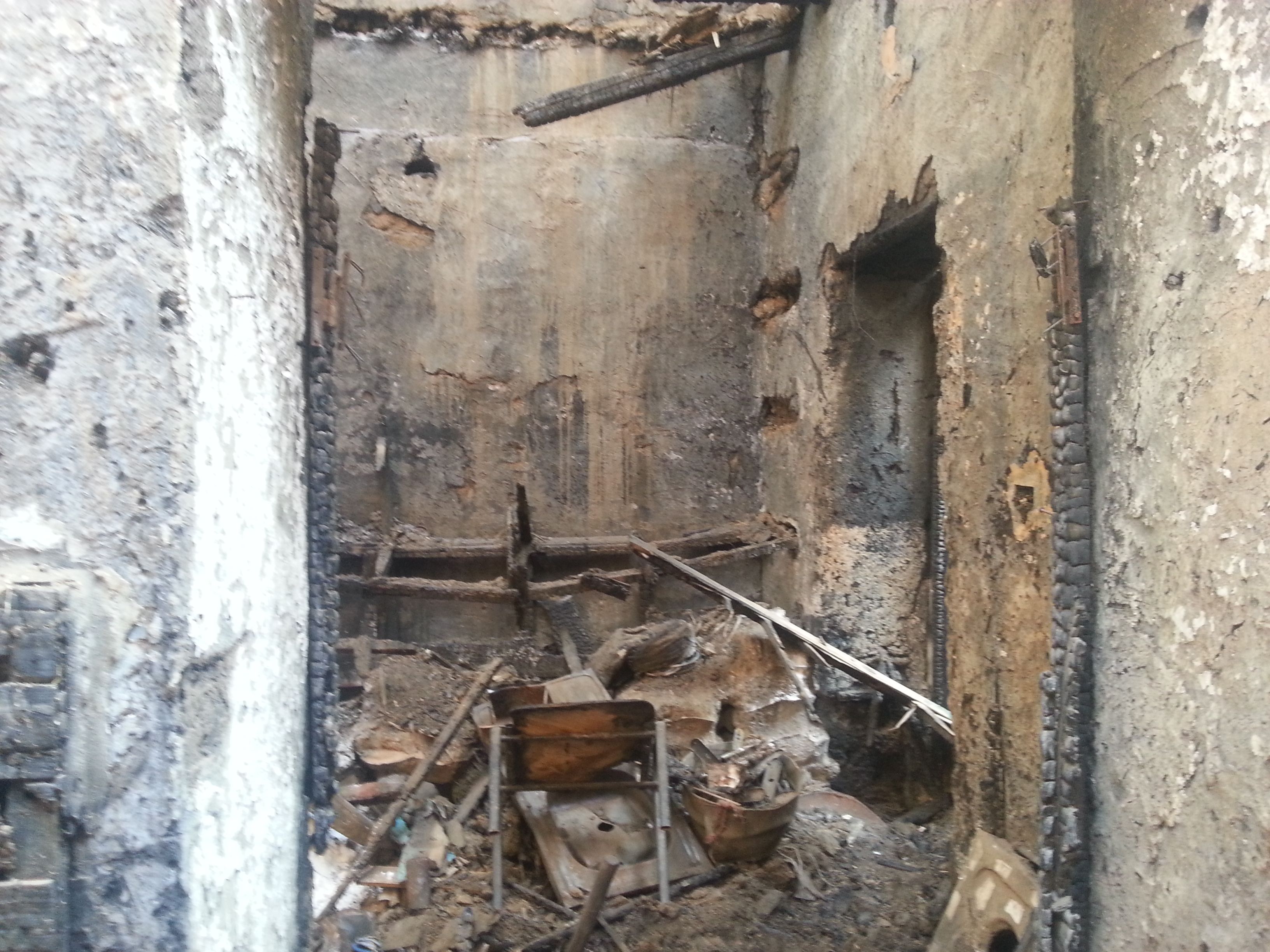
A day at the ‘Islamic Emirate of Delga’
Dust and desert. Dust and road. Dust and checkpoints. Turn left. Dust and tombs. Dust and dust. Dust and farms. Dust and shacks. You’re in. Dust and trucks. Dust and streets. Dust and minarets. Dust and churches. Burned churches.
This is Delga, Upper Egypt 120,000 people — 20,000 Christians.
When deposed President Mohamed Morsi's supporters were killed in Cairo on August 14 during the forcible eviction of their sit-ins, their Upper Egypt supporters and counterparts attacked Christians in Delga. They ransacked a monastery, looted churches, burned houses. Sixty Christian families had to run and hide.
Security forces couldn’t do anything — actually, they didn’t do anything. Upper Egypt used to an Islamist stronghold and, for many radicals, a haven. When they saw their brethren dying in Cairo, they hit what was available within their reach — Christians.
I wanted to check it out.
But how? According to an AP story, Islamists had taken over the city. Egyptian authorities were unable to maintain law and order there — unlike Cairo, where you may die in police custody for breaking the curfew.
I was picturing a kind of an Islamic Emirate of Delga. A city guarded by bearded men, spitting on the ground and beating people up. I was imagining Kalashnikov barrels sneaking out of windows. Rumors spread that they were taking jiziya (a tax for non-Muslim citizens living in Islamic states). I was expecting bad guys you don’t want to mess with. The police said they tried to retake the city twice. They failed.
But they came back on September 16, this time with a massive amount of force. The Ministry of Interior did an Apocalypse Now-like operation. At dawn, 18 APCs, six helicopters and six commando units entered Delga. We don’t know if they played Ride of the Valkyries, but they arrested 72 people. Among them, two Muslim Brotherhood leaders.
This is what happened — supposedly. I wasn’t there at that time.
I was there the day before.
“Where’s this burnt monastery?” we asked when we entered the city late in the day, anxious to enter the city and find out about the most radical men of the Nile Valley.
Right, left, left again, right, right …we’re running late, let’s ask these people, waiting outside a shop. A nice guy on his motorcycle said "ta'ala ya pasha" (come, sir). We came. He guided us through the tight streets of Delga. The place wasn’t that far; after a few lefts and rights, we arrived at the doors of the monastery. "Salamou aleikom" (may God bless you), our guide said as he left us.
No Islamist checkpoints. Loads of bearded men, but all without Kalashnikovs. I didn’t spot any policemen — I’ve never spotted any in my short time in Upper Egypt's villages anyways. I just saw — well, I saw Egyptians.
The gates of the monastery were opened for us. They were brand new, as the former ones were smashed a month ago during the attacks. We entered. Dust and monastery. It was a Christian compound, surrounded by high brick walls. In the middle, the Church of Saint Abraham was standing high and burned, its pillars in the sand, its people inside, intoning all together. The photographer I traveled with vanished to take lots of pictures. I sat to ask lots of questions. Where were you and who are you, why are you here and why you were there, how do you feel and what happened and oh by the way, when?
The priest invited us to his house. It wasn’t a long walk, a few hundred meters from the monastery. He said hello to his Muslim neighbors sitting on a bench. He had an immense belly. Why do country priests always have immense bellies? We chatted briefly, but soon he got busy. Four little widows came in to get their pensions. They wore black, threadbare clothes that made them even tinier. As they were illiterate, they had their personal stamp that the priest used to sign for them in a little notebook. A neighbor showed up.
“Mahmoud, take the foreigners to the Christian family who’ve just come back home,” the priest ordered.
Mahmoud took us, said hello to the priest’s neighbors, still on their bench. They had Salafi beards and country priests’ bellies.
The family had left their home during the sectarian clashes a month ago. The attackers had looted, ransacked and burned parts of the house. Women were now sweeping as if they were cleaning their home after a storm. Rubbing, scrubbing, chatting.
Sixty people were supposed to be living here. I didn’t get it. How could 60 people fit in this crooked little house?
“Look, you don’t understand, I have five children” — the father counts his five children — “and we all live there,” he said, showing us a raw room without a ceiling. It’s his home. And the other families are living here and there, left and right, down and up. Roughly 10 rooms, about five to six people per room, there you find your 60.
One month ago, they fled the sectarian clashes and hid in a Muslim family’s house — with some Jama’a al-Islamiya members, said one of the Christian guys. The Islamist group is considered by the US and European Union to be a terrorist organization.
I didn’t get it — again. During sectarian clashes, Christian families hid with Muslim families and — this has to be double-checked — Jama’a al-Islamiya members? Right. The organization said on August 15 they had not taken part in the attacks against churches. But still, I was wondering: To what extent is it possible to say “sectarian clashes” when Christian families hid among Muslim ones? And how many opportunist thugs were among the attackers?
The house has a rooftop with a view of the monastery. There is a big, tall jar containing Upper Egyptian corn flakes that people eat for breakfast with milk or hot water. It smells — it tastes — like a farm. One is enough. On a roof below, half a dozen charred victims were lying dead — chickens, burned when the henhouse was torched during the attacks.
Downstairs, the photographer finds children hiding in a little niche, their eyes wide open like kittens. They laugh. Everyone else does too.
The people would like to show us another room. I would have loved to, but I had to go.
So we say good bye to everybody, take care and see you soon.
That was a Sunday morning in the so-called Islamic Emirate of Delga.
تقارير ذات صلة
Agreement partially reopens St. Samuel Monastery road, but leaves broader security concerns unresolved
The agreement does not address the broader security concerns monks have raised in the past
Disputed status of Beni Suef church sparks sectarian violence
The disputed legal status of a church in Beni Suef sparked sectarian violence and 20 arrests
Securing Coptic churches: The necessary role of the scouts
As the state’s efforts to secure churches become more centralized, church scouts play an increasingly pivotal role
Your support is the only way to ensure independent, progressive journalism survives.
You have a right to access accurate information, be stimulated by innovative and nuanced reporting, and be moved by compelling storytelling. Subscribe now to become part of the growing community of members who help us maintain our editorial independence.
Join us